Asia · Trending
China's Factory Activity Contracts for First Time Since February
Manufacturing PMI fell to 49.2 in July as domestic demand weakens, raising pressure on Beijing to deliver fresh stimulus despite strong export performance
KEY TAKEAWAYS
- ·China's official manufacturing PMI fell to 49.2 in July from 50.3 in June, the first contraction since February and below the 50.1 economist consensus.
- ·The non-manufacturing index dropped to 49, the lowest since December 2022, indicating weakness has spread beyond factories to services and construction.
- ·Strong double-digit export growth in 2026 gives Beijing room to delay major stimulus despite second-quarter GDP slowing to 4.3 percent, the weakest in over three years.
Manufacturing Weakness Returns
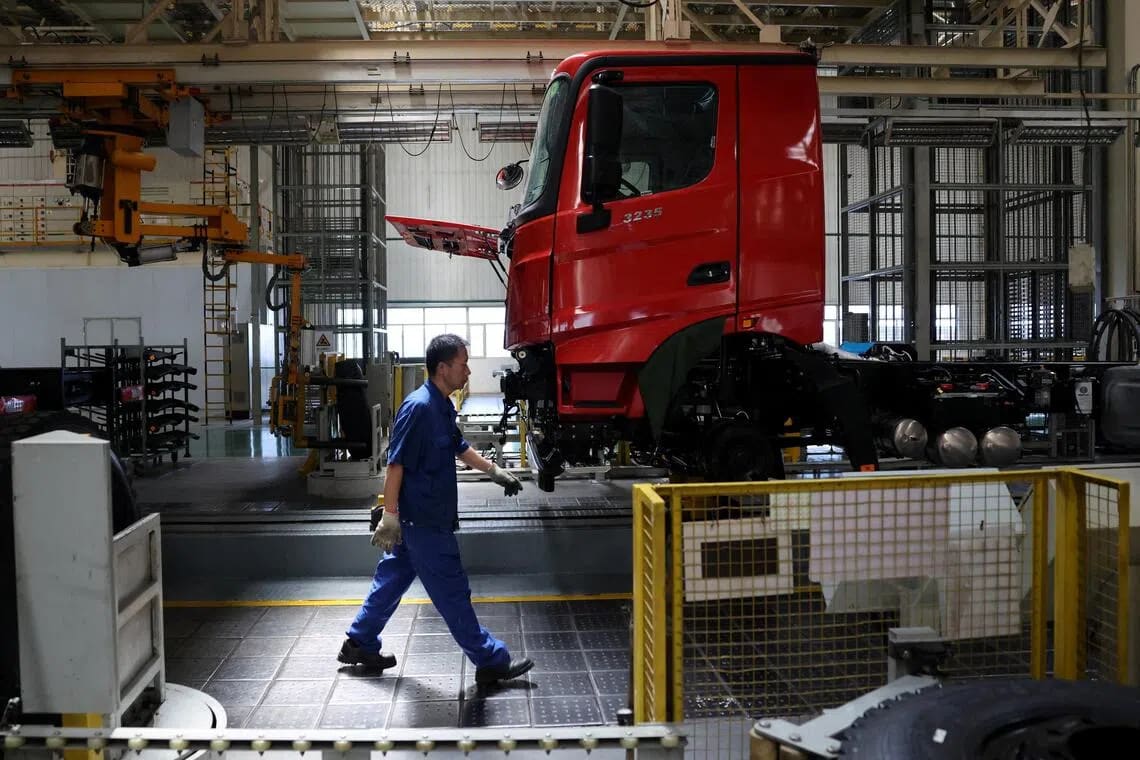
China's factory sector slipped back into contraction in July, ending a four-month run of expansion and signaling deeper fragility beneath the surface of the world's second-largest economy. The official manufacturing purchasing managers' index dropped to 49.2, down from 50.3 in June, according to the National Bureau of Statistics. Economists had expected the index to hold steady at 50.1. Any reading below 50 signals contraction.
The non-manufacturing gauge, which tracks construction and services, fell harder than anticipated to 49, marking the weakest print since December 2022. It stood at 50.2 the previous month.
The twin declines underscore a troubling reality: domestic demand remains stubbornly weak even as Chinese exporters continue to rack up gains in overseas markets. For executives and investors watching the region's largest economy, the divergence raises a critical question about whether Beijing will move decisively to shore up growth or continue its measured approach.
Exports Mask Domestic Frailty
China's export sector has been a rare bright spot, expanding at double-digit rates through the first half of 2026. That resilience has given policymakers room to hold off on aggressive stimulus, even as internal consumption and business investment sag. The manufacturing contraction in July suggests that export strength alone cannot carry the broader economy.
Second-quarter GDP growth slowed to 4.3 percent year-on-year, the weakest quarterly expansion in more than three years. A strong start to the year kept the January-June average at 4.7 percent, still within the government's 2026 target range of 4.5 to 5 percent. But the trajectory is unmistakably downward.
Business and consumer confidence remain subdued despite an end to the years-long deflation cycle, aided in part by energy price increases tied to geopolitical disruptions in Iran. The statistics office noted that softness in domestic demand is now outweighing external resilience.
Policy Response Under Scrutiny
Senior officials convened for a pivotal policy meeting on July 30 and pledged to "roll out pragmatic and effective new policies in a timely manner." The language was deliberate but vague, leaving markets to parse whether Beijing is preparing meaningful intervention or merely signaling readiness.
Infrastructure spending, a traditional lever for stimulus, has been dialed back in recent months. Policymakers have promised to accelerate public expenditure and tap funds raised through government bonds, but concrete measures have yet to materialize at scale.
Investors are split on what comes next. Some see the strong export data as a cushion that allows Beijing to delay major fiscal or monetary easing. Others view the PMI contraction as a red flag that demands immediate action, particularly as the government tries to sustain growth near the lower bound of its target corridor.
Broader Implications for Asia
China's manufacturing slowdown carries weight beyond its borders. Regional supply chains from Vietnam to South Korea depend on Chinese demand for intermediate goods, and a sustained pullback in factory activity would ripple through Asian trade flows. Japanese machinery exporters and Taiwanese semiconductor equipment makers have already flagged softer order books tied to Chinese industrial sentiment.
The services sector, which had been expected to pick up slack as the economy rebalances away from heavy industry, is now showing its own signs of strain. The drop in the non-manufacturing index to 49 suggests that consumer-facing businesses are feeling the pinch as households tighten spending.
For multinational executives planning capital allocation in Asia, the July data reinforce the case for caution. China's growth model, long powered by infrastructure investment and export competitiveness, is facing structural headwinds that short-term policy tweaks may not fully address. The question is whether Beijing will deploy the fiscal firepower necessary to stabilize momentum or continue to prioritize financial discipline over near-term growth.
The next round of economic indicators, due in mid-August, will offer further clarity on whether July's contraction was a one-month blip or the start of a deeper slide. Until then, the pressure on policymakers to act will only intensify.
RELATED STORIES
India's Chinese Import Bill Climbs Despite Self-Reliance Push
Priyanka V. Rao · 3 min
China's August Inflation Accelerates on Energy and Typhoon Disruption
Tran Quoc Bao · 2 min

GAC and FAW Explore Merger of Toyota Joint Ventures in China
Cheng Wei-Lun · 3 min
China Imposes Anti-Dumping Measures on Japanese Semiconductor Chemical Imports
Jun-ho Seo · 3 min
Spot something wrong? Email editor@briefasia.com. We log every correction publicly.