Sustainability · Energy
China Controls 80 Percent of Global Solar and Battery Production
New mandatory standards for EV efficiency and battery safety position Beijing as the de facto rule-maker in clean technology, reshaping how the world decarbonizes.
KEY TAKEAWAYS
- ·China manufactures roughly 80 percent of the world's solar panels and lithium-ion battery cells, and 70 percent of electric vehicles, with Chinese firms accounting for 55 percent of global clean energy investment between 2019 and 2025.
- ·Beijing introduced the world's first mandatory energy consumption standard for battery-electric vehicles in January and a binding battery safety standard requiring no fire or explosion from EV power batteries this month.
- ·The United States and European Union have imposed tariffs of 25 to 100 percent on Chinese EVs and clean technology, raising costs for domestic consumers while Chinese exports to other regions reached a record $26 billion in March.
Manufacturing Concentration Defines Clean Energy Supply
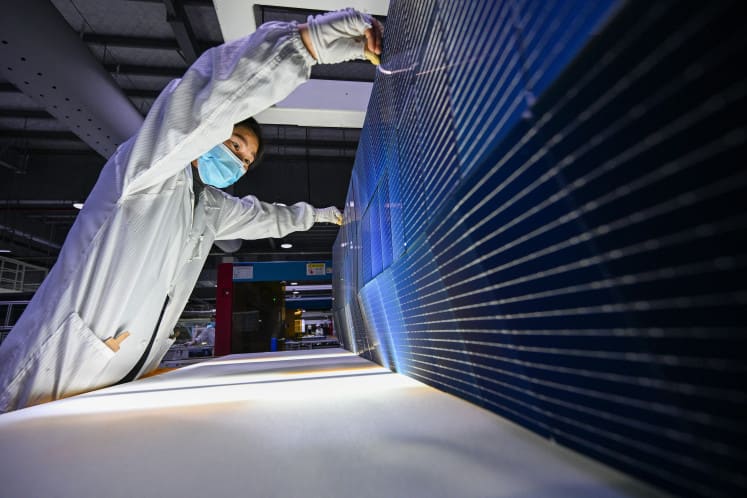
China manufactures approximately 80 percent of the world's solar photovoltaic modules, 80 percent of lithium-ion battery cells, 70 percent of electric vehicles, and more than 90 percent of heavy electric trucks. Between 2019 and 2025, Chinese firms accounted for 55 percent of global clean energy manufacturing investment, totaling $1.1 trillion.
In March alone, Chinese exports of solar equipment, batteries, and electric vehicles reached $26 billion, a 70 percent increase year-on-year. The surge followed disruptions to oil supply routes through the Strait of Hormuz, accelerating demand for alternatives to petroleum-based transport. The global electric vehicle fleet displaced 1.8 million barrels of oil per day in 2025, equivalent to 13 percent of United States crude production.
Beijing Introduces Binding Technical Standards
In January, China implemented the world's first mandatory energy consumption standard for battery-electric passenger vehicles. The regulation sets a hard cap on kilowatt-hours per 100 kilometers, adjusted for vehicle weight, and is 11 percent stricter than earlier voluntary guidelines.
A separate mandatory battery safety standard took effect this month, requiring that EV power batteries produce no fire or explosion under prescribed test conditions. This marks the first time such criteria have been codified as binding national requirements. Carbon footprint reporting for EV batteries is now compulsory, with lifecycle tracking from raw material extraction through recycling. China has also established a national information platform to trace every battery from production to end-of-life, enforcing strict recycling rules.
Asia Angle: Regional Integration and Standard Alignment
Countries across Asia face a choice: adopt Chinese technical specifications to benefit from lower costs and faster deployment, or impose trade barriers that raise prices and slow decarbonization. Indonesia, Thailand, Vietnam, and the Philippines have accelerated EV adoption programs in the past 18 months, largely relying on Chinese-built vehicles and charging infrastructure. Singapore and South Korea are evaluating how to align domestic grid protocols with Chinese battery management systems to enable vehicle-to-grid integration.
Japan and South Korea, both home to legacy automotive and electronics industries, have resisted full alignment. Tokyo has maintained separate battery safety certification processes, while Seoul has imposed tariffs on select Chinese battery imports. Yet even these markets rely on Chinese-manufactured precursor materials for their own battery production lines.
Standard-Setting Shifts From West to East
In 2025, China led the formulation of 285 international standards under the International Organization for Standardization and the International Electrotechnical Commission, a 27 percent increase from the prior year. These standards cover new energy systems, electric vehicles, and lithium-ion batteries. China signed 130 standardization cooperation agreements with 75 countries and organizations.
Historically, dominant manufacturers have written the technical rules for emerging industries before those rules become part of multilateral processes. The United States set standards for early computing and telecommunications; Europe did the same for mobile networks. China is now performing that role for clean technology.
Trade Barriers Raise Costs, Slow Deployment
The United States and European Union have imposed tariffs ranging from 25 to 100 percent on Chinese electric vehicles and clean technology imports. The measures have increased costs for domestic buyers without reducing China's export volumes to other markets. Chinese manufacturers have responded by expanding sales to Southeast Asia, Latin America, the Middle East, and Africa.
For importing nations, the alternative to engaging with Chinese standards is not energy independence but higher costs and slower decarbonization. Utilities and regulators outside China must understand battery chemistries, thermal management systems, and vehicle-to-grid protocols if they are to integrate Chinese-built equipment into national grids. Reciprocal transparency on performance data would allow planners to assess interoperability and lifecycle costs with confidence.
Pathways for Cooperation
Three mechanisms could enable more effective integration of Chinese clean technology into global markets. First, importing countries could participate in China's standard-setting processes to ensure that mandatory Chinese specifications are compatible with their own grid infrastructure and regulatory frameworks. Second, reciprocal data-sharing agreements could establish comparable performance, safety, and lifecycle metrics, giving utilities and regulators the information needed to plan deployments. Third, trade and investment frameworks could facilitate two-way flows of minerals, capital, and technical expertise, rather than treating clean technology as a one-way import.
International institutions, including the International Energy Agency and parties to the Paris Agreement, have recognized the need for coordinated standards to support equitable decarbonization. These organizations have been slower to address the scale of China's manufacturing dominance and to incorporate Chinese specifications into multilateral processes.
The net zero transition already depends on Chinese factories. The question facing policymakers is whether that dependency is managed through tariffs and antagonism or through purposeful engagement that accelerates deployment while ensuring equipment meets local needs.
RELATED STORIES
BYD Sets Sights on 2 Million Overseas Sales in 2026 After Brazil, Europe Surge
Cheng Wei-Lun · 3 min
China Imposes Anti-Dumping Measures on Japanese Semiconductor Chemical Imports
Jun-ho Seo · 3 min
China's Auto Chip Race Shifts to Volume as Horizon Robotics Crosses 15 Million Units
Jun-ho Seo · 3 min
China Targets 84% Share of AR-HUD Production by 2031
Cheng Wei-Lun · 3 min
Spot something wrong? Email editor@briefasia.com. We log every correction publicly.