Technology · Products
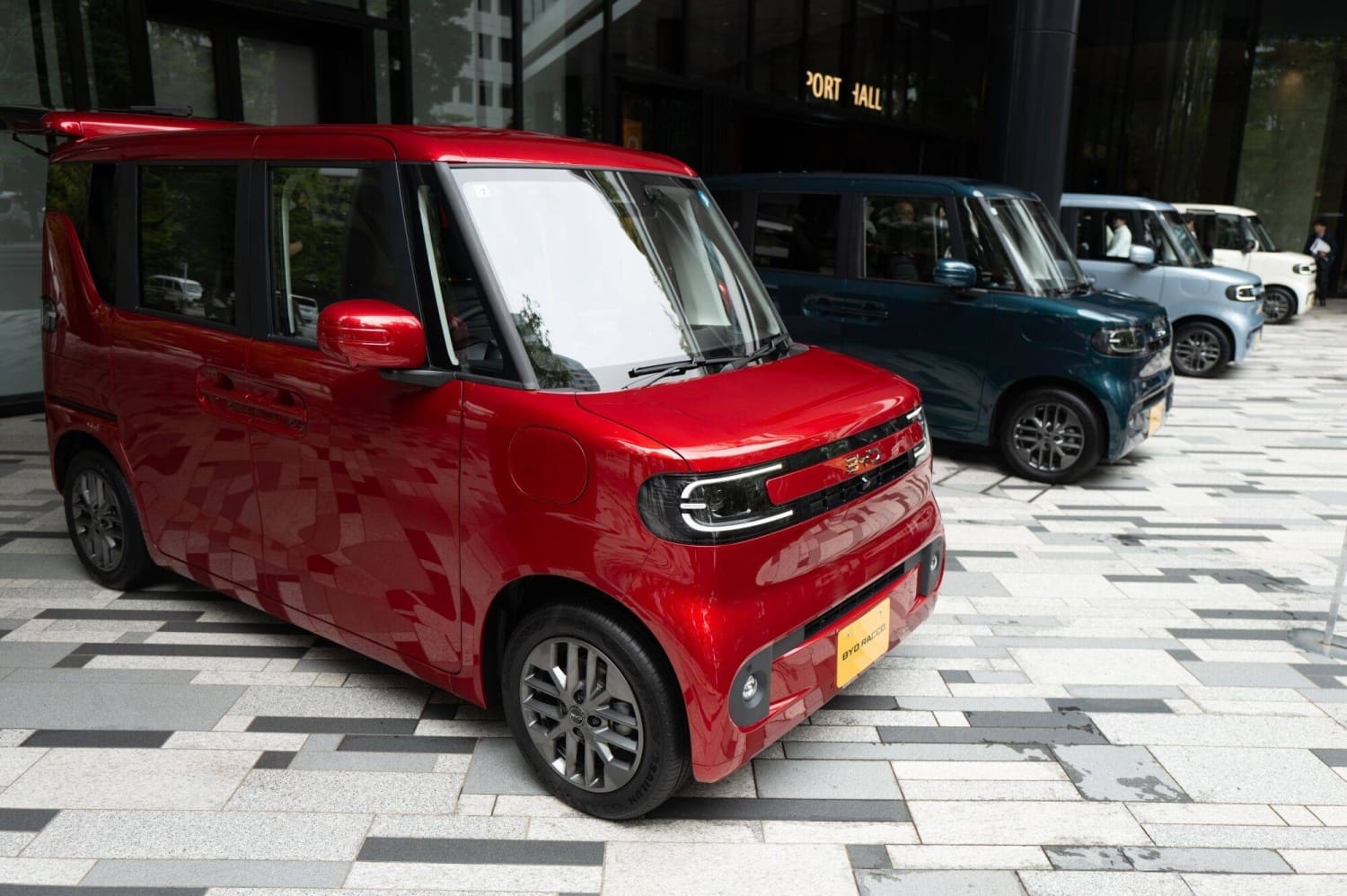
BYD Launches Minicar in Japan to Challenge Kei EV Market
Chinese automaker debuts Racco electric kei car in Tokyo, entering a segment dominated by domestic manufacturers
KEY TAKEAWAYS
- ·BYD introduced its Racco electric kei car at a Tokyo media event, entering a segment that represents one-third of Japan's vehicle sales.
- ·The launch marks BYD's strategy to compete on local terms in a category historically dominated by Suzuki, Daihatsu, Honda, and Nissan.
- ·Success will depend on BYD's ability to build service infrastructure and consumer trust in a market where foreign automakers have struggled to gain share.
BYD Enters Japan's Compact Car Arena
BYD unveiled its Racco electric minicar at a media event in Tokyo this week, positioning itself to compete in Japan's kei car segment. The move represents a strategic expansion for the Chinese automaker into a vehicle category that has long been the preserve of domestic Japanese manufacturers.
Kei cars, or "keijidosha," occupy a unique position in Japan's automotive landscape. These compact vehicles, limited by regulation to specific dimensions and engine sizes, account for roughly one-third of all vehicle sales in the country. Their popularity stems from tax incentives, lower insurance costs, and parking advantages in crowded urban centers.
Testing Ground for Regional Ambitions
BYD's decision to develop an electric kei car signals its intent to compete on local terms rather than simply exporting its standard model lineup. Japanese buyers have historically favored domestic brands for kei vehicles, with Suzuki, Daihatsu, Honda, and Nissan controlling the vast majority of the segment.
The Racco launch comes as BYD continues its broader push into developed Asian markets. The automaker has expanded rapidly across Southeast Asia and is now turning attention to more mature markets where brand loyalty and regulatory standards present higher barriers to entry.
Electric kei cars remain a nascent category in Japan. While several domestic manufacturers have introduced battery-electric versions, adoption has been gradual. Range anxiety, charging infrastructure, and higher upfront costs compared to gasoline-powered kei cars have slowed the transition.
Navigating a Crowded Field
BYD faces established competition from Japanese automakers who have decades of experience engineering vehicles specifically for local preferences. Kei car buyers prioritize fuel efficiency, reliability, and interior space optimization within strict dimensional constraints.
The Chinese automaker's success in Japan will depend on its ability to match or exceed these expectations while leveraging its experience in battery technology and electric drivetrain integration. BYD has scaled production of affordable electric vehicles in China, but translating that capability to a highly specific vehicle format presents distinct challenges.
Japan's automotive market has proven difficult for foreign manufacturers to penetrate. Cultural preferences, dealer network advantages held by domestic brands, and exacting quality standards have limited the market share of imports. BYD will need to establish service infrastructure and build consumer trust in a market where brand reputation carries significant weight.
Broader Implications for Asia's EV Transition
The Racco's introduction reflects a broader shift in Asia's automotive industry. Chinese manufacturers are moving beyond their home market to compete directly with established players in their strongest territories. This dynamic is reshaping competitive landscapes across the region.
For Japan, BYD's entry could accelerate electric kei car development among domestic manufacturers. Competition often spurs innovation, and the presence of a well-capitalized foreign competitor may push incumbents to invest more aggressively in electrifying the segment.
The outcome will hinge on execution. BYD must navigate regulatory approval, build distribution channels, and convince Japanese consumers that a Chinese-made kei car can meet their standards. The company's performance in this segment will offer insights into whether Chinese automakers can succeed in Asia's most demanding automotive markets.
RELATED STORIES
Kioxia Pushes Flash Memory to Replace DRAM Amid Market Squeeze
Jun-ho Seo · 3 min
China Imposes Anti-Dumping Measures on Japanese Semiconductor Chemical Imports
Jun-ho Seo · 3 min
Malaysia's Rare Earth Deposits Draw Foreign Interest Ahead of China Export Controls
Priyanka V. Rao · 3 min
Honda Demands 30% Price Cuts From Suppliers in $9.4 Billion Cost Plan
Cheng Wei-Lun · 3 min
Spot something wrong? Email editor@briefasia.com. We log every correction publicly.