Technology · Products
BYD Launches First Foreign Electric Kei Car in Japan's Dominant Small-Vehicle Market
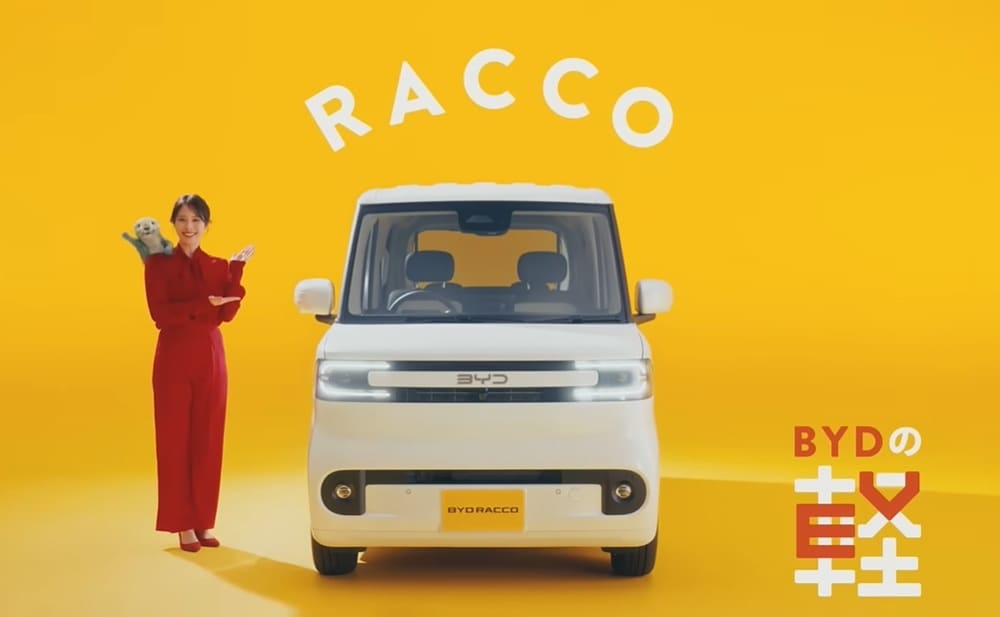
The Chinese automaker enters Japan's fiercely protected compact-car segment with the Racco, priced at ¥2.1 million and backed by celebrity endorsement
KEY TAKEAWAYS
- ·BYD introduced the Racco, the first kei car designed by a foreign automaker for Japan, priced at ¥2.1 million in a segment representing 40 percent of domestic vehicle sales.
- ·The Chinese EV maker has established 77 sales locations in Japan and overtook Tesla in 2025 as the world's largest electric vehicle seller.
- ·Kei cars receive tax breaks and lower insurance in Japan, but foreign brands have historically failed to gain market share in the fiercely loyal segment.
Breaking Into a Closed Market
BYD has crossed a threshold that foreign automakers have avoided for decades: building an electric vehicle specifically for Japan's kei-car category. The Racco, unveiled in Tokyo this week, represents the first kei model launched by an overseas manufacturer in a segment that accounts for roughly 40 percent of all new vehicle sales in Japan.
The company's entry carries symbolic weight. Kei cars, defined by strict dimensional limits of 1.4 meters in width and 3.4 meters in length, have remained an almost entirely domestic affair since the category was formalized in the 1950s. Foreign brands have historically struggled to gain traction in Japan's automotive market, and none have invested in designing vehicles to meet kei specifications until now.
BYD priced the Racco at ¥2.1 million (approximately US$14,500), positioning it in the mid-range of the kei segment. The vehicle stands 180 centimeters tall, maximizing interior space within the category's tight constraints. To amplify its launch, BYD recruited Alice Hirose, one of Japan's most recognizable actors, for its advertising campaign, a signal that the company intends to compete on cultural terms as much as technical ones.
The Kei Advantage
The kei category enjoys unique benefits in Japan. Owners receive tax breaks, lower insurance premiums, and relaxed parking requirements, making these vehicles economically attractive in a country where urban space is expensive and streets are often narrow. The cars have developed a dedicated following that extends beyond Japan. Even U.S. President Donald Trump publicly urged American manufacturers to produce similar compact vehicles late last year, calling them an overlooked opportunity.
Despite their popularity, kei cars have remained a fortress for Japanese automakers. Suzuki, Daihatsu, Honda, and Nissan dominate the segment, with designs refined over decades to meet local tastes and regulatory nuances. BYD's decision to develop the Racco signals confidence that its electric powertrain technology and cost advantages can overcome the market's historical resistance to foreign brands.
Liu Xueliang, president of BYD Japan, framed the launch as part of a broader mission during the Tokyo event. "We want to deliver unprecedented convenience and enjoyment to all people across Japan through our technology," Liu said, emphasizing the company's ambition to move beyond niche sales.
Expansion Across Asia and Beyond
BYD's push into Japan follows a period of rapid international expansion. The company overtook Tesla in 2025 to become the world's largest seller of electric vehicles, driven by aggressive pricing and vertical integration of battery production. In Europe, BYD has established a growing dealer network and announced plans for local manufacturing to sidestep tariff pressures.
In Japan, BYD has built out 77 sales locations, according to company data, a significant infrastructure investment for a market where foreign automakers typically maintain minimal retail presence. The kei launch suggests BYD sees Japan not as a symbolic market but as a volume opportunity, provided it can convince consumers that an overseas brand can meet the exacting standards of reliability and fit that Japanese buyers expect.
The Test Ahead
The real question is whether BYD can translate its global momentum into Japanese showroom traffic. Kei-car buyers tend to prioritize brand familiarity, dealer proximity, and resale value, areas where domestic manufacturers hold structural advantages. BYD's electric powertrain offers lower running costs, but Japan's charging infrastructure outside major cities remains uneven, and range anxiety persists even in compact-vehicle segments.
Foreign automakers have repeatedly underestimated the difficulty of the Japanese market. BYD's willingness to design a vehicle from the ground up for kei specifications, rather than adapting an existing model, shows a level of commitment that previous entrants lacked. Whether that commitment translates into sustained market share will depend on execution, service network quality, and the company's ability to navigate the cultural nuances of selling cars in one of the world's most brand-loyal automotive markets.
The Racco's arrival shifts the competitive landscape, even if modestly. For the first time, Japanese kei buyers have an electric option designed by a company outside the traditional domestic circle. How they respond will offer a test case for whether globalization can finally penetrate one of the automotive industry's most insular segments.
RELATED STORIES
Kioxia Pushes Flash Memory to Replace DRAM Amid Market Squeeze
Jun-ho Seo · 3 min
China Imposes Anti-Dumping Measures on Japanese Semiconductor Chemical Imports
Jun-ho Seo · 3 min

Preferred Networks Eyes Public Listing to Scale AI Chip Production
Aiko Nakamura · 2 min

Malaysia's Rare Earth Deposits Draw Foreign Interest Ahead of China Export Controls
Priyanka V. Rao · 3 min
Spot something wrong? Email editor@briefasia.com. We log every correction publicly.