Technology · AI
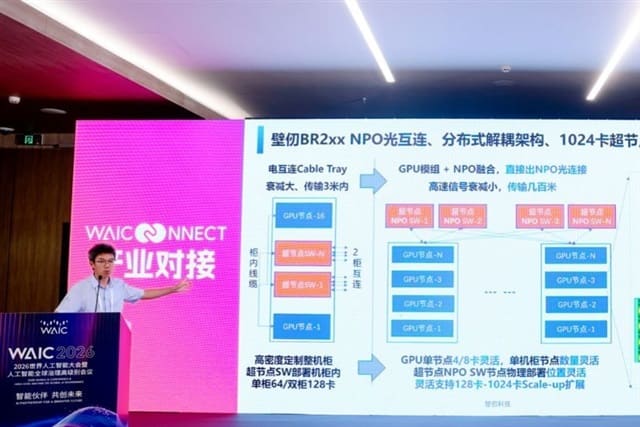
Biren Unveils 1,024-GPU Super Node With Near-Packaged Optics at WAIC
Chinese chip designer's new infrastructure play targets large language model workloads as domestic AI compute race intensifies
KEY TAKEAWAYS
- ·Biren Technology introduced a 1,024-GPU super node using near-packaged optics at the World Artificial Intelligence Conference in Shanghai, targeting large language model workloads.
- ·The system leverages NPO interconnect technology to reduce latency and power consumption, positioning Biren in China's race to build AI infrastructure independent of Western chip supply chains.
- ·Commercial viability remains uncertain as Biren faces production scaling challenges, software ecosystem maturity gaps, and the need to prove competitive total cost of ownership against established players.
Scaling AI Compute With Advanced Interconnects
Biren Technology introduced a 1,024-GPU super node architecture at the World Artificial Intelligence Conference in Shanghai, leveraging near-packaged optics (NPO) to address compute bottlenecks in large language model training and AI agent deployment. The announcement positions the Chinese GPU developer alongside domestic rivals racing to build hyperscale infrastructure independent of Western chip supply chains.
The super node configuration relies on NPO interconnect technology, which places optical components in close proximity to processing units to reduce latency and power consumption compared to traditional optical transceivers. This approach has gained traction in AI data centers where inter-GPU communication can account for up to 40% of training time in distributed systems.
Biren's system targets workloads that require massive parallel processing, particularly the pre-training and fine-tuning phases of foundation models. A 1,024-GPU cluster can theoretically deliver petaflop-scale compute, though real-world performance depends heavily on interconnect bandwidth and software optimization. The company did not disclose performance benchmarks or deployment timelines at the conference.
China's AI Infrastructure Push
The unveiling comes as Chinese technology firms accelerate domestic GPU development following export restrictions on advanced chips from Nvidia and AMD. Biren, founded in 2019, has emerged as one of several homegrown contenders seeking to fill the gap, alongside Huawei's Ascend processors and startups like Moore Threads and Iluvatar CoreX.
Near-packaged optics represents a middle path between traditional pluggable optics and co-packaged optics, which integrates photonics directly into chip packages. NPO maintains some manufacturing flexibility while achieving lower power and latency than pluggable solutions. Several hyperscalers, including Meta and Microsoft, have backed NPO roadmaps for next-generation data center networks.
For Biren, the technology choice reflects both technical ambition and supply chain pragmatism. Co-packaged optics requires advanced packaging capabilities that remain concentrated in Taiwan and South Korea, while NPO can leverage more widely available assembly processes. This matters in an environment where access to cutting-edge foundry capacity is constrained by geopolitics.
Deployment Questions Remain
Despite the technical specifications, several practical questions linger. Biren has faced production challenges in the past, including delays in bringing its BR100 GPU series to volume manufacturing due to foundry access issues. The company's ability to scale a 1,024-GPU system depends not just on chip design but on thermal management, power delivery, and software stack maturity.
The conference demonstration did not clarify which customers have committed to deployments or whether the super node is production-ready. Chinese cloud providers like Alibaba Cloud, Tencent Cloud, and Baidu's AI Cloud have been testing domestic GPU alternatives, but adoption has been gradual as software ecosystems remain less mature than Nvidia's CUDA platform.
Interconnect bandwidth is another critical factor. NPO can theoretically support terabit-per-second data rates, but achieving those speeds at scale requires precise alignment and thermal control. Any degradation in link quality across hundreds of connections can create performance cliffs in distributed training jobs.
The Broader Competitive Landscape
Biren's move reflects a broader pattern in China's AI infrastructure buildout. The government has prioritized self-sufficiency in computing hardware through subsidies, procurement preferences, and research funding. The National Integrated Circuit Industry Investment Fund has backed multiple GPU startups, spreading risk across several contenders rather than concentrating resources on a single national champion.
This strategy contrasts with the oligopoly that has emerged in Western AI compute, where Nvidia commands over 80% market share in data center GPUs. Chinese firms are betting that vertical integration, from chip design to system architecture, can offset per-unit performance gaps through better optimization for local workloads and pricing.
Whether that bet pays off depends on execution. A 1,024-GPU super node is an engineering statement, but commercial success requires sustained production, competitive total cost of ownership, and an ecosystem of model developers willing to port their code. WAIC serves as a showcase for ambition; the real test will unfold in data centers over the next 18 months as these systems move from prototypes to production.
RELATED STORIES
JCET Eyes $968 Million to Scale AI Packaging Lines
Tran Quoc Bao · 3 min

Sharpa Secures $668 Million at $3.3 Billion Valuation in Tech Giant-Backed Round
Cheng Wei-Lun · 2 min

China Scrubs 5.6 Million AI-Generated Posts in Platform Cleanup
Cheng Wei-Lun · 3 min
China's Chip Makers Split Three Ways Beneath the Revenue Growth
Tran Quoc Bao · 3 min
Spot something wrong? Email editor@briefasia.com. We log every correction publicly.