Perspectives · Analysis
Beijing's New AI Bloc Aims to Rewrite Global Tech Order
WAICO assembles 29 non-Western members in a bid to challenge democratic nations' AI governance and supply chains.
KEY TAKEAWAYS
- ·China launched the World AI Cooperation Organization in July 2026 with 29 founding members, including Russia, Brazil, and Pakistan, but no major Western democracies or India.
- ·China holds 60 percent of global AI patents and operates 1.125 billion internet users, creating the world's largest AI training dataset and faster deployment cycles than Western competitors.
- ·WAICO mirrors the Belt and Road Initiative's strategy, offering infrastructure and financial support to non-democratic or isolated regimes in exchange for diplomatic alignment and influence.
- ·Beijing seeks to control AI regulatory frameworks, enabling it to shape what models can say and which narratives are reinforced globally, similar to its DeepSeek model's political filtering.
- ·Western companies and engineers are increasingly adopting Chinese open-source AI models for cost and performance, creating supply-chain dependencies that mirror earlier telecommunications concerns.
A Shanghai Launch with Strategic Intent
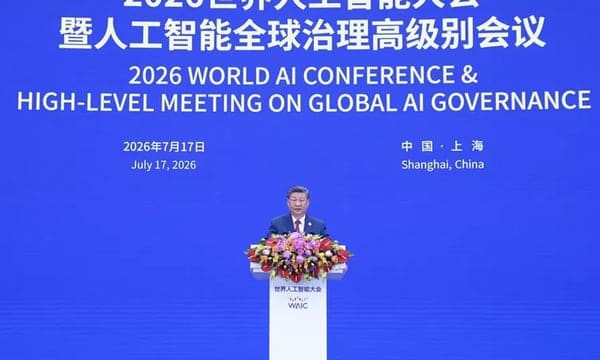
When Beijing unveiled the World AI Cooperation Organization this July in Shanghai, it brought together 29 founding members spanning Russia, Brazil, South Africa, Indonesia, Malaysia, Pakistan, and a range of other Global South states. Conspicuously absent were major Western democracies and India. China frames WAICO as an intergovernmental forum for "beneficial, safe, and fair" AI development, but the membership roster and the organization's name itself signal deeper ambitions.
The acronym WAICO differs by a single letter from the United Nations' World AI Organization designation, WAIO. In Chinese diplomatic culture, names carry symbolic weight. That proximity is no accident. It telegraphs Beijing's intent to position WAICO as a parallel governance structure, one that competes with multilateral institutions anchored in liberal norms.
Family Logic and the Quest for Control
Confucian tradition emphasizes moral rectitude, face-saving, and family-centered hierarchies. Modern Chinese statecraft borrows from that playbook, speaking the language of collective prosperity while pursuing concentrated advantage. Resource scarcity and cycles of internal conflict have bred a leadership mindset that equates control with security. Cooperation becomes transactional, conditioned on deference to Beijing's strategic interests.
WAICO reflects that logic. On the surface, it promises regulatory harmony and shared growth. Beneath, it assembles a coalition of non-democratic or diplomatically isolated regimes, offering financial and technological support in exchange for alignment. Russia, Cuba, and Myanmar sit inside the tent, gaining access to Chinese AI capabilities and Belt and Road-style infrastructure investment. In return, Beijing secures diplomatic leverage, narrative amplification, and a foothold in regions where Western influence has receded.
The Belt and Road Playbook, Now in Silicon
WAICO borrows directly from the Belt and Road Initiative's strategic architecture. Both mobilize vast state resources to bind partner countries through infrastructure, debt, and technology transfer. Both target states on the periphery of the liberal international order, offering "unconditional aid" that carries implicit political conditions. And both serve a common objective: to build an alternative axis that counters U.S.-led alliances and dilutes Western normative power.
The difference lies in the asset class. Where Belt and Road deployed ports, railways, and power grids, WAICO deploys algorithms, compute clusters, and training datasets. That shift matters. AI infrastructure is harder to audit, easier to update remotely, and capable of shaping information flows in ways physical infrastructure cannot. A Chinese-built railway is visible; a Chinese-trained language model operating inside a government ministry is not.
Data Scale as Strategic Advantage
China enters the AI race with structural advantages that elude Western competitors. As of December 2025, the country counted 1.125 billion internet users and 602 million generative AI users, a year-on-year increase of 141.7 percent in the latter category. That user base generates training data at a scale no other nation can match. Large-scale testing, iteration, and deployment happen faster in Beijing than in Washington or Brussels.
State control over capital allocation accelerates the cycle. The Chinese government can concentrate resources on compute infrastructure, algorithm development, and data pipelines without navigating parliamentary debate or quarterly earnings calls. By the end of last year, China's generative AI computing capacity exceeded 1,590 quadrillion calculations per second, according to the China Internet Network Information Center. Data from the World Intellectual Property Organization shows China holding 60 percent of global AI patents.
That scale translates into influence. At this year's World AI Conference, Beijing-based Moonshot AI launched its Kimi K3 flagship model. MiniMax debuted its M3 architecture. Huawei showcased the Atlas 950 super node. These systems are open-source, performant, and cheap. Siemens and a growing cadre of Silicon Valley engineers are adopting Chinese models for cost and customization reasons, creating a form of supply-chain dependency that mirrors earlier concerns about telecommunications hardware.
Regulatory Capture Through Institutional Design
At the Shanghai conference, Xi Jinping called for laws, monitoring systems, and emergency protocols to ensure AI "always remains under human control." He opposed prioritizing one nation's security over others in the AI domain. The rhetoric is calibrated for multilateral audiences, but the subtext is clear: Beijing wants to write the rulebook.
Control over AI governance means control over what models can say, which questions they can answer, and which historical narratives they reinforce. The Chinese Communist Party understands that AI will function as the encyclopedia and search engine of the next era. DeepSeek, a Chinese model, already avoids politically sensitive queries. If WAICO succeeds in establishing itself as the authoritative body for AI regulation in the Global South, that filtering logic scales globally.
This is not merely industrial policy. It is an attempt to reshape the information architecture that underpins democratic discourse. If Western companies and governments increasingly rely on Chinese models for efficiency and cost, they import Beijing's ontological assumptions about what constitutes acceptable knowledge.
Democratic Alliances Versus Authoritarian Coordination
The United States has countered with the Pax Silica Initiative, a coalition of democratic nations focused on supply-chain security, semiconductor resilience, and interoperable standards. Pax Silica emphasizes voluntary cooperation, private-sector participation, and rule-of-law protections. It is slower, messier, and constrained by electoral cycles and antitrust enforcement.
That contrast matters. Democratic alliances are built on trust, transparency, and shared values. They cannot command compliance or requisition national wealth at will. Authoritarian coordination, by contrast, moves faster because it answers to a single strategic center. WAICO can promise immediate compute access, preferential financing, and political cover without navigating legislative oversight.
The risk is that speed and scale obscure long-term costs. Belt and Road projects have left partner countries with unsustainable debt, underutilized infrastructure, and diminished sovereignty. WAICO may follow a similar trajectory, embedding dependencies that are difficult to unwind once Chinese AI systems are woven into government operations, financial services, and public communication platforms.
The Narrative War and Social Fracture
Beijing has learned to weaponize the language of anti-hegemony. By framing WAICO as a corrective to Western monopoly, it positions itself as the champion of the Global South and casts U.S. export controls as unjust suppression. That narrative circulates on TikTok, YouTube, and other platforms where younger audiences consume news. Over time, it erodes the legitimacy of democratic coalitions and fosters internal division within Western societies.
This is asymmetric warfare at the level of perception. Democratic governments must justify their policies through open debate, exposing internal disagreements and tactical compromises. Authoritarian regimes face no such constraint. They can project unity, deploy state media in coordination, and shape discourse without fear of domestic pushback.
What Comes Next
WAICO represents Beijing's bid to dominate AI governance before international norms congeal. If it succeeds in becoming the default regulatory framework for non-Western nations, the bifurcation of the global AI ecosystem will be complete. One hemisphere will operate under liberal principles of transparency, contestability, and pluralism. The other will operate under centralized control, political filtering, and state-directed innovation.
Western policymakers face a choice. They can accelerate investment in open, interoperable AI infrastructure and offer credible alternatives to Chinese models. Or they can cede the Global South to Beijing's institutional architecture and accept a world where AI governance is written in Zhongnanhai, not Geneva or Washington.
The window for that choice is narrowing. Chinese models are already embedded in enterprise software, research labs, and government procurement pipelines. Each adoption creates path dependency. Each dependency shifts the balance of power. And each shift brings Xi Jinping closer to his stated goal: seizing the historical opportunity to rewrite the global order.
RELATED STORIES
Beijing's AI Bar Offers Free DeepSeek Access as Price Wars Reshape Global Market
Cheng Wei-Lun · 3 min

China's Star Fund Managers Lose Ground After Rotating Into AI Stocks
Cheng Wei-Lun · 4 min
State Funds Step In as AI Volatility Tests China's Bull Market Strategy
Cheng Wei-Lun · 3 min
DeepSeek Backs Unitree With $20.8 Million Stake in Shanghai IPO
Cheng Wei-Lun · 3 min
Spot something wrong? Email editor@briefasia.com. We log every correction publicly.