Technology · Policy
Beijing Frames AI Training Drive as Bridge Across Digital Fault Lines
Twenty-nine nations join China's new multilateral platform while scholars debate whether capacity-building or geopolitical leverage will define its legacy
KEY TAKEAWAYS
- ·China launched the 29-member World Artificial Intelligence Cooperation Organisation in Shanghai on 17 July, pledging AI training for thousands across emerging economies including Indonesia, Malaysia, Pakistan and Uzbekistan.
- ·Academics compare WAICO to the Belt and Road Initiative, arguing adoption of Chinese AI models and technical standards will deepen economic ties and extend Beijing's influence into software and data infrastructure.
- ·The initiative competes with US-led Pax Silica, which focuses on secure semiconductor supply chains, while China emphasises affordable open-source models and skills development to generate demand in the Global South.
A New Front in Technology Diplomacy
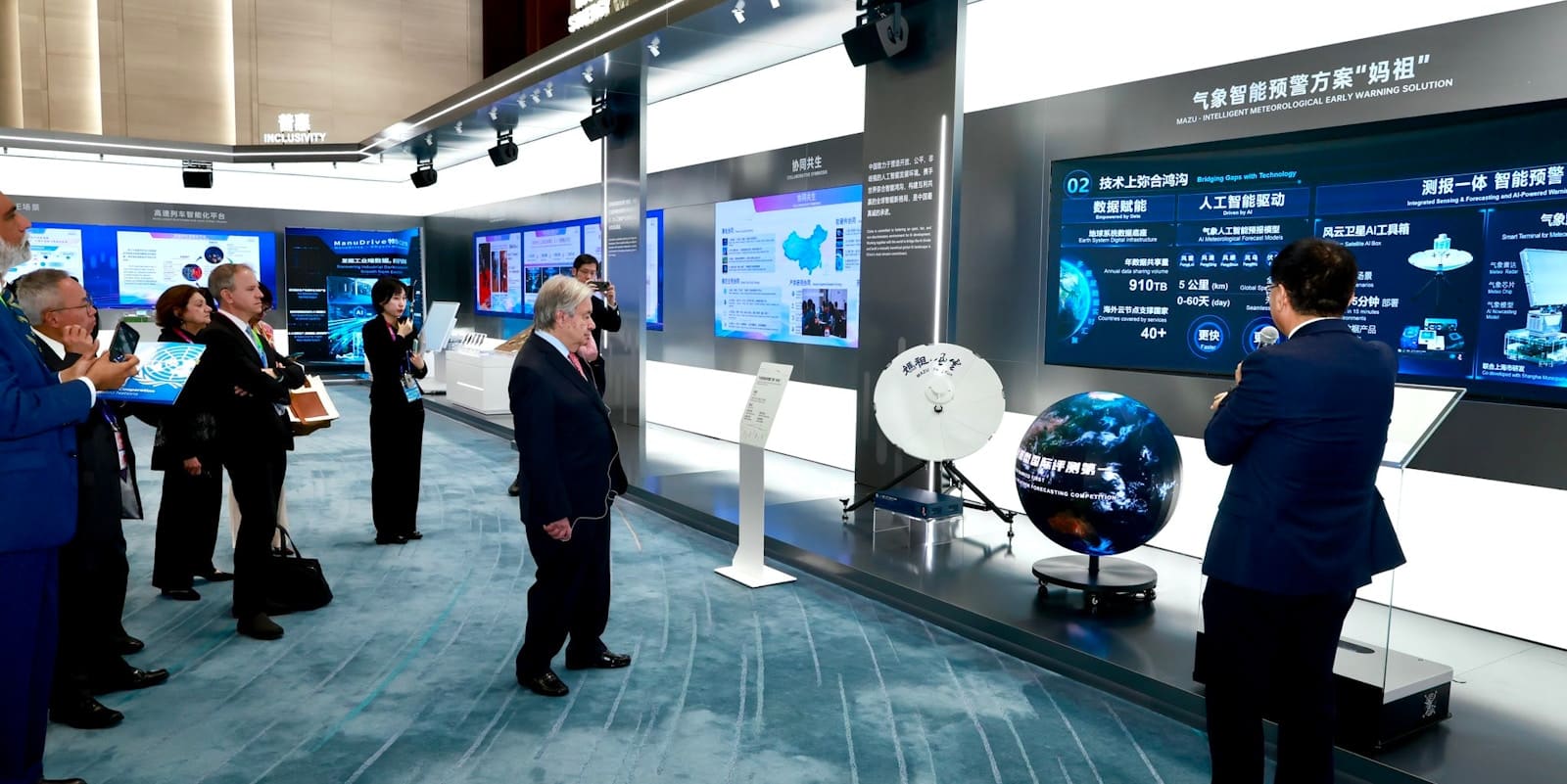
President Xi Jinping stood before delegates from 29 nations in Shanghai on 17 July to unveil the World Artificial Intelligence Cooperation Organisation, a platform Beijing positions as a remedy for unequal access to machine-learning tools and expertise. The initiative pledges to train thousands of technologists across emerging economies, sparking immediate debate over whether the effort represents genuine capacity-building or another chapter in China's expansion of soft power.
Indonesia, Kazakhstan, Laos, Malaysia, Myanmar, Pakistan and Uzbekistan signed on as founding members. United Nations Secretary General António Guterres attended the launch, lending multilateral credibility to an organisation China frames around UN Charter principles and what officials call a "people-centred" approach to governance.
The rollout arrives as Washington pushes Pax Silica, a coalition securing the full AI supply chain from semiconductors and rare-earth minerals through to manufacturing and energy infrastructure. Singapore, the Philippines, South Korea, Japan and India have joined that American-led grouping, hardening the contours of rival technology spheres across Asia.
Echoes of Belt and Road
Shinan Hao, who teaches international relations at Shanghai International Studies University, drew a direct line between WAICO and the decade-old Belt and Road Initiative. Where BRI deployed ports, railways and telecommunications networks to bind China to the Global South, the new AI agenda extends that playbook into software, data and algorithmic standards, according to Hao.
Adoption of Chinese machine-learning models and technical frameworks will deepen economic and technological ties, he argued, creating what he described as "a new, more knowledge-intensive phase" of infrastructure diplomacy. Open-source collaboration may also require fresh investment in server farms, fibre-optic backbones and power grids across participating countries, further embedding Chinese contractors and vendors.
Hao pointed to Southeast Asia as an early proving ground. The China-Asean AI Cooperation Center already links Chinese algorithms with regional projects in healthcare diagnostics, transport optimisation, precision agriculture and public administration. WAICO could supply the institutional scaffolding that turns scattered commercial deals into a durable network combining technology transfer, financing, training and governance norms.
Chinese firms stand to gain first-mover advantages in markets where AI adoption remains nascent, Hao noted. Access to real-world use cases, local partnerships and customer feedback loops in these economies could accelerate product refinement and market share ahead of Western competitors.
Divergent Interpretations
Xue Lan, dean of Schwarzman College at Tsinghua University and a veteran scholar of public policy, dismissed the notion that technical assistance automatically translates into ideological influence. He described concerns about values imposition as "far-fetched fantasy" and urged observers to resist framing every initiative through a zero-sum geopolitical lens.
China's awareness of the digital divide is sincere, Xue told Eco-Business, and training programmes can deliver tangible benefits without ulterior motives. He added that Beijing would welcome American participation in capacity-building efforts, suggesting room for cooperative rather than competitive dynamics.
The divergence in expert opinion reflects broader uncertainty about how WAICO will operate in practice. The organisation's charter remains light on enforcement mechanisms, funding commitments and the degree to which member states will harmonise regulatory standards or procurement rules.
Competing Models, Overlapping Geography
Pax Silica concentrates on supply-chain security among trusted partners, prioritising chip fabrication, critical-mineral sourcing and energy resilience. China's pitch revolves around affordability, open-source models and skills development, offering a lower barrier to entry for countries lacking advanced semiconductor ecosystems or venture capital.
Hao argued that this differentiation gives Beijing a structural advantage in generating demand from the ground up. By embedding affordable tools in everyday public services and small enterprises, Chinese technology may achieve stickiness even as Pax Silica expands its footprint. The result could be a layered technology landscape in Southeast Asia, with countries drawing on both blocs rather than committing exclusively to one.
Yet that fluidity carries risk. Hao warned that Western capitals may interpret Chinese engagement as an attempt to export competing standards or fragment global governance frameworks. Regulatory divergence could intensify, and emerging economies may face pressure to pick sides, complicating procurement decisions and cross-border data flows.
What Comes Next
WAICO's success hinges on execution details that remain opaque: curriculum design, instructor recruitment, certification pathways and whether training translates into jobs or entrepreneurship. If the initiative mirrors BRI's uneven track record, debt sustainability and local capacity absorption will emerge as flashpoints.
For now, the organisation offers Beijing a narrative counterweight to American technology alliances, casting China as a partner willing to share tools rather than hoard them. Whether that story resonates will depend less on rhetoric than on measurable outcomes in clinics, farms and municipal offices across the Global South over the next three to five years.
The digital divide is real, and the race to close it is accelerating. Both WAICO and Pax Silica claim to serve that goal. The question is whether competition between them will spur innovation and choice, or entrench fragmentation that leaves emerging economies navigating incompatible systems and geopolitical crossfire.
RELATED STORIES

China Scrubs 5.6 Million AI-Generated Posts in Platform Cleanup
Cheng Wei-Lun · 3 min

AliExpress Shifts Focus to Brand Building as AI Hardware Sales Surge Overseas
Cheng Wei-Lun · 2 min
LG Pivots to AI-Defined Vehicle Platform as Korea Chases China's Self-Driving Lead
Jun-ho Seo · 3 min

China's Auto Chip Race Shifts to Volume as Horizon Robotics Crosses 15 Million Units
Jun-ho Seo · 3 min
Spot something wrong? Email editor@briefasia.com. We log every correction publicly.