Technology · Startups
Atomionics Opens Quantum Sensing Hub to Expand Underwater Detection
The Singapore deep-tech firm is adapting its gravity-mapping technology from land exploration to sub-sea navigation and infrastructure security
KEY TAKEAWAYS
- ·Atomionics opened a quantum-sensing hub in Singapore on 31 July to adapt its gravity-mapping technology for underwater navigation and sub-sea infrastructure security.
- ·The company's GRAVIO system has matched 95 per cent of exploratory drilling results on land and is now being developed for GPS-independent positioning beneath the ocean surface.
- ·Atomionics plans to expand sensor production in Singapore over the next 12 to 18 months with deployment in Australia, the United States and India.
Quantum Technology Moves Underwater
Atomionics launched an integrated quantum-sensing hub in Singapore's Alexandra district on 31 July, marking a strategic shift toward underwater applications for its gravity-mapping technology. The deep-tech startup, backed by SG Growth Capital and mining giant BHP, is adapting quantum gravimetry to enable GPS-independent navigation beneath the ocean surface.
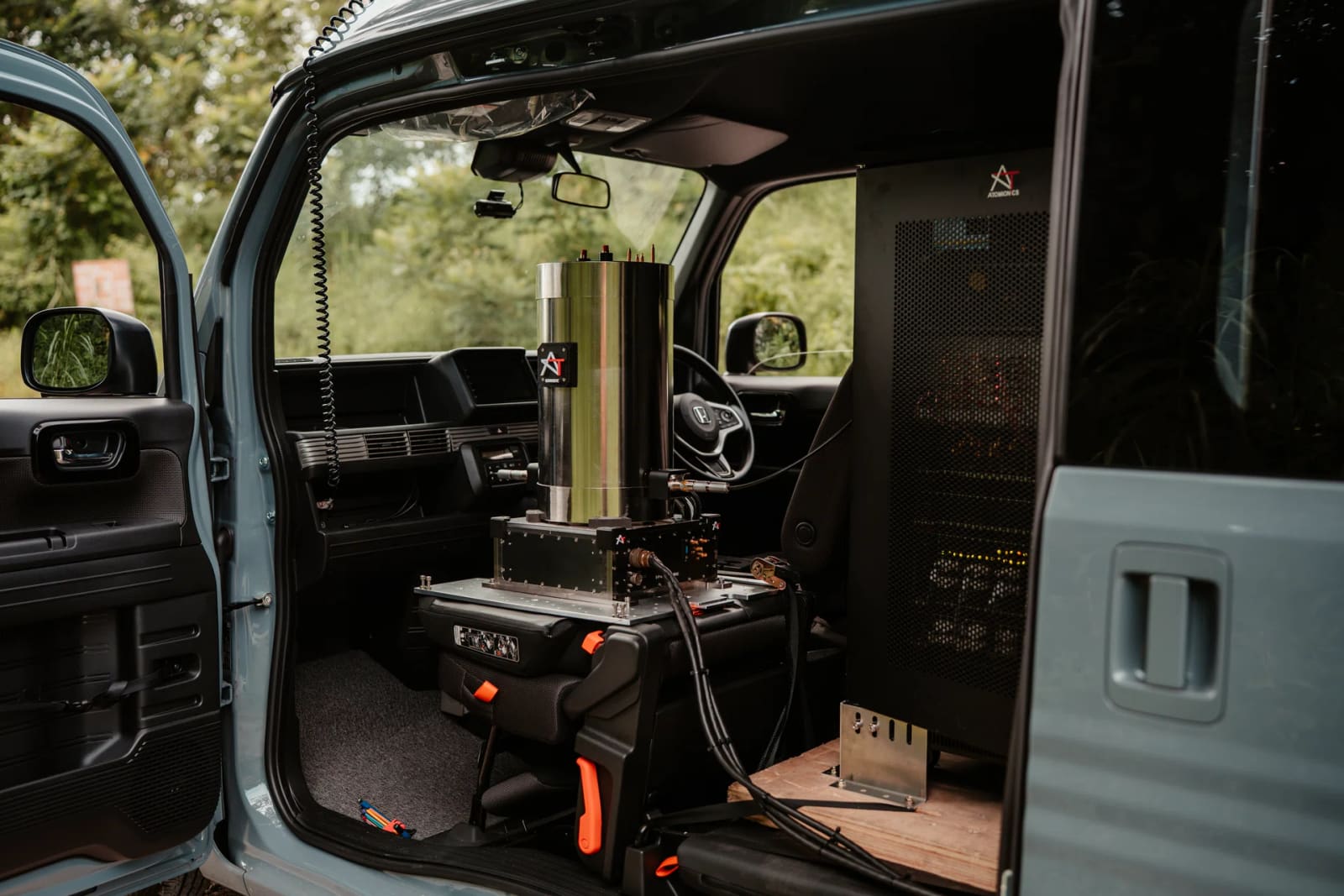
The company's quantum gravimetry measures gravitational forces to map subsurface structures. While its existing GRAVIO system detects underground minerals and hydrocarbons on land, the new facility will focus on adapting the technology for sub-sea environments where satellite positioning fails.
"To see beneath the water is to hold an advantage that spans defence, energy and infrastructure," said Ravi Kumar, Atomionics co-founder and chief technology officer.
Navigation Without Satellites
Traditional inertial navigation systems accumulate positioning errors over time due to mechanical drift, requiring periodic GPS recalibration. Quantum gravimetry offers a potential alternative by mapping gravitational variations on the ocean floor, allowing vessels and autonomous systems to determine their position without external signals.
Beyond navigation, underwater quantum sensing could map critical sub-sea infrastructure, including fibre-optic cables that carry intercontinental data traffic, and locate resources beneath the seabed. The dual-use nature of the technology has attracted defence sector investment alongside commercial backers.
Atomionics currently operates three sensor units. The company's GRAVIO system has generated 3D subsurface models matching 95 per cent of exploratory drilling results, according to Atomionics. The technology eliminates the need for physical drilling in initial resource surveys, reducing both cost and environmental disruption.
On land, civil engineering applications include soil bed analysis and sinkhole detection ahead of construction projects.
Defence and Commercial Convergence
Cap Vista, the investment arm of Singapore's Defence Science and Technology Agency, has backed Atomionics as part of a strategy to develop technologies with both military and civilian applications. The startup maintains an ongoing partnership with Singapore's Ministry of Defence to advance quantum sensing for dual-use deployment.
"Cap Vista invests where commercial technology and strategic capability converge, and quantum sensing sits squarely at that intersection," said Eunice Ooi, CEO of Cap Vista.
The investor roster also includes SG Growth Capital and BHP, reflecting interest from both sovereign capital and resource extraction sectors. Enterprise Singapore, the government agency supporting local firms' international expansion, has highlighted Atomionics as evidence of the city-state's deepening quantum technology ecosystem.
Emily Liew, assistant managing director of Enterprise Singapore, noted that the company demonstrates how frontier research can translate into commercially viable deep-tech innovation within Singapore's infrastructure.
Scaling Up Manufacturing and Deployment
Co-founder and CEO Sahil Tapiawala outlined plans to expand sensor production and data collection operations over the next 12 to 18 months. All development and manufacturing will remain based in Singapore, with deployment planned in Australia, the United States and India.
The company aims to increase its sensor fleet beyond the current three units to support commercial contracts and field trials across multiple geographies. Scaling production locally positions Singapore as a manufacturing node for quantum sensing hardware, an emerging category within Asia's deep-tech landscape.
Atomionics' expansion comes as quantum technologies transition from laboratory demonstrations to field deployment. Gravimetry represents one of the more mature quantum sensing applications, with real-world use cases in resource exploration, infrastructure monitoring and defence already taking shape.
The Alexandra hub consolidates research, engineering and manufacturing under one roof, a model that could accelerate iteration cycles as the company moves from land-based systems to the more demanding underwater environment. Water pressure, salinity and temperature variations introduce technical challenges absent in terrestrial applications, requiring hardware adaptations and new calibration protocols.
As quantum sensing moves from concept to deployment, Singapore's combination of defence sector interest, sovereign capital and proximity to resource-rich markets in Southeast Asia and Australia positions Atomionics to capture early-mover advantage in a technology category still taking form.
RELATED STORIES

Singapore Targets High-Value Data Centre Workloads as Neighbors Scale Up Capacity
Cheng Wei-Lun · 3 min

Southeast Asian Firms Overlook Digital Pact Worth USD 2 Trillion
Lim Hui Ying · 4 min

Addvalue Technologies Lands $5 Million in Space and Radio Contracts
Tran Quoc Bao · 3 min

Singapore Tightens Stablecoin Rules to Separate Regulated Tokens From Crypto Claims
Priyanka V. Rao · 2 min
Spot something wrong? Email editor@briefasia.com. We log every correction publicly.