Finance · Markets
Asia Investors Navigate Sharper Currency Swings as Dollar, Yen Chart Volatile Paths
From ringgit rallies to yen's 40-year lows, fragmented FX moves force portfolio managers to rethink hedging strategies across the region
KEY TAKEAWAYS
- ·The US dollar fell to 1.26 against the Singapore dollar in early 2026 before reversing to a one-year high by June, while the yen hit a 40-year low and Malaysia's ringgit appreciated 7 per cent.
- ·Currency concentration poses a key risk for investors, as significant depreciation in a single currency can erase investment gains even in diversified portfolios of stocks, bonds, and funds.
- ·Experts recommend selective hedging using currency options, with bond investors typically hedging most exposure for stability while equity investors hedge partially or remain unhedged for capital appreciation.
Divergent Trends Reshape Currency Landscape
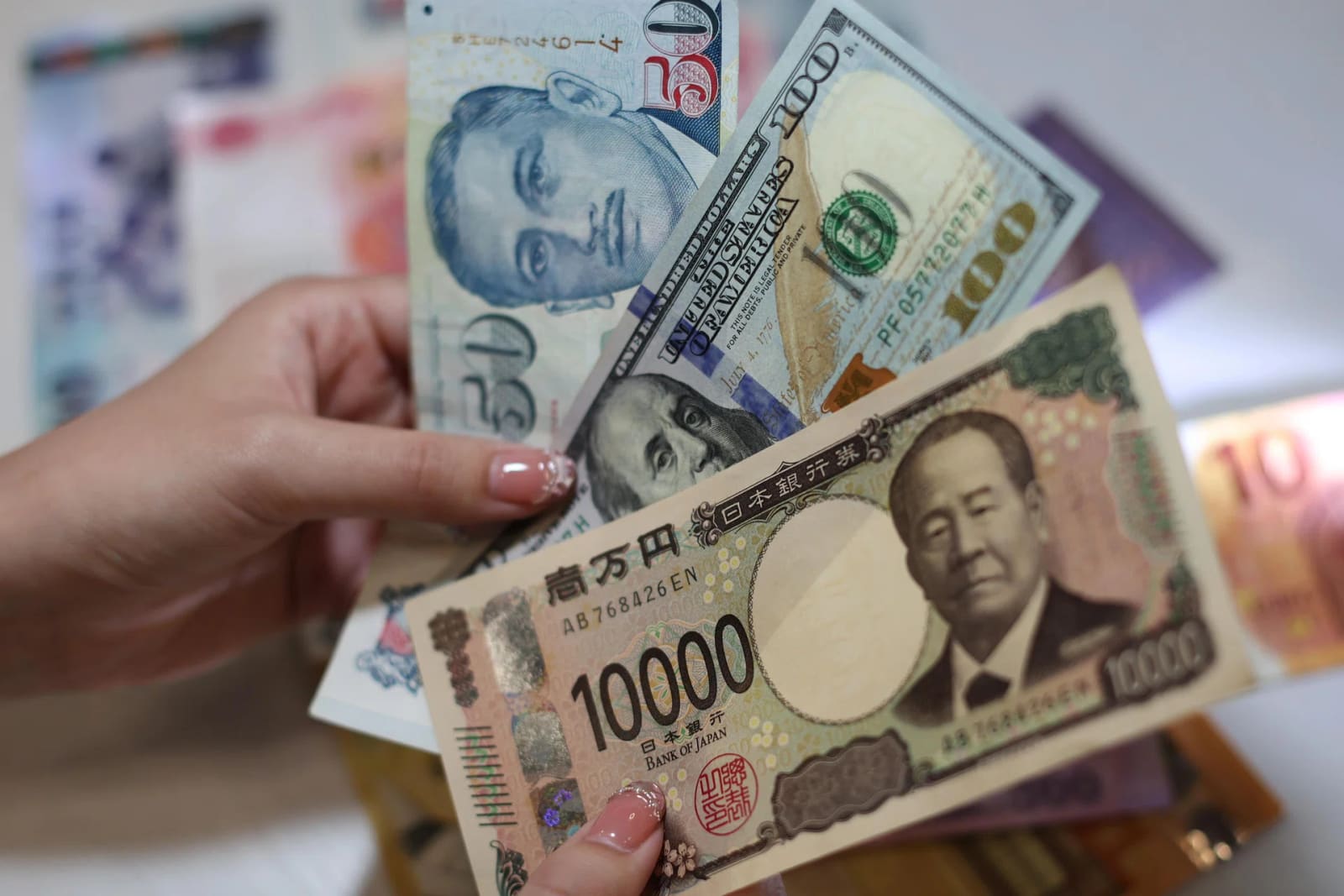
Currency markets across Asia-Pacific have experienced unusually sharp divergences over the past twelve months, pushing investors to reassess how they manage foreign exchange exposure in cross-border portfolios. The US dollar has swung through dramatic reversals, the yen touched multi-decade lows, and Malaysia's ringgit posted its strongest run in years.
The greenback fell to a multi-year trough in late 2025, reaching 1.26 against the Singapore dollar earlier this year, as the Federal Reserve delivered aggressive rate cuts amid a cooling labour market. By June, however, the dollar had reversed course and climbed to a one-year high, buoyed by resilient equity markets and an improving economic outlook.
The Japanese yen followed an equally volatile trajectory. A mid-2025 rally, driven by expectations of Fed easing and gradual Bank of Japan tightening, proved fleeting. The yen surrendered those gains by June, sliding to a 40-year low against the dollar.
Meanwhile, Malaysia's ringgit emerged as the standout performer among Asian currencies, breaking through a 13-month high in November 2025 and appreciating 7 per cent against the dollar over the year. The rally marked a historic reversal after decades of broader depreciation.
Gauges of expected volatility in major currencies have edged higher in recent weeks, according to Bloomberg data, underscoring the challenge facing portfolio managers in the second half of 2026.
Concentration Risk Looms Large
A key vulnerability for investors lies in currency concentration, particularly when volatility intensifies. A portfolio may appear well-diversified across equities, bonds, and funds, yet still carry significant risk if most holdings are denominated in a single currency.
Christopher Wong, FX strategist at OCBC, noted that any meaningful depreciation in that currency can erode investment returns when converted back to an investor's home currency. In some cases, currency moves can wipe out otherwise solid gains.
Currency concentration also amplifies exposure to a single country's economic cycle, interest rate policy, and domestic risks. As monetary policies across Asia and the West continue to diverge, that exposure becomes harder to manage.
A Split Outlook for Regional Currencies
Experts expect global currencies to follow increasingly differentiated paths through the remainder of 2026. The Singapore dollar and Swiss franc are viewed as relatively resilient, supported by stable policy frameworks and strong external balances. In contrast, emerging-market currencies such as the Indonesian rupiah and the yen are expected to remain more volatile.
Saktiandi Supaat, head of FX research at Maybank Securities, emphasized that the goal for investors should not be to identify a single winning currency, but rather to diversify exposure across currencies with different economic drivers. Policy credibility, interest rate differentials, and domestic fundamentals matter more than short-term directional bets on the dollar alone.
A balanced portfolio, he said, should combine defensive currencies with selective exposure to cyclical ones where valuations and fundamentals remain attractive. The approach differs by investment horizon. Long-term investors can afford to ride out short-term currency swings, while those with defined liabilities or shorter time frames may need more active management. Regular rebalancing can prevent unintended currency concentrations from building up over time.
Hedging Tools and Trade-Offs
Currency options have become a common risk management tool, particularly during periods of elevated uncertainty around interest rates, geopolitics, and trade policy. Unlike forward contracts, which lock in an exchange rate, options provide downside protection while allowing investors to benefit if exchange rates move in their favour.
The flexibility comes at a cost. Option premiums rise during periods of greater market volatility, reducing overall returns if the hedge proves unnecessary. The way these tools are deployed varies by asset class and investment objective.
Bond investors, for example, typically prioritize income stability and capital preservation. Currency moves can easily overwhelm the yield generated by a bond, especially given the modest returns typical of fixed income. A 5 per cent annual bond return can be offset by a similar-sized depreciation in the underlying currency, Saktiandi noted. As a result, bond investors often hedge most or all of their foreign currency exposure to preserve predictable returns.
Equity investors, by contrast, usually operate over longer time horizons and seek capital appreciation. They tend to hedge only part of their currency exposure, or remain unhedged entirely, particularly if they expect the underlying currency to appreciate or if hedging costs are high.
Wong stressed that the aim is not to eliminate all currency risk, but to ensure no single currency exerts an outsized impact on the portfolio. Selective hedging, rather than blanket coverage, remains the preferred approach for most institutional investors navigating the current environment.
Regional Implications
The fragmented currency landscape has broader implications for capital flows and asset allocation across Asia. Differentiated monetary policies between the Fed, the Bank of Japan, and regional central banks are likely to sustain elevated volatility in the months ahead.
For portfolio managers, the challenge is to balance defensive positioning with opportunistic exposure. The ringgit's rally, for instance, caught many by surprise, illustrating the risk of underweighting currencies with improving fundamentals. At the same time, the yen's prolonged weakness underscores the danger of assuming mean reversion will occur on predictable timelines.
As Asia's economies continue to diverge in growth, policy stance, and external balances, currency management is set to play a more central role in portfolio construction. Investors who fail to account for FX risk may find that currency moves, rather than underlying asset performance, determine their returns for the year.
RELATED STORIES

Blackstone's AirTrunk Lines Up S$2 Billion Loan for Singapore REIT IPO
Anand Sundaram · 3 min

Blackstone's AirTrunk Pursues $1.6 Billion Loan Ahead of Singapore REIT Listing
Jun-ho Seo · 3 min

CIMB Commits to 55% Dividend Floor as Regional Portfolio Offsets Indonesia Pressure
Priyanka V. Rao · 4 min
Singapore Dollar Gains Ground as Currency Diversification Pick
Tran Quoc Bao · 2 min
Spot something wrong? Email editor@briefasia.com. We log every correction publicly.