Technology · Policy
APAC Enterprises Struggle to Prove What Their AI Systems Actually Did
Nearly all firms say they want human accountability for automated decisions, yet fewer than four in ten maintain tamper-proof records of how those choices were made.
KEY TAKEAWAYS
- ·A survey of 720 senior professionals across nine Asia-Pacific markets found that 98.6% want software linking AI actions to human owners, yet only 38% maintain immutable audit trails.
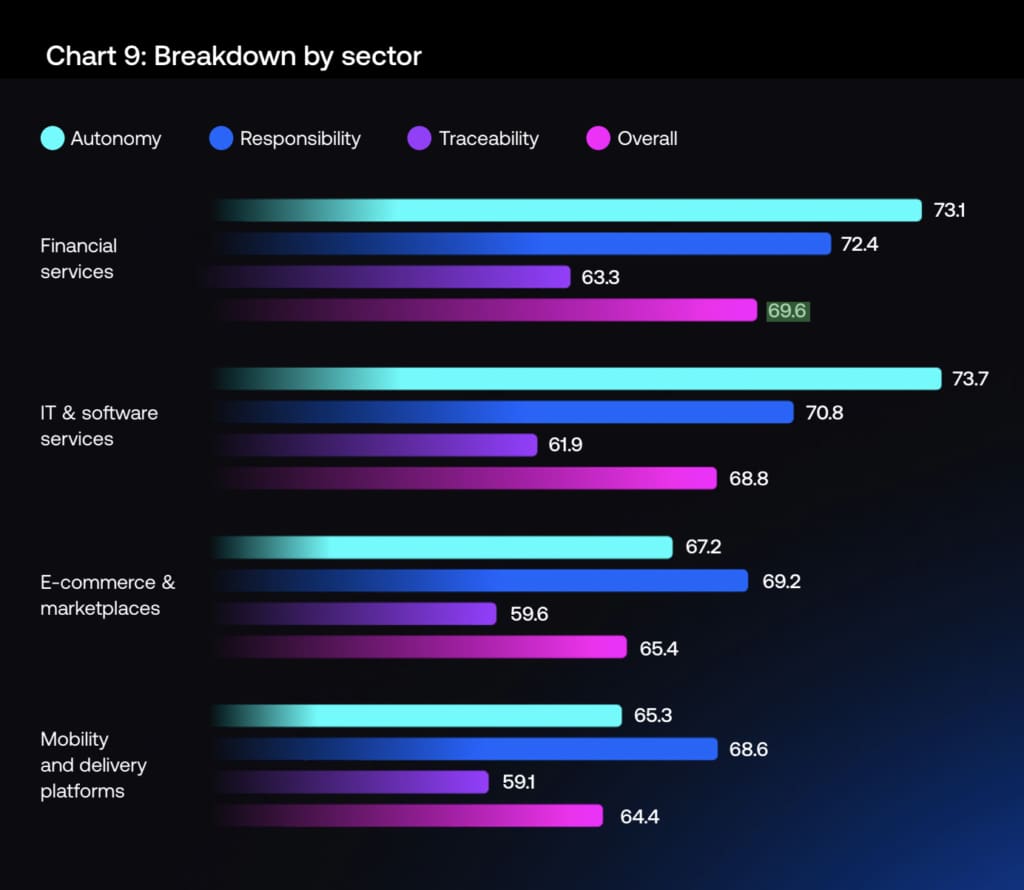
- ·Financial services leads with a Traceability score of 63.3 and 68% keeping structured records of automated decisions, driven by regulatory pressure and compliance risk concerns.
- ·Organisations scored an average of 61.0 on Traceability, trailing Autonomy and Responsibility scores near 70, creating what Sumsub calls the Accountability Asymmetry.
The Accountability Problem No One Solved
Autonomous systems now execute thousands of decisions daily inside Asia-Pacific enterprises, moving funds, clearing transactions, and routing customer requests without waiting for human approval. Yet when regulators or auditors ask who made a specific call and why, most organisations cannot provide a defensible answer.
A governance benchmark study conducted by Sumsub surveyed 720 senior professionals in technology, product, risk, compliance, and operations across nine Asia-Pacific markets and four sectors, scoring each organisation on a 100-point scale across three dimensions: Autonomy, Responsibility, and Traceability. The results show a pronounced imbalance. While 98.6% of respondents indicated they are very or somewhat likely to adopt software that links every automated action to a responsible human identity, the infrastructure to deliver that link remains incomplete.
What Keeps Executives Awake
Incorrect or unreliable automated decisions top the list of perceived risks, cited by 52% of respondents. Regulatory and compliance exposure follows at 44%, data quality or input problems at 43%, and lack of transparency at 33%. Each of these concerns converges on a single fear: an output that appears sound until a third party examines the chain of logic behind it.
Organisations have correctly diagnosed the threat but have not yet built defences around it. The study found that Traceability scored 61.0, trailing both Autonomy and Responsibility, which hovered near 70. Sumsub labels this imbalance the Accountability Asymmetry, the gap between how fully an organisation claims ownership of automated outcomes and how thoroughly it can reconstruct the path that produced them.
While 95% of respondents say they are confident explaining an AI decision, only half can reconstruct the sequence of steps that generated it. More concerning, just 38% maintain an immutable audit trail. Mick Amelishko, Senior Engineering Manager at Sumsub, framed the issue in economic terms: every action taken without a traceable record represents a cost deferred rather than avoided, and explainability allows an organisation to see the bill before it arrives.
Financial Services Sets the Pace
Among the four sectors examined, financial services achieved the highest Traceability score at 63.3 and the highest Responsibility score at 72.4, yielding an overall governance rating of 69.6. The sector also leads in deployment depth: 72% of financial institutions already operate multi-step automated systems in production, ahead of IT, mobility, and e-commerce.
That maturity reflects the regulatory environment. For banks and payment providers, compliance risk ranks as the top concern when deploying autonomous systems, cited by 54% of respondents in the sector. An automated payment triggered without a durable audit trail translates directly into liability exposure. As a result, 68% of financial services firms keep structured records of automated decisions, compared with 59% in IT, 55% in mobility, and 50% in e-commerce.
Edmund Phuang, Digital Data & AI Adoption Lead at CIMB Singapore, highlighted a second benefit: institutionalising knowledge. Large language models allow a bank to capture expertise embedded in hundreds of credit memos, enabling new employees to start from the organisation's accumulated best practices rather than building experience from scratch.
Proof as Infrastructure
Penny Chai, Vice President for APAC at Sumsub, characterised the pattern as prudence rather than hesitation. Establishing robust tracking architectures and guardrails is the prerequisite for deploying high-stakes automation at scale. The capability to produce reconstructable, verifiable evidence will separate organisations that can scale autonomous operations from those that cannot.
For business leaders, the recommendation is straightforward: assign ownership of each automated outcome before deployment and make traceability a release gate. An agent that cannot be reconstructed is a liability that cannot be priced. Compliance and risk teams should treat traceability as an audit requirement, applying the standard of whether a reviewer can independently reconstruct a decision without relying on the model to explain itself after the fact.
For regulators and policymakers, the challenge lies in incentive design. Standards that reward demonstrable traceability, reconstructable decisions, and tamper-proof trails will accelerate market adoption faster than mandates requiring written policies alone.
Trust as Competitive Edge
Verified accountability is emerging as a commercial signal, not simply a compliance checkbox. As agents transact at scale, counterparties become more willing to integrate with systems that arrive with verifiable identity and a clean record. The same proof that satisfies a regulator also functions as a trust signal in commercial relationships, allowing automated systems to operate across organisational boundaries with less friction.
The gap between intent and execution remains wide across the region. Enterprises understand the risks, express demand for accountability tools, and recognise the stakes. What they have not yet built is the infrastructure to deliver proof when it matters. The organisations that close that gap first will define the next phase of automation in Asia-Pacific markets.
RELATED STORIES
Southeast Asian Workers Embrace AI Tools Faster Than Global Peers
Priyanka V. Rao · 3 min

Franklin Templeton Restructures Leadership With Two Senior Appointments
Priyanka V. Rao · 4 min
Singapore's Big Three Banks Post Solid First-Half Gains as Wealth Offsets Margin Pressure
Priyanka V. Rao · 3 min

Singapore Banks Hit Record Highs on Wealth Management Surge
Priyanka V. Rao · 2 min
Spot something wrong? Email editor@briefasia.com. We log every correction publicly.