Finance · Banking
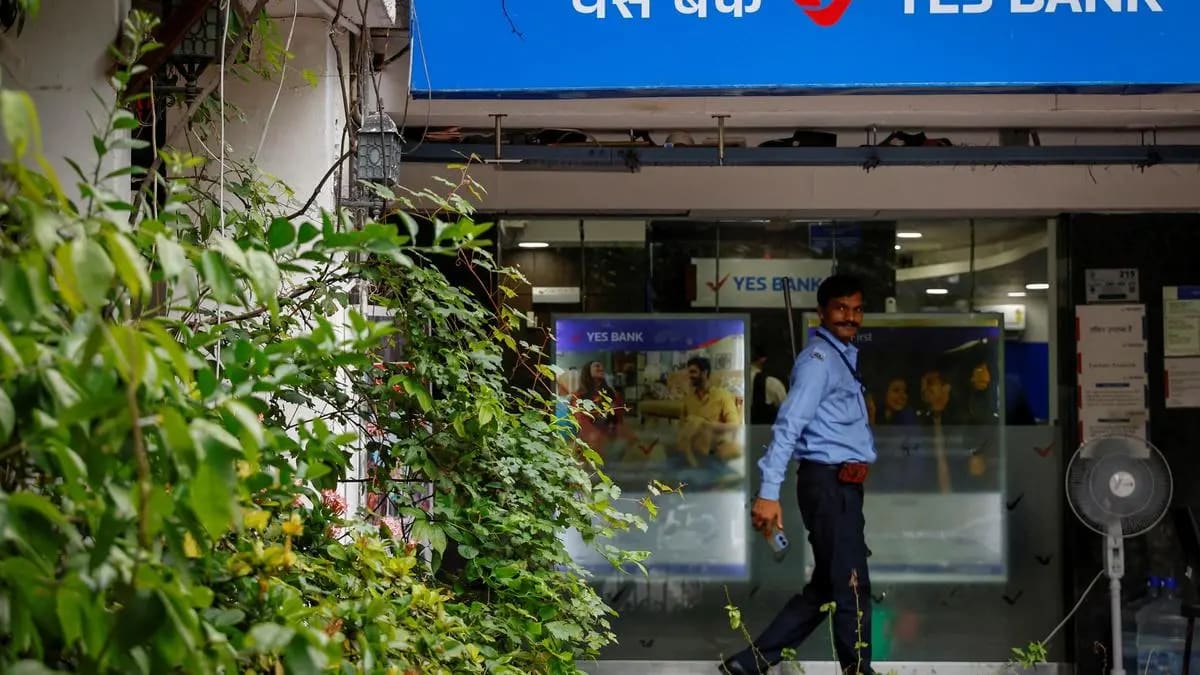
Yes Bank Approves $1.9 Billion Capital Raise as Stock Slides
Mumbai-based lender secures board approval for equity and debt issuance while receiving $105 million tax refund from reassessment proceedings
KEY TAKEAWAYS
- ·Yes Bank's board approved raising up to ₹16,000 crore through ₹7,500 crore in equity and ₹8,500 crore in debt securities, with dilution capped at 10 per cent for each.
- ·The lender received an ₹879-crore tax refund for assessment year 2018-19, reversing a prior ₹112.81-crore demand from March 2024 reassessment.
- ·Shares fell 0.88 per cent to ₹24.87 but have gained 16.19 per cent year-to-date, outperforming the Nifty Bank index which dropped 3.38 per cent.
Capital Structure Overhaul
Yes Bank's board approved a dual-track fundraising plan on Monday that could bring ₹16,000 crore into the Mumbai-based lender, split between equity securities and debt instruments. The private sector bank disclosed the move as shares slipped 0.88 per cent to ₹24.87 in early Tuesday trading, opening at ₹25.25 against a prior close of ₹25.09.
The board cleared an enabling resolution to raise up to ₹7,500 crore through equity securities, using permissible methods that cap dilution at 10 per cent of existing shareholding. A separate resolution authorized ₹8,500 crore in debt securities, available in Indian or foreign currency across multiple tranches in domestic or overseas markets. Any convertible debt instruments within that allocation would also carry a 10 per cent dilution ceiling.
Both proposals require shareholder and regulatory sign-off. Yes Bank plans to table them at its 22nd annual general meeting on August 19.
Tax Refund Windfall
In parallel filings, Yes Bank announced it had received a consolidated refund order for ₹879 crore from the Jurisdictional Assessing Officer. The refund stems from appellate orders tied to income-tax assessment and reassessment proceedings for the 2018-19 assessment year. The amount includes interest income and tax relief on a claimed expense, crossing SEBI's ₹120-crore materiality threshold for mandatory disclosure.
The refund reverses earlier pressure: Yes Bank faced an additional tax demand of ₹112.81 crore for the same assessment year following a March 2024 reassessment order. The fresh ruling provides a financial cushion as the lender pursues its capital agenda.
Market Performance and Valuation
The stock touched an intraday low of ₹24.91 by 9:48 am on Tuesday, with trading volumes reaching 271.81 lakh shares worth ₹68.22 crore. Yes Bank remains below its 52-week high of ₹25.78, recorded on June 18, but trades well above its 52-week low of ₹17.20 from March 30.
Year-to-date, the stock has climbed 16.19 per cent, extending a 22.76 per cent gain over the past twelve months. That performance sharply outpaces the Nifty Bank index, which has declined 3.38 per cent in the same calendar-year window. Yes Bank now carries a price-to-earnings ratio of 22.42 and a market capitalization of ₹77,994.47 crore.
Capital Strategy in Context
The fundraising blueprint signals Yes Bank's intent to shore up its capital base ahead of regulatory shifts and potential asset expansion. Indian private banks face tighter capital adequacy norms under Basel III, and the dual equity-debt structure offers flexibility to balance Tier 1 and Tier 2 capital requirements.
The 10 per cent dilution cap on both equity and convertible debt suggests management aims to limit shareholder dilution while accessing growth capital. With the AGM set for mid-August, investor response to the proposals will test market confidence in the lender's trajectory.
The tax refund, meanwhile, provides near-term liquidity without altering the capital structure. At ₹879 crore, the windfall is modest relative to the planned raise but offers breathing room for operational expenses and provisioning as Yes Bank navigates a competitive lending environment.
What Comes Next
Shareholder approval at the August meeting is the next gate. Regulatory clearances from the Reserve Bank of India and SEBI will follow, with timelines hinging on the final structure of the equity and debt instruments. Market watchers will track how management deploys the proceeds and whether the capital infusion translates into loan-book growth or balance-sheet repair.
Yes Bank's outperformance against the Nifty Bank index underscores investor appetite for turnaround stories in India's private banking sector. Whether that momentum holds through a dilutive capital raise remains the open question.
RELATED STORIES

Temasek Defends SIA's Air India Stake as Loss-Making Carrier Seeks $1.5 Billion
Priyanka V. Rao · 3 min

Singapore Airlines Confronts $375 Million Capital Call From Air India
Priyanka V. Rao · 3 min

Razorpay Deploys Foundation AI Model Across India's Payment Rails
Priyanka V. Rao · 2 min
Navi Secures $100 Million From Prosus Ahead of India IPO Push
Priyanka V. Rao · 2 min
Spot something wrong? Email editor@briefasia.com. We log every correction publicly.