Finance · Markets
Vietnamese Gold Trades Lower as Local Prices Diverge From Global Rally
Domestic bullion dropped 0.71 percent Tuesday while international spot markets edged up, widening a year-to-date divergence that has seen Vietnam's gold shed 8.4 percent in 2026.
KEY TAKEAWAYS
- ·Saigon Jewelry Company gold bars fell 0.71 percent to 140 million dong per tael Tuesday, even as international spot gold rose 0.2 percent to $4,059.81 per ounce.
- ·Vietnamese gold prices have declined 8.4 percent year to date, reflecting ample local supply, regulatory controls, and muted retail demand compared to earlier periods.
- ·U.S. labor market data due this week will shape Federal Reserve rate expectations and determine whether global gold extends its consolidation or breaks higher.
Domestic Prices Move in Opposite Direction
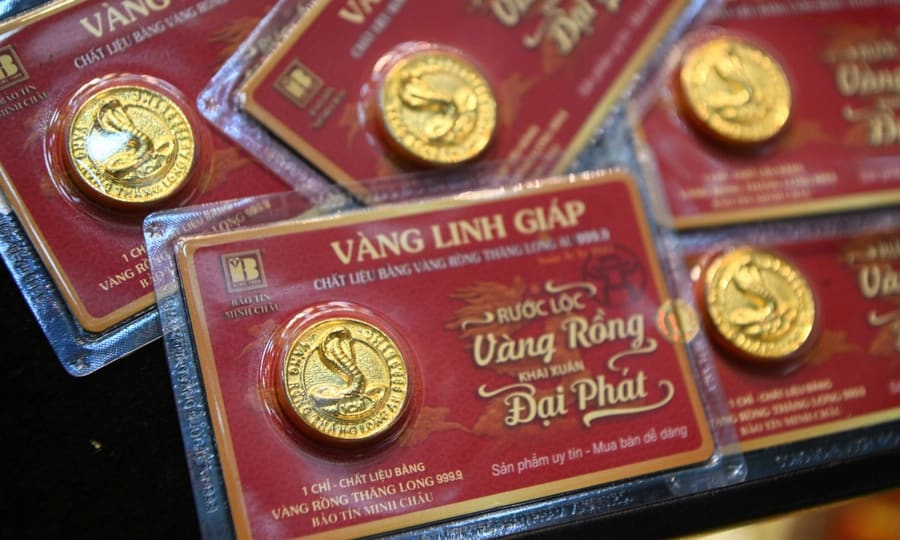
Gold bars traded in Vietnam declined Tuesday morning, moving against a modest uptick in international bullion markets. Saigon Jewelry Company's benchmark bar fell 0.71 percent to 140 million dong per tael, equivalent to $5,326.65. The tael, a traditional Southeast Asian unit of measurement, represents 37.5 grams or approximately 1.2 ounces.
Gold rings held steady at 141.2 million dong per tael. The domestic market has now shed 8.4 percent since the start of 2026, according to Saigon Jewelry Company data, marking a sustained retreat from earlier highs.
The divergence between Vietnam's domestic gold market and international pricing has become increasingly pronounced. While local bars weakened Tuesday, spot gold on global exchanges rose 0.2 percent to $4,059.81 per ounce. That spread reflects structural differences in how Vietnam's gold market operates compared to liquid international exchanges in London, New York, and Shanghai.
Global Fundamentals Point to Consolidation
International bullion markets are treading water as traders parse competing signals on monetary policy and geopolitical risk. Investors are waiting for a string of U.S. labor market releases this week that could reshape expectations for Federal Reserve rate decisions in the coming months.
Job opening figures were due Tuesday, followed by the ADP employment report on Wednesday and the closely watched nonfarm payrolls data on Friday. These reports carry outsized weight because they inform the Fed's view on whether the economy can tolerate further rate cuts or whether inflation pressures require a sustained restrictive stance.
Ajay Kedia, director at Kedia Commodities in Mumbai, noted that gold is in a consolidation phase. Weakness in employment data could pressure the U.S. dollar, which typically benefits gold by making dollar-denominated assets cheaper for holders of other currencies. A softer dollar would likely push international gold prices higher in the near term.
Mixed signals on potential U.S.-Iran diplomatic talks also introduced uncertainty into the market. Gold often rallies on geopolitical tension, but clarity on negotiations can dampen safe-haven demand. Investors are balancing these headline risks against the more fundamental question of where U.S. interest rates are headed.
Vietnam's Gold Market Operates Under Unique Constraints
The gap between domestic and international gold prices in Vietnam stems from a combination of regulatory controls, import restrictions, and local supply dynamics. The State Bank of Vietnam maintains tight oversight of gold trading and has periodically intervened to stabilize premiums over international prices.
In recent years, authorities have auctioned gold bars to narrow the spread between local and global rates. These interventions aim to curb speculation and reduce incentives for smuggling, which has historically been a challenge when domestic premiums surge. The central bank's willingness to release supply from reserves or licensed commercial banks can dampen local prices even when global markets are firm.
Vietnam's gold market also reflects distinct demand patterns. Households hold significant quantities of physical gold as a store of value and hedge against currency depreciation. Wedding season, Lunar New Year, and other cultural events drive episodic spikes in retail demand, creating volatility that is less pronounced in Western markets.
The 8.4 percent year-to-date decline in domestic gold prices suggests that local supply has been ample relative to demand, or that regulatory measures have successfully capped premiums. It also indicates that Vietnamese investors may be rotating out of gold into other assets, such as real estate, equities, or dollar-denominated savings, as the dong has remained relatively stable in 2026.
Regional Context and Capital Flows
Across Southeast Asia, gold markets in Thailand, Indonesia, and the Philippines have also shown sensitivity to local currency movements and central bank policies. However, Vietnam's market is particularly insulated due to its capital controls and the fact that gold imports are channeled through state-licensed entities.
In contrast, Singapore and Hong Kong operate as regional gold trading hubs with deep liquidity and minimal restrictions. Prices in those markets track London spot rates closely, with only small premiums for fabrication and logistics. Vietnam's divergence from that benchmark underscores the degree to which domestic policy shapes local pricing.
The broader trend in Asia has been one of accumulation by central banks. Monetary authorities in China, India, and several ASEAN nations have been adding to gold reserves as part of a strategy to diversify away from dollar assets. Retail demand in India, the world's second-largest gold consumer, has also remained robust, supported by cultural preferences and a large wedding season.
Vietnam's central bank has not disclosed recent changes to its gold reserves, but the country's history of household gold holdings means that any policy shift toward liberalization or tighter controls can have immediate price effects.
What Comes Next for Traders
The immediate outlook for Vietnam's gold market hinges on two factors: the trajectory of international prices and any further regulatory action by the State Bank. If U.S. labor data this week signals a cooling economy, the Fed may signal readiness to cut rates, which would likely lift global gold. Whether that translates into higher domestic prices in Vietnam depends on the central bank's appetite for allowing premiums to widen.
Conversely, if employment data comes in strong and inflation concerns resurface, the Fed may hold rates higher for longer. That scenario would weigh on gold globally and could reinforce downward pressure in Vietnam, especially if local demand remains subdued.
Traders will also watch for any announcements from the State Bank regarding gold auctions or changes to import quotas. In past episodes of price volatility, the central bank has used auctions as a tool to inject supply and stabilize the market. Given the 8.4 percent decline so far this year, authorities may view current price levels as manageable and refrain from intervention unless premiums spike.
For now, the Vietnamese gold market is caught between global consolidation and domestic policy constraints, creating a pricing environment that reflects both international fundamentals and local regulatory realities.
RELATED STORIES
Vietnam Gold Climbs as Diplomatic Hopes Push Precious Metal to Seven-Week High
Priyanka V. Rao · 2 min
Vietnam's Gold Bars Retreat as Traders Lock in Gains After Seven-Week Rally
Priyanka V. Rao · 5 min

DatVietVAC Turns Profitable in First Half, Eyes Concert Season Boost
Tran Quoc Bao · 4 min

Vietnam's Stock Index Expected to Hold Near 1,800 as Markets Consolidate
Tran Quoc Bao · 3 min
Spot something wrong? Email editor@briefasia.com. We log every correction publicly.