Asia · Trade
Vietnam Records $20.5 Billion Trade Gap Amid Import Surge
Rising demand for machinery and production materials drove import growth to 34.8% in the seven-month period, outpacing export expansion and widening the country's trade deficit.
KEY TAKEAWAYS
- ·Vietnam recorded a trade deficit of $20.52 billion in the first seven months of 2026 as imports climbed 34.8% to $340.05 billion, outpacing export growth of 21.7%.
- ·Machinery, equipment, and raw materials made up 94.1% of imports, with the foreign-invested sector accounting for $247.91 billion of total purchases.
- ·The trade surplus with the United States reached $91.4 billion while the deficit with China widened 39.7% to $93 billion, reflecting Vietnam's role as a regional assembly hub.
Deficit Emerges as Imports Accelerate
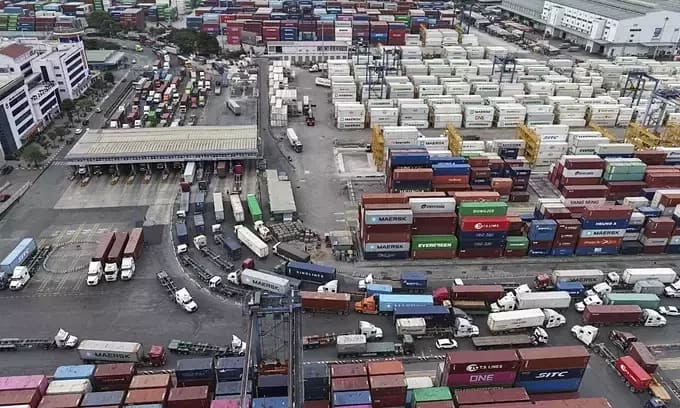
Vietnam closed the first seven months of 2026 with a trade deficit of $20.52 billion, a reversal driven by accelerating purchases of industrial machinery, raw materials, and production components. Cross-border trade reached $659.58 billion during the period, climbing 28.1% from the same stretch in 2025, according to the National Statistics Office.
Import spending hit $340.05 billion, a 34.8% jump year-on-year, substantially outpacing the 21.7% rise in merchandise shipments abroad. The foreign-invested sector accounted for $247.91 billion of those purchases, up 39.2%, while domestic firms imported $92.14 billion worth of goods, a 24.1% increase.
Export revenue totaled $319.53 billion between January and July. Foreign-invested enterprises and joint ventures contributed $255.89 billion of that figure, posting 26.4% growth, while domestic exporters generated $63.64 billion, up a more modest 5.8%.
Manufacturing Inputs Dominate Buying
Production-related goods made up 94.1% of Vietnam's import basket, valued at $319.95 billion. Machinery, equipment, tools, and spare parts represented 56.9% of total inbound shipments, while raw materials and fuels accounted for another 37.2%. Consumer goods comprised just 5.9% of imports, equivalent to $20.1 billion.
Forty products each exceeded $1 billion in import value, collectively representing 93% of the total. Two categories alone surpassed $10 billion apiece, making up 52% of all inbound trade.
The composition underscores Vietnam's role as a manufacturing hub heavily reliant on imported components and capital equipment to feed assembly lines and processing facilities.
Export Base Remains Manufacturing-Led
Manufactured goods formed the backbone of Vietnam's outbound trade, generating $287.91 billion and accounting for 90.1% of total exports. Agricultural and forestry products brought in $22.79 billion, or 7.1%, while seafood shipments totaled $6.86 billion. Fuel and mineral exports contributed $1.97 billion, representing 0.6% of the total.
Thirty-one product lines each recorded export turnover above $1 billion, collectively capturing 93% of total value. Seven categories individually surpassed $10 billion, together making up 69.7% of all exports.
The domestic economic sector's share of export revenue stood at 19.9%, a figure that has edged higher but remains well below the contribution of foreign-invested manufacturers.
Bilateral Imbalances Persist
The United States remained Vietnam's top export destination, absorbing $104.7 billion in goods over the seven-month span. Vietnam recorded a trade surplus of $91.4 billion with Washington, up 22.6% from a year earlier.
China held its position as Vietnam's largest supplier, shipping $138.6 billion worth of goods into the country. The bilateral deficit with Beijing widened 39.7% to $93 billion, reflecting the import-intensive nature of Vietnam's export manufacturing model.
The diverging balances highlight Vietnam's position in regional supply chains: importing intermediate goods and machinery from Northeast Asia, then shipping finished products to North American and European markets.
Policy Push for Export Diversification
Nguyen Thi Huong, director of the National Statistics Office, outlined several priorities for sustaining export momentum. She recommended deeper use of existing free trade agreements, stronger trade promotion efforts, and expansion into emerging markets including Latin America, Africa, and Halal-certified segments.
Huong also called for better market intelligence support for exporters, assistance navigating new product standards, and backing in anti-dumping disputes. She emphasized the need for improved access to financing and adoption of advanced manufacturing technologies to lift product quality and expand market reach.
The recommendations reflect concern that the widening deficit, if sustained, could pressure foreign exchange reserves and complicate macroeconomic management. Diversifying both supply sources and export destinations remains a central plank of Vietnam's trade strategy as regional and global supply chains continue to reconfigure.
RELATED STORIES

Southeast Asian Firms Overlook Digital Pact Worth USD 2 Trillion
Lim Hui Ying · 4 min

Vietnam Ships 1.7 Million Tonnes of Coffee as Brazil Delays and EU Rules Reshape Trade
Tran Quoc Bao · 3 min
Vietnam's Trade Turnover Hits $770 Billion as Imports Surge Past Exports
Jun-ho Seo · 2 min
Samsung's Vietnam Operations Post 23% Profit Jump to $2.3 Billion
Tran Quoc Bao · 3 min
Spot something wrong? Email editor@briefasia.com. We log every correction publicly.