Asia · Business
Vietnam Pitches Itself as Southeast Asia Innovation Hub to New Zealand Investors
Top Vietnamese leader calls for deeper collaboration beyond trade, targeting R&D and manufacturing partnerships during Auckland business forum.
KEY TAKEAWAYS
- ·Vietnamese leadership urged New Zealand companies at an Auckland roundtable to view Vietnam as a partner for research, product development, and regional manufacturing, not just a market for exports.
- ·Bilateral trade between Vietnam and New Zealand reached approximately USD 1.9 billion in 2024, with officials seeking to shift the relationship toward joint ventures and technology collaboration.
- ·Vietnam's pitch leverages its ASEAN integration, trade agreements, and expanding digital infrastructure, targeting sectors including agritech, renewable energy, and advanced manufacturing.
Beyond Market Access
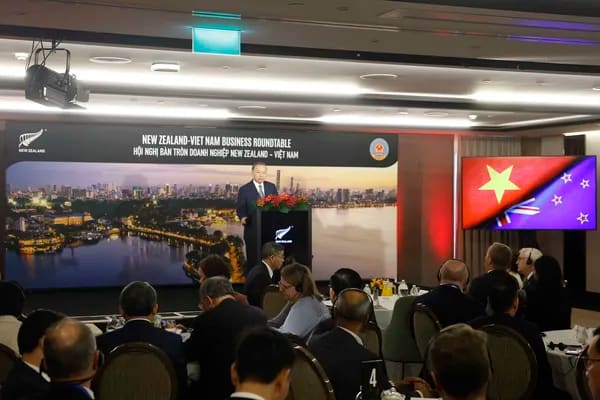
Vietnam is recalibrating its pitch to foreign investors. At a business roundtable in Auckland on August 13, Vietnamese leadership pressed New Zealand companies to rethink their approach to the Southeast Asian nation - not merely as a destination for exports, but as a collaborative base for research, product development, and manufacturing across the region.
The message signals a strategic shift. While Vietnam has long attracted foreign direct investment through low-cost manufacturing and export-oriented zones, officials now emphasize higher-value activities: joint R&D initiatives, innovation partnerships, and integrated supply chains that leverage Vietnam's geographic and economic position within ASEAN.
Regional Integration as Leverage
Vietnam's proposition rests on its integration into regional trade networks and its growing role in global supply chains. The country has signed multiple free trade agreements over the past decade, including the Comprehensive and Progressive Agreement for Trans-Pacific Partnership (CPTPP) and the EU-Vietnam Free Trade Agreement, providing investors with preferential access to markets spanning more than a billion consumers.
For New Zealand firms, particularly in agriculture technology, renewable energy, and advanced manufacturing, Vietnam offers a production and testing ground with lower regulatory friction than some neighboring economies. The country's young, educated workforce and expanding digital infrastructure add to the appeal for companies seeking to establish regional operations without the cost premiums of Singapore or the complexity of navigating China's regulatory environment.
What New Zealand Brings
New Zealand's strengths in dairy, agritech, and environmental technology align with Vietnam's development priorities. Vietnam remains a major importer of dairy products, with demand growing as the middle class expands. Collaboration on sustainable farming practices, precision agriculture, and food processing technology could address both supply chain resilience and environmental pressures facing Vietnamese agriculture.
Renewable energy is another convergence point. Vietnam has ambitious targets for wind and solar capacity to meet rising electricity demand and reduce reliance on coal. New Zealand expertise in geothermal and wind energy project management could accelerate deployment, particularly in offshore wind, where Vietnam has licensed several large-scale projects but lacks deep local experience.
The Innovation Angle
The emphasis on innovation is not rhetorical. Vietnam has increased public spending on science and technology, aiming to raise R&D expenditure to 2 percent of GDP by 2030. Several Vietnamese cities, including Hanoi and Ho Chi Minh City, have launched innovation districts and startup incubators, supported by government incentives and partnerships with universities.
Foreign firms that establish R&D centers in Vietnam can access these incentives, including tax breaks and streamlined approval processes for technology transfer. For smaller New Zealand companies, co-developing products tailored to Southeast Asian markets - whether in food technology, clean energy, or digital services - can be more cost-effective than building operations from scratch in higher-cost hubs.
Trade Dynamics in Context
Bilateral trade between Vietnam and New Zealand has grown steadily, reaching approximately USD 1.9 billion in 2024, according to official Vietnamese data. New Zealand exports primarily dairy products, meat, and wood, while Vietnam ships textiles, electronics, and footwear. The trade balance favors New Zealand, but Vietnamese officials are keen to diversify the relationship toward joint ventures and technology collaboration rather than simple commodity exchange.
The Auckland roundtable took place during a state visit that included discussions on education, labor mobility, and climate cooperation. Both governments have expressed interest in expanding educational exchanges, which could feed talent pipelines for joint ventures and ease technology transfer.
Execution Challenges
Vietnam's pitch faces practical hurdles. Intellectual property enforcement, while improving, remains uneven, a concern for New Zealand firms considering R&D partnerships. Bureaucratic processes, despite recent reforms, can be opaque, particularly at the provincial level where investment licenses are issued. Language barriers and differences in business culture add friction.
Infrastructure gaps persist outside major cities. While Hanoi and Ho Chi Minh City offer modern facilities, secondary cities - where land and labor costs are lower - often lack reliable logistics, stable power supply, and digital connectivity. Companies venturing beyond the main hubs need to budget for infrastructure investments or accept operational constraints.
What Comes Next
The success of Vietnam's repositioning will depend on follow-through. Investment promotion agencies will need to deliver on promises of streamlined approvals, transparent regulations, and protection for foreign intellectual property. Vietnamese firms, for their part, must demonstrate capacity to collaborate on complex projects, not just serve as contract manufacturers.
For New Zealand companies, the opportunity lies in early-mover advantage. As geopolitical tensions prompt multinationals to diversify supply chains away from China, Vietnam is capturing a disproportionate share of relocating investment. New Zealand firms that establish R&D and production partnerships now could secure positions in supply chains serving ASEAN's 680 million consumers.
The Auckland roundtable is one conversation in a broader recalibration. Whether it translates into tangible partnerships will become clear over the next 12 to 18 months, as companies evaluate project feasibility and both governments work to lower barriers. The pitch has been made. Execution will determine whether it resonates.
RELATED STORIES
German Appliance Maker Vorwerk Opens HCMC Office After 14-Month Vietnam Build-Out
Priyanka V. Rao · 3 min

Vietnam's Durian Shipments to China Jump 43% as Harvest Season Peaks
Tran Quoc Bao · 3 min
AI and Cloud Adoption Drive New Growth in Vietnam's Digital Economy
Cheng Wei-Lun · 3 min

HiteJinro Expands Vietnam Footprint with Scholarship Program and New Production Facility
Cheng Wei-Lun · 3 min
Spot something wrong? Email editor@briefasia.com. We log every correction publicly.