Finance · Markets
Vietnam Gold Rebounds After Fed Rate Decision Looms Over Asian Markets
Domestic bullion erased morning losses as traders positioned ahead of U.S. monetary policy announcement, with local bars settling at VND141.5 million per tael
KEY TAKEAWAYS
- ·Vietnam's gold bars recovered to VND141.5 million per tael on Wednesday, erasing a 0.7 percent morning decline ahead of the Federal Reserve's rate decision.
- ·Global spot gold gained 0.22 percent to $4,036.09 per ounce, supported by technical buying near the $4,000 level and mixed Fed rate hike expectations.
- ·Higher U.S. interest rates raise the opportunity cost of holding non-yielding gold, creating headwinds for Asian physical markets if the Fed tightens further.
Intraday Reversal in Hanoi and Saigon
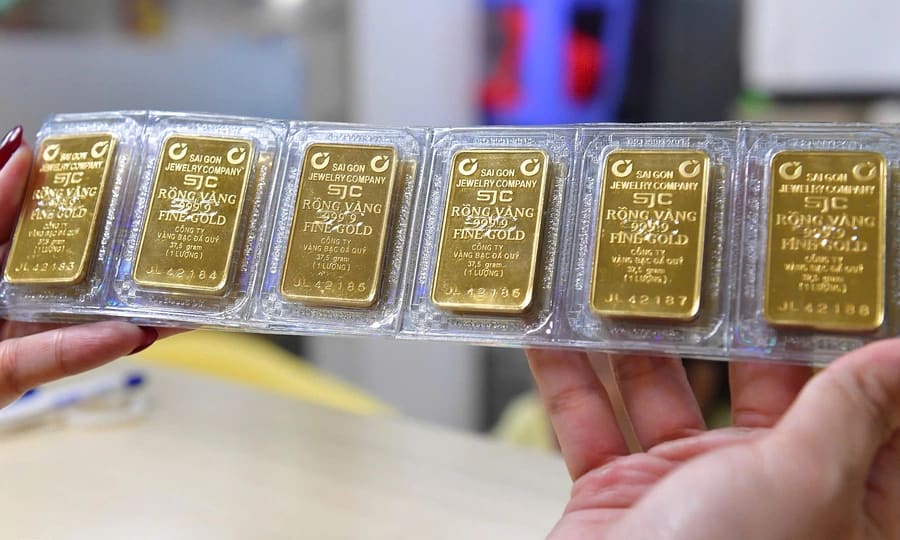
Vietnam's domestic gold market staged a recovery on Wednesday afternoon, erasing a morning decline that had pulled prices down by roughly seven-tenths of a percentage point. Saigon Jewelry Company, one of the country's benchmark bullion dealers, listed gold bars at VND141.5 million per tael by the close, according to the company. That matched Tuesday's settlement level and represented a full recovery from the session's earlier weakness.
Gold rings, a popular retail format in Vietnam, followed a similar path and closed at VND141 million per tael. One tael equals 37.5 grams.
The bounce underscores the tight coupling between Vietnam's physical gold market and global sentiment, particularly around U.S. monetary policy events. Wednesday's session unfolded hours before the Federal Reserve was scheduled to announce its latest interest rate decision, an event that has historically moved both spot bullion and Asian premiums.
Global Spot Prices Hold Above Key Threshold
International spot gold edged higher on Wednesday, gaining two-tenths of a percent to reach $4,036.09 per ounce, while U.S. gold futures for August delivery held steady at $4,037.30. The modest advance came as investors positioned cautiously ahead of the Federal Reserve's policy statement, widely expected to leave rates unchanged but closely watched for any shift in forward guidance.
Nikos Tzabouras, senior market analyst at Tradu.com, a unit of Jefferies, attributed the firmness to technical buying near the $4,000 psychological threshold. He also pointed to emerging diplomatic signals between Washington and Tehran as a factor that may have reduced some geopolitical risk premium, while noting that market pricing reflected a consensus expectation for the Fed to stand pat.
Roughly two-thirds of market participants anticipated no change in the federal funds rate, but a meaningful minority, approximately 31 percent, had positioned for a 25-basis-point increase. That split reflects lingering uncertainty about the Fed's tolerance for persistent inflation data, even as headline consumer price growth has moderated from earlier peaks.
Interest Rate Dynamics and Non-Yielding Assets
Gold's relationship with interest rates remains a central driver for both institutional and retail flows. While the metal is traditionally viewed as a store of value during inflationary periods, higher nominal rates raise the opportunity cost of holding bullion, which generates no coupon or dividend. A rate hike would therefore tend to pressure gold, while a dovish hold or cut would support it.
The current environment is particularly complex for Asian gold markets. Vietnam, like many regional peers, imports a significant share of its bullion from Switzerland and the Middle East, and local pricing tracks global spot rates with a modest premium or discount depending on supply and import duty structures. When the Fed tightens, dollar strength typically follows, which can dampen local-currency demand for gold across emerging Asia. Conversely, expectations of a policy pause or pivot have historically triggered inflows into physical markets from Hanoi to Mumbai.
Vietnam's Role in Regional Bullion Flows
Vietnam has long been one of Asia's more active retail gold markets, driven by a cultural preference for physical savings and limited trust in alternative store-of-value assets. Gold bars and jewelry serve both as a hedge against local currency volatility and as a form of portable wealth, particularly in rural areas where formal banking penetration remains incomplete.
The State Bank of Vietnam has periodically intervened in the domestic gold market to narrow the gap between local and international prices, aiming to curb speculative hoarding and reduce dollarization. In recent years, authorities have also experimented with standardized gold bar auctions to increase transparency and stabilize premiums. These measures have had mixed success, with premiums widening during periods of macroeconomic stress or global supply tightness.
Wednesday's price action suggests that Vietnamese traders are increasingly attuned to the Fed's policy trajectory. The morning dip likely reflected pre-announcement caution, while the afternoon rebound indicated that market participants saw value at lower levels, particularly if the Fed's statement leaned dovish or reiterated data-dependent language without signaling imminent tightening.
Broader Implications for Asian Precious Metals
The interplay between U.S. monetary policy and Asian gold demand has grown more pronounced as financial integration deepens. Real-time pricing, mobile trading platforms, and the proliferation of gold-backed exchange-traded products have reduced information asymmetries and tightened arbitrage spreads between London, New York, and regional hubs such as Singapore, Hong Kong, and Ho Chi Minh City.
For institutional investors, gold remains a portfolio diversifier and a hedge against tail risks, including currency debasement and geopolitical shocks. For retail buyers in Vietnam and neighboring markets, it continues to function as a savings vehicle and a hedge against local inflation, which has periodically spiked due to food price volatility and supply chain disruptions.
The Fed's decision on Wednesday was expected to set the tone for bullion markets through the third quarter. If the central bank holds rates steady and signals confidence in the inflation trajectory, gold could consolidate in a range above $4,000 per ounce. A hawkish surprise, however, would likely trigger a sharper correction, with Asian physical markets bearing the brunt of the selloff as dollar strength and higher real yields weigh on demand.
What Comes Next for Domestic Pricing
Looking ahead, Vietnamese gold prices will remain sensitive to three primary factors: the Fed's policy stance, the dong's stability against the dollar, and domestic regulatory changes. The State Bank of Vietnam has signaled its intention to maintain exchange rate stability, but external shocks such as a sharp Fed pivot or renewed trade tensions could test that commitment.
On the supply side, global mine production has plateaued, and central bank buying, particularly from emerging-market monetary authorities, has provided a structural bid under prices. Asian central banks, including those in Thailand, Singapore, and India, have been net buyers over the past two years, a trend that has supported regional sentiment and reduced downside volatility.
For Vietnamese households and small investors, the afternoon rebound on Wednesday offered a reminder of gold's dual role: a liquid asset that can be sold quickly in local markets, and a long-term store of value that tends to preserve purchasing power across economic cycles. As the Fed's policy trajectory becomes clearer in the coming months, that balance will continue to shape trading patterns and premiums across Vietnam's gold counters.
RELATED STORIES

Vietnam's VN-Index Climbs Toward 1,800 as Market Sentiment Strengthens
Priyanka V. Rao · 3 min

Vietnam Pursues Deeper Capital Market Ties with London
Tran Quoc Bao · 3 min

Malaysia Hospital Group A1Health Prepares US$1.7 Billion IPO for Early 2027
Tran Quoc Bao · 2 min

Southeast Asian Firms Overlook Digital Pact Worth USD 2 Trillion
Lim Hui Ying · 4 min
Spot something wrong? Email editor@briefasia.com. We log every correction publicly.