Finance · Deals
Unitree Robotics Shares Surge 460 Percent in Shanghai Debut
China's humanoid robot maker raised $904 million as Beijing pushes embodied AI leadership amid US technology rivalry
KEY TAKEAWAYS
- ·Unitree Robotics raised $904 million and closed 460 percent higher at 845 yuan per share in its Shanghai Stock Exchange debut, becoming mainland China's first publicly traded humanoid robotics maker.
- ·Chinese manufacturers shipped an estimated 18,500 humanoid robot units in the first half of this year, with Unitree and Agibot each shipping over 5,000 units last year compared to far lower US production volumes.
- ·The US Federal Communications Commission banned imports of new foreign-made humanoid and quadruped robots last month, threatening Unitree's US market access which previously represented 13 percent of company revenue.
Trading Debut and Investor Response
Unitree Robotics, one of China's largest humanoid robot manufacturers, closed 460 percent higher at 845 yuan per share in its Shanghai Stock Exchange debut yesterday. The company raised approximately 6.1 billion yuan ($904 million) through its initial public offering on the STAR market, with shares priced at 150.80 yuan. Intraday trading saw the stock climb as high as 629 percent before settling at the closing level.
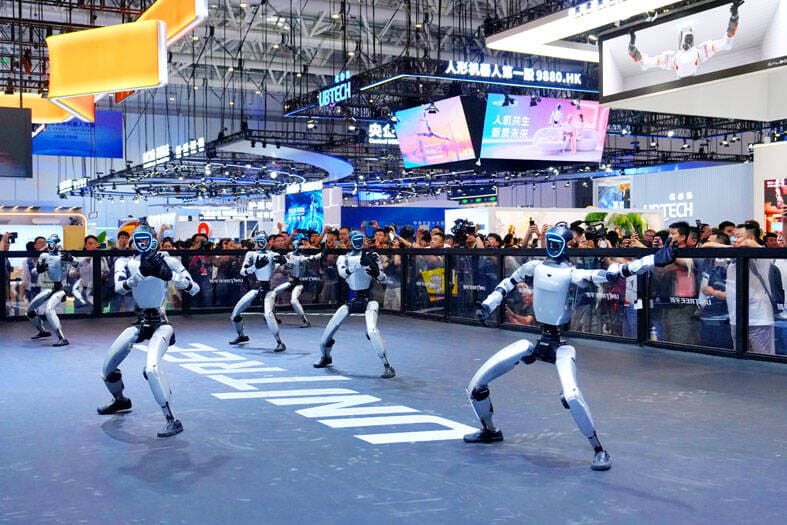
The Hangzhou-based company, founded by entrepreneur Wang Xingxing in 2016, becomes the first publicly traded humanoid robotics manufacturer in mainland China. The listing coincided with the World Robot Conference in Beijing, which drew more than 300 exhibitors and underscored Chinese government prioritization of robotics development.
Production Scale and Market Position
China has established a commanding lead in humanoid robot manufacturing capacity and scaling capability. Last year, roughly 15,000 humanoid robots shipped globally, with Unitree and domestic competitor Agibot Innovation each shipping more than 5,000 units, according to technology research firm Omdia. Chinese manufacturers collectively shipped an estimated 18,500 humanoid robot units in the first half of this year alone, far outpacing US producers.
Unitree reported 1.7 billion yuan in revenue last year, generated primarily through sales of humanoid robots and quadruped robots. More than 40 percent of that revenue originated from overseas markets, with the United States accounting for roughly 13 percent of total sales.
The company plans to allocate IPO proceeds toward advanced robot research and development initiatives and expansion of its manufacturing base. Analysts suggest the offering could establish valuation benchmarks for future robotics sector listings in the region.
Commercial Viability Questions
Despite impressive shipment volumes, industry observers note that many humanoid robots remain confined to demonstrations, performances, and research applications rather than large-scale commercial deployments. The fundamental competitive test will center on whether manufacturers can deliver reliable performance and attractive returns on investment in industrial and commercial settings at scale.
Current market dynamics reflect this uncertainty. UBTech Robotics, another major Chinese humanoid robot maker with shares listed in Hong Kong, saw its stock fall more than 10 percent on the same day as Unitree's debut, suggesting investor caution about sector-wide valuations and commercial prospects.
US Export Controls and Strategic Implications
The listing arrives against a backdrop of intensifying technology rivalry between Beijing and Washington. Advanced robotics, often termed embodied artificial intelligence, has emerged as a key battleground in this competition. Last month, the US Federal Communications Commission banned imports of new foreign-made humanoid and quadruped robots on national security grounds.
Unitree has cautioned that the ban applies to its new models and could materially affect future US market sales. The company faces additional risk that Washington may expand restrictions to cover existing models currently exempt from the prohibition. The US market represented a significant revenue stream before the ban took effect.
Industry analysts expect Chinese robot makers to pivot toward major markets outside the United States, particularly Europe, as they navigate the shifting regulatory landscape. This geographic reorientation could reshape global supply chains and competitive positioning in the embodied AI sector over the coming years.
The IPO provides mainland investors with direct exposure to a sector leader at a moment when China's technological capabilities in robotics manufacturing are ascending, even as questions about real-world application and international market access remain unresolved.
RELATED STORIES
State Investors Step In as AI Valuations Shake Chinese Markets
Cheng Wei-Lun · 3 min

CXMT Overtakes Tencent as China's Most Valuable Listed Company
Cheng Wei-Lun · 3 min
Xiaomi Reports 43% Profit Drop as Memory Costs Outpace Smartphone Revenue
Cheng Wei-Lun · 3 min

State Funds Exit Kweichow Moutai as Baijiu Giant Faces 40% Stock Decline
Cheng Wei-Lun · 4 min
Spot something wrong? Email editor@briefasia.com. We log every correction publicly.