Asia · Trade
Thailand and Malaysia Capture Record Durian Sales as China's Imports Surge 47%
Southeast Asian exporters ship 1.07 million tonnes to Chinese buyers in first half of 2026, but oversupply pushes wholesale prices down as much as 20%
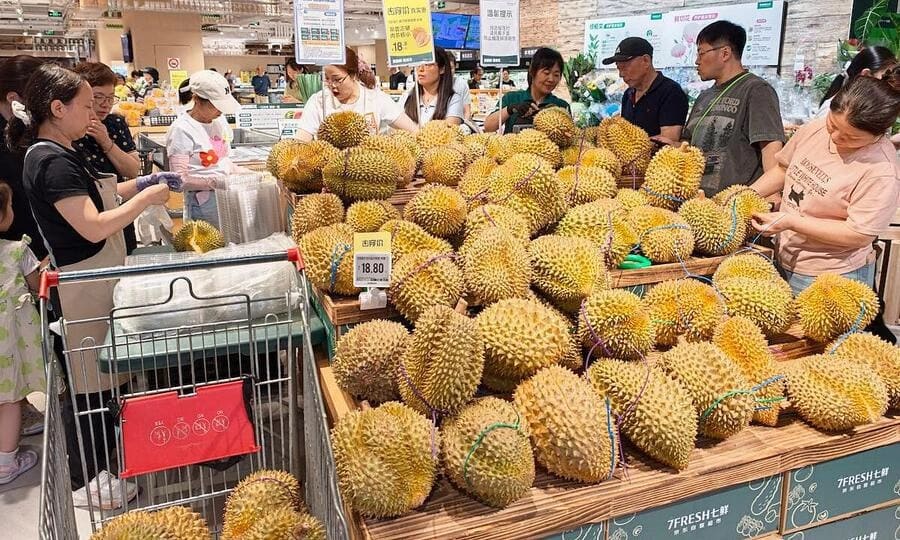
KEY TAKEAWAYS
- ·China imported 1.07 million tonnes of durian in the first half of 2026, a 47% year-over-year increase, with Thailand accounting for $3.79 billion or 81% of the market.
- ·Malaysia's durian exports to China jumped 342% to $30.26 million in H1 2026 as new orchards reached full production and infrastructure improved.
- ·Wholesale durian prices in China fell 14% to 20% this year as Southeast Asian supply growth outpaced demand, pressuring exporters during peak harvest season.
Thailand Maintains Dominance as Volumes Climb
China imported 1.07 million tonnes of durian in the first six months of 2026, a 51% increase from 708,000 tonnes in the same period last year, according to Chinese customs data. Thailand shipped $3.79 billion worth of the fruit, capturing 81% of the market and cementing its position as the dominant supplier to Chinese consumers.
Vietnam ranked second with $846 million in exports, representing 18% of total Chinese durian imports during the period. The country received approval to export fresh durians to China in 2022 and has since ramped up shipments, though quality-control issues have surfaced intermittently.
Malaysia, a newer player in China's fresh durian market, recorded $30.26 million in exports to China in the first half of 2026, a 342% jump from the same period in 2025. The spike reflects Beijing's gradual opening to additional suppliers and Malaysia's push to establish a foothold in the world's largest durian market.
Infrastructure and E-Commerce Accelerate Cross-Border Flows
Improved logistics infrastructure has played a direct role in the export surge. Expanded services on the China-Laos Railway have shortened transit times for Southeast Asian fruit, reducing spoilage and enabling growers to reach inland Chinese cities more efficiently.
The rise of Chinese e-commerce platforms has also widened distribution channels, allowing consumers in lower-tier cities to order fresh durians that previously circulated only in coastal hubs like Shanghai and Guangzhou. Thailand benefits from a mature supply chain and quality-control framework that has built consumer trust over the past decade.
Oversupply Pressures Prices Down
Despite strong import growth, wholesale durian prices in China have fallen between 14% and 20% so far this year, according to industry estimates. The decline stems from a supply glut during peak harvest season as orchards planted six to 10 years ago reach full production.
"Malaysia, Thailand and Vietnam are experiencing an oversupply during the current peak durian harvest season as orchards reach full production and output expands faster than demand," said Lim Chin Khee, an adviser to the Durian Academy, a Malaysian institution that trains growers.
China consumes roughly 90% of the world's durian supply, but domestic demand has not kept pace with the rapid expansion in Southeast Asian output. Higher inventories and more cautious consumer spending have added downward pressure on prices.
Malaysia Seeks Land Shipping Route to Ease Glut
Agricultural officials in Malaysia have asked China's General Administration of Customs to approve a land-based shipping route to complement existing sea and air freight channels, according to state news agency Bernama. The move aims to reduce logistics costs and open additional pathways for Malaysian growers struggling with excess inventory.
The maturation of durian trees planted during the last investment cycle has intensified the oversupply problem in Malaysia. Lim noted that while long-term demand from China remains robust, short-term production growth has outstripped consumption, creating a price squeeze during peak season.
Long-Term Demand Outlook Stays Firm
Industry observers expect Chinese demand for durian to continue growing over the next decade, driven by rising middle-class incomes and deeper market penetration in inland provinces. However, the current imbalance between supply and demand suggests that prices may remain under pressure until production stabilizes or new export markets emerge.
Thailand's established logistics network and brand recognition give it a structural advantage, but Vietnam and Malaysia are investing in quality improvements and cold-chain infrastructure to close the gap. The next 18 months will test whether Southeast Asian exporters can manage supply growth without triggering a prolonged price slump.
RELATED STORIES
Malaysia's Rare Earth Deposits Draw Foreign Interest Ahead of China Export Controls
Priyanka V. Rao · 3 min

Volkswagen Probes Chinese Supplier After Hundreds of New Graduates Dismissed
Cheng Wei-Lun · 3 min
Honda Demands 30% Price Cuts From Suppliers in $9.4 Billion Cost Plan
Cheng Wei-Lun · 3 min

Beijing Warns Domestic EV Makers Against Overseas Price Wars
Cheng Wei-Lun · 3 min
Spot something wrong? Email editor@briefasia.com. We log every correction publicly.