Asia · Politics
Taiwan's Drone Industry Faces Budget Crisis as Opposition Pushes NT$8 Billion in Cuts
Economic Affairs Minister warns that proposed reductions to uncrewed vehicle program would cripple a 267-company supply chain and derail efforts to build a democratic drone ecosystem in the Asia-Pacific.
KEY TAKEAWAYS
- ·Taiwan's opposition party proposes cutting NT$8 billion from the current fiscal year's drone development budget, part of a six-year NT$44.2 billion program launched in October 2025 to build democratic UAV supply chains.
- ·The Ministry of Economic Affairs warns the cuts would disrupt 267 companies in Taiwan's uncrewed vehicle ecosystem, delaying R&D, investment, and production plans while increasing financial pressure on manufacturers.
- ·Budget uncertainty threatens Taiwan's goal to reach NT$40 billion in drone production value by 2030 and undermines its positioning as a regional hub for democratic allies seeking alternatives to Chinese UAV suppliers.
Opposition Targets Six-Year Program
Taiwan's uncrewed vehicle industry confronts a critical funding threat as the Chinese Nationalist Party caucus moves to slash approximately NT$8 billion (US$246 million) from this fiscal year's drone development budget. The proposed cuts target a six-year, NT$44.2 billion program launched by the Executive Yuan in October 2025, designed to establish Taiwan as a hub for democratic drone supply chains across the Asia-Pacific.
Minister of Economic Affairs Kung Ming-hsin warned that the reductions would effectively dismantle government support for the sector. Opposition lawmakers already removed drone-related appropriations from a special defense budget in May, and the new cuts would eliminate the industry's remaining institutional backing, he said at a legislative meeting in Taipei.
The minister disputed claims from opposition legislators that the program was budgeted without clear demand. Planning for the Asian UAV AI Innovation and Application R&D Center in Chiayi County began well before budget proposals were submitted, and related field projects are already operational, according to Kung.
Supply Chain at Risk
The Ministry of Economic Affairs identified more than 267 companies currently participating in Taiwan's uncrewed vehicle supply chain. These firms depend on government contracts, research subsidies, and procurement commitments embedded in the development program's annual allocations.
Budget disruptions would cascade through the ecosystem, affecting existing project timelines, research and development pipelines, capital investment schedules, and mass-production roadmaps, the ministry said. Operating costs would rise and financial pressure would mount on smaller component manufacturers and systems integrators that have aligned their business plans with multi-year government commitments.
The program aims to lift Taiwan's drone industry production value beyond NT$40 billion by 2030, positioning the island as a counterweight to mainland Chinese dominance in commercial and military UAV manufacturing. That ambition hinges on consistent government funding to de-risk private investment in advanced propulsion, sensor fusion, autonomous navigation, and secure data-link technologies.
Regional Ambitions in Question
Taiwan's drone initiative sits within a broader effort among democratic allies to diversify supply chains away from authoritarian manufacturing bases. Japan, South Korea, and India have announced parallel programs to cultivate domestic UAV capabilities, while the United States has tightened export controls on drone components destined for China.
The Chiayi R&D center is designed to serve as a regional testbed for artificial intelligence-driven flight control, swarming algorithms, and edge-computing payloads. International partners from Australia and European NATO members have expressed interest in procurement agreements contingent on Taiwan demonstrating scalable production capacity.
Opposition lawmakers argue that the uncrewed vehicle budget overlaps with separate drone legislation proposed by both ruling and opposition parties, creating redundancy. They contend that funding should be consolidated under a single regulatory framework rather than dispersed across executive programs.
The Ministry of Economic Affairs counters that legislative proposals address airspace regulation and civilian drone registration, while the executive program funds industrial R&D, infrastructure, and supply-chain integration. The two tracks are complementary rather than duplicative, officials said.
Industry Pushback
Taiwan's drone manufacturers, many of which pivoted from traditional aerospace or electronics subcontracting, have urged lawmakers to preserve funding. Several firms announced expansion plans in 2025 based on expected government orders for surveillance, agricultural, and disaster-response platforms.
Budget uncertainty has already delayed capital equipment purchases and stalled negotiations with foreign component suppliers. Some companies are reconsidering investments in clean-room facilities for advanced composite airframe production, citing the risk that government anchor orders may not materialize.
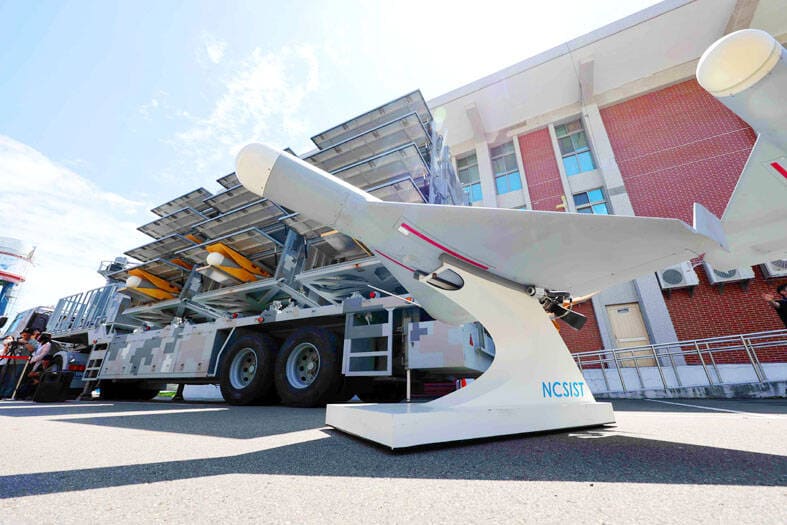
The National Chungshan Institute of Science and Technology, Taiwan's primary defense research agency, has developed multiple UAV prototypes under the program, including fixed-wing reconnaissance platforms and rotary-wing loitering munitions. The institute's Aeronautical Systems Research Division in Taichung relies on budget continuity to transition prototypes into low-rate initial production.
What Comes Next
Legislative negotiations over the budget are expected to intensify in the coming weeks. The ruling party holds a minority in the legislature, requiring coalition support or opposition defections to preserve funding levels.
International defense analysts are monitoring the dispute as an indicator of Taiwan's commitment to asymmetric defense investments. Uncrewed systems are central to the island's strategy for countering numerically superior adversary forces, and budget cuts could signal waning domestic consensus on defense priorities.
Kung emphasized that without central government support, Taiwan's ability to anchor a democratic drone supply chain in the region would be severely compromised. The island's manufacturers would be left to compete on price alone against subsidized Chinese producers, a contest they are unlikely to win without policy backing and sustained R&D funding.
RELATED STORIES
Eurasian Security Bloc Convenes as Shein Prices Hong Kong IPO
Cheng Wei-Lun · 3 min

Itochu and Taiwan IT Leader Back Taiwanese Chip Firms' Kyushu Push
Cheng Wei-Lun · 3 min
Taiwan's National Security Council Expands Role in Defense Strategy
Cheng Wei-Lun · 3 min
Tokyo Summit Pushes Trilateral Tech Alliance Among Taiwan, Japan, and US
Cheng Wei-Lun · 3 min
Spot something wrong? Email editor@briefasia.com. We log every correction publicly.