Perspectives · Analysis
Southeast Asia Is Riding China's Export Wave, Not Drowning in It
The region's factories are absorbing Chinese machinery and investment faster than they are losing ground, but dependency risks loom large.
KEY TAKEAWAYS
- ·Southeast Asia imported over $500 billion from China last year, leaving a $290 billion deficit, yet the region's own exports grew 54 per cent since 2019, outpacing China's 51 per cent.
- ·Around 90 per cent of Southeast Asian imports from China are intermediate inputs and capital goods, while Chinese manufacturing investment tripled to $75 billion, creating twice as many local jobs per project as other foreign investors.
- ·Vietnam and Malaysia have captured the largest gains by integrating into Chinese supply chains, while Indonesia and Thailand lag due to weaker competitiveness and higher regulatory barriers.
- ·Heavy reliance on Chinese technology and capital risks locking Southeast Asia into lower value chain positions and exposes the region to US decoupling pressure and transshipment scrutiny.
A Different Kind of Shock
When China's customs surplus hit $1.2 trillion last year and exports climbed to $3.8 trillion, alarm bells rang across Washington and Brussels. Policymakers warned of a second China shock, echoing the dislocation that followed Beijing's 2001 entry into the World Trade Organization. Back then, American factory towns hollowed out and developing nations saw their own industrialization stall as cheap Chinese goods flooded global markets. The fear now is a repeat performance, with Southeast Asia cast as collateral damage.
The numbers look ominous at first glance. Southeast Asia imported more than half a trillion dollars of merchandise from China last year, leaving the region with a collective trade deficit of around $290 billion. Indonesian textile factories shed 80,000 jobs in 2024 alone. Japanese automakers in Thailand are closing plants or pulling back capacity. It is easy to see why some voices are calling for Southeast Asian governments to join the tariff offensive against Chinese overcapacity.
Yet that narrative misses the deeper transformation underway. Today's China shock bears little resemblance to the first. Where Beijing once served as the world's final assembly line, stitching together components made elsewhere and shipping finished goods to rich-country consumers, it now supplies the machinery, intermediate inputs, and technology that power factories across the developing world. China has evolved from assembler to supplier of the supply chain itself.
Factory to the Factories
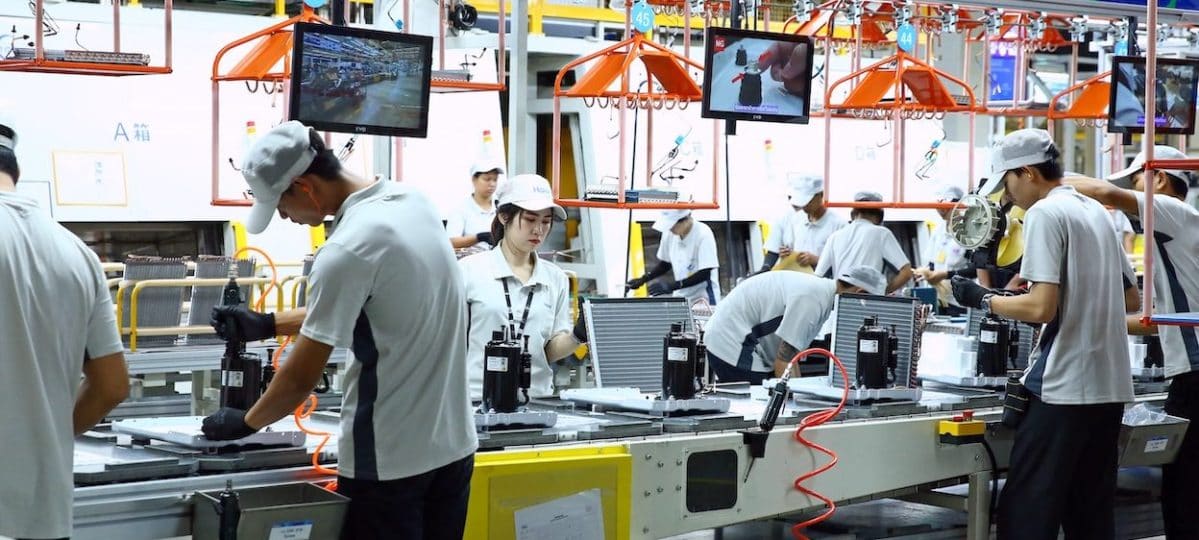
Around 90 per cent of what Southeast Asia buys from China consists of intermediate inputs and capital goods, not consumer products. Chinese-made industrial robots, semiconductor equipment, solar panel production lines, and precision components flow into Vietnamese electronics plants, Malaysian semiconductor fabs, and Thai battery factories. These inputs do not displace local production; they enable it.
Chinese direct investment into Southeast Asian manufacturing reached $15.4 billion in 2024, nearly triple the $5.7 billion recorded in 2019. When portfolio flows are included, total Chinese capital inflows approached $75 billion last year, equivalent to roughly 2 per cent of Southeast Asia's combined GDP. Greenfield investment data suggests the average Chinese manufacturing project in the region generates almost twice as many local jobs as comparable investment from other countries, largely because Chinese firms favor labor-intensive electronics assembly over automated processes.
This dynamic explains why Southeast Asia's own export performance has remained robust even as China's surplus balloons. Since 2019, Chinese merchandise exports have grown 51 per cent. Southeast Asian exports are up 54 per cent. China's trade surplus has expanded 178 per cent over that span; Southeast Asia's collective surplus is up 142 per cent, despite the widening bilateral deficit with Beijing. In key global value chain sectors including textiles, electronics, machinery, and autos, China's share of world exports rose from 22.8 per cent in 2019 to 24.6 per cent in 2024. Southeast Asia's share climbed from 9.2 per cent to 11.3 per cent.
Value-added export data, which strips out the value of imported inputs and isolates the contribution of domestic production, tells a similar story. Between 2019 and 2022, the latest period for which comprehensive data is available, China's value-added exports in major global value chain sectors rose almost 40 per cent. Southeast Asia's grew 24 per cent. That gap reflects China's position higher up the value chain, but it also underscores that Southeast Asia is not being crowded out. Instead, the region is capturing a growing slice of a rapidly expanding pie.
Winners and Laggards
Not every Southeast Asian economy is benefiting equally. Vietnam and Malaysia, both open to trade and investment and relatively competitive in manufacturing, have outpaced regional peers. Vietnam's electronics exports have surged as Chinese suppliers set up shop to serve global clients seeking alternatives to mainland production. Malaysia has attracted semiconductor investment from Chinese firms building out capacity outside their home market.
Indonesia and Thailand, by contrast, have lagged. Both face higher regulatory barriers, weaker infrastructure, and less competitive manufacturing ecosystems. Thailand's automotive sector, long a regional anchor, has struggled to adapt as Chinese electric vehicle makers bypass traditional supply chains. Indonesia's textile industry, once a major employer, has found itself squeezed between low-cost Chinese imports and a lack of domestic investment in productivity-enhancing technology.
These divergent outcomes highlight a broader truth: the second China shock rewards economies that can integrate into Chinese-led supply chains while building their own capabilities. Countries that erect barriers or fail to invest in competitiveness risk being left behind, unable to benefit from Chinese capital and technology but still exposed to import competition.
The Dependency Trap
The immediate gains are real, but they come with long-term risks. Southeast Asia is becoming structurally dependent on Chinese supply chains, capital, and technology. That dependence creates political vulnerability, particularly as Washington intensifies efforts to decouple from Beijing and pressures allies to follow suit. The United States has made clear it will scrutinize imports from third countries that serve as transshipment hubs for Chinese goods or rely heavily on Chinese inputs. Southeast Asian exporters could find themselves caught in the crossfire.
There is also an economic risk. Heavy reliance on Chinese machinery and components can lock Southeast Asian manufacturers into the lower rungs of the value chain, assembling products with limited scope for innovation or margin expansion. If Chinese firms retain control over core technologies and high-value production stages, Southeast Asia's industrialization may stall at the same middle-income threshold that has trapped other emerging markets.
Avoiding that outcome will require deliberate policy choices. Governments must invest in education, infrastructure, and research capacity to enable local firms to move up the value chain. They need to maintain diversified trade and investment linkages, ensuring that no single partner accounts for an outsized share of critical inputs or capital. And they must resist the temptation to close off their economies in response to acute import surges, a move that would sacrifice long-term growth for short-term political relief.
Targeted safeguards, such as anti-dumping duties on specific products or curbs on unregulated online imports, can address concentrated pain in vulnerable sectors without undermining the broader benefits of openness. Social protection programs are essential to support workers displaced by import competition and facilitate their transition into expanding industries. But broad-based protectionism would be a mistake, cutting Southeast Asia off from the capital, technology, and supply chain integration that have driven its recent export success.
A Moment of Opportunity
The second China shock is not the economic catastrophe that some fear. For Southeast Asia, it represents an opportunity to accelerate industrialization by tapping into Chinese capital, technology, and supply chains. The region's export growth and rising share of global manufacturing output suggest it is seizing that opportunity, even as China itself expands.
The challenge now is to convert near-term gains into sustained upgrading. That means building domestic capabilities, diversifying partnerships, and avoiding the dependency traps that have ensnared other developing regions. Southeast Asia has the potential to emerge from this era not as a victim of Chinese overcapacity, but as a manufacturing hub in its own right. Whether it does so will depend on the policy choices governments make today.
RELATED STORIES

From Tourism Graduate to Indonesia Electronics Distributor: Wook Eyes IPO
Cheng Wei-Lun · 3 min
Indonesia Seeks 100GW Solar Build From China, But Not Chinese Ownership
Priyanka V. Rao · 3 min
China's Manufacturing Index Holds Below Expansion Threshold for Second Month
Cheng Wei-Lun · 5 min

China's Social Security Fund Doubles Offshore Holdings to $86 Billion
Jun-ho Seo · 3 min
Spot something wrong? Email editor@briefasia.com. We log every correction publicly.