Lifestyle · Culture
Singapore Coffee Roaster Kim Guan Guan Scales From Door-to-Door Sales to 1,500 Clients
Jason Soon built his business by learning to roast beans himself after suppliers failed to meet quality standards, then pivoted online during the pandemic.
KEY TAKEAWAYS
- ·Kim Guan Guan Coffee now supplies traditional Nanyang coffee to over 1,500 F&B businesses in Singapore after founder Jason Soon learned roasting to control quality following supplier inconsistencies.
- ·The company launched consumer brand Kim's Duet in 2021 and grew monthly sales on Shopee tenfold from 2024 after pivoting online during the pandemic.
- ·Soon reinvests profits into automation and talent development, having built the business from door-to-door sales in 1988 with no initial roasting knowledge.
From Supplier to Roaster
Jason Soon started Kim Guan Guan Coffee in 1988 with a simple model: buy robusta beans from Indonesian roasters, grind them, and sell the powder to Singapore coffee shops. Fresh from national service and encouraged by a relative, he entered the business at a time when kopitiam culture was booming across the island.
Within two years, the venture hit a wall. Financial pressure mounted, his business partner walked, and Soon found himself working 16-hour days handling grinding, sales, and accounting alone. More damaging were the customer complaints. Bean quality from his suppliers was inconsistent, and clients began walking away.
The solution was clear but daunting: take control of roasting. Soon had no background in the craft, but he acquired a roaster and taught himself traditional Nanyang techniques from scratch. The move allowed him to standardize quality and rebuild trust with clients who had dropped off.
Today, Kim Guan Guan Coffee operates its own certified roastery in Singapore, importing, roasting, packing, and supplying traditional ground coffee and tea dust to more than 1,500 food and beverage businesses. The company also sells directly to consumers through online platforms, primarily Shopee.
The Pivot to Digital
For decades, Soon focused almost exclusively on the business-to-business channel. E-commerce was not a priority until the pandemic forced his hand. When COVID-19 lockdowns hit, demand shifted online overnight, and Kim Guan Guan had to scramble to catch up.
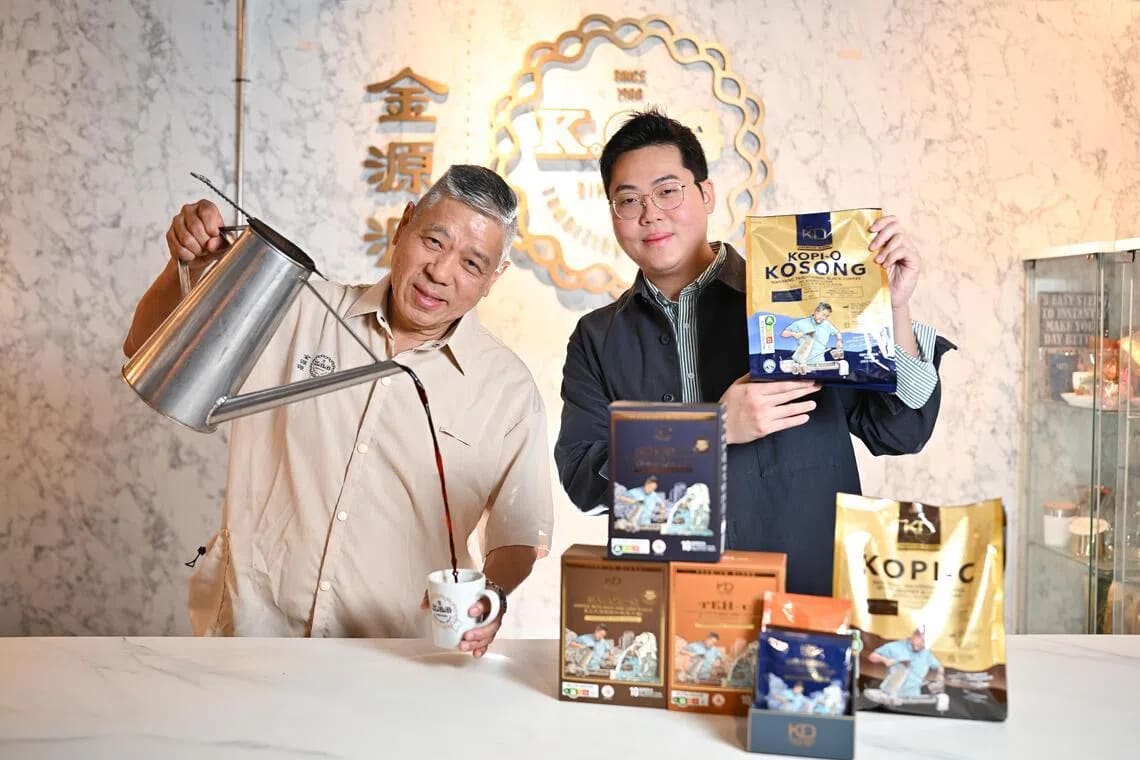
The delay cost time and revenue, but it also opened a new channel. In 2021, Soon launched Kim's Duet, a consumer-facing brand that packages Singapore Nanyang coffee and tea in steep bag formats for home brewing. His son Nigel, 29, now heads the brand as partnerships and growth manager.
Shopee has become one of the strongest platforms for Kim's Duet. Working with the platform's team, the brand grew its monthly sales tenfold from 2024, according to the company. The digital push has allowed Kim Guan Guan to reach consumers beyond the traditional kopitiam setting, where authentic Nanyang coffee has historically been concentrated.
Real Estate and Reinvestment
Soon's approach to capital has been conservative and asset-focused. Around 2010, space constraints pushed the company to invest in a warehouse. Purchased at a low price, the property has since tripled in value. He views real estate as a hedge against inflation and a source of rental income, a strategy he has applied to his personal investments as well.
Rather than extracting profits early, Soon has consistently reinvested in the business. He cites this as his best financial decision, alongside property investments that generate stable side income. If he had a windfall of one million dollars today, he says he would channel most of it into automating roasting processes and developing in-house talent, with an eye toward scaling Singapore coffee for global distribution.
Building Without a Safety Net
Soon grew up without financial cushion. Every dollar had to be earned and stretched, a reality that shaped his risk tolerance and work ethic. When he and his wife bought their first HDB flat, they lacked the funds for the minimum deposit, a moment he describes as a turning point in understanding the importance of savings and financial planning.
He now lives in a seven-bedroom condominium and drives a Mercedes-Benz S-Class, but his daily routine remains grounded. He still pulls his own cup of traditional coffee each morning before starting work, a practice that keeps him connected to the product and the craft.
His son Nigel has taken on a growing role in the business, steering Kim's Duet as the company balances its legacy in food services with expansion into consumer markets. The family dynamic mirrors the broader strategy: respect for tradition, paired with willingness to adapt when the market demands it.
What Comes Next
Kim Guan Guan's growth trajectory reflects a broader shift in Singapore's food and beverage landscape, where heritage brands are finding new life online and younger consumers are willing to pay for convenience without sacrificing authenticity. The steep bag format that Kim's Duet uses is part of that equation, making traditional Nanyang coffee accessible outside the kopitiam without requiring specialized equipment.
Soon's story is less about disruption and more about persistence. He built a business by solving problems as they appeared: inconsistent suppliers, financial strain, a partner's exit, a pandemic that shut down physical channels. Each time, the response was the same: learn the skill, control the process, and reinvest in the next stage.
For a company that started with door-to-door sales and a single roaster, reaching 1,500 clients and scaling digitally represents decades of incremental gains. The coffee itself has not changed much. What has changed is who can access it, and how.
RELATED STORIES

Addvalue Technologies Lands $5 Million in Space and Radio Contracts
Tran Quoc Bao · 3 min

Singapore Tightens Stablecoin Rules to Separate Regulated Tokens From Crypto Claims
Priyanka V. Rao · 2 min

Shein Drops 4% in Hong Kong Debut as Tariff Pressure Weighs on Valuation
Priyanka V. Rao · 4 min

Singapore Targets High-Value Data Centre Workloads as Neighbors Scale Up Capacity
Cheng Wei-Lun · 3 min
Spot something wrong? Email editor@briefasia.com. We log every correction publicly.