Sustainability · Mobility
Singapore Awards New EV Charging Contracts Ahead of 2027 Infrastructure Push
Two operators will install chargers at housing estates and public facilities as the city-state races to meet its fast-hub commitment
KEY TAKEAWAYS
- ·EVe awarded SP Mobility and ComfortDelGro Engie contracts to install EV chargers at 13 sites, with the first location opening in Q3 2027.
- ·Four of the 13 sites will be fast-charging hubs, supporting Singapore's goal of one hub per HDB town by end-2027.
- ·The operators were selected from a pre-qualified panel vetted on reliability, customer experience, and project delivery capability.
Expanding the Grid
Singapore's state-backed charging authority has awarded fresh infrastructure contracts to two private operators, marking another step in the city-state's effort to wire up residential and public spaces for electric vehicles.
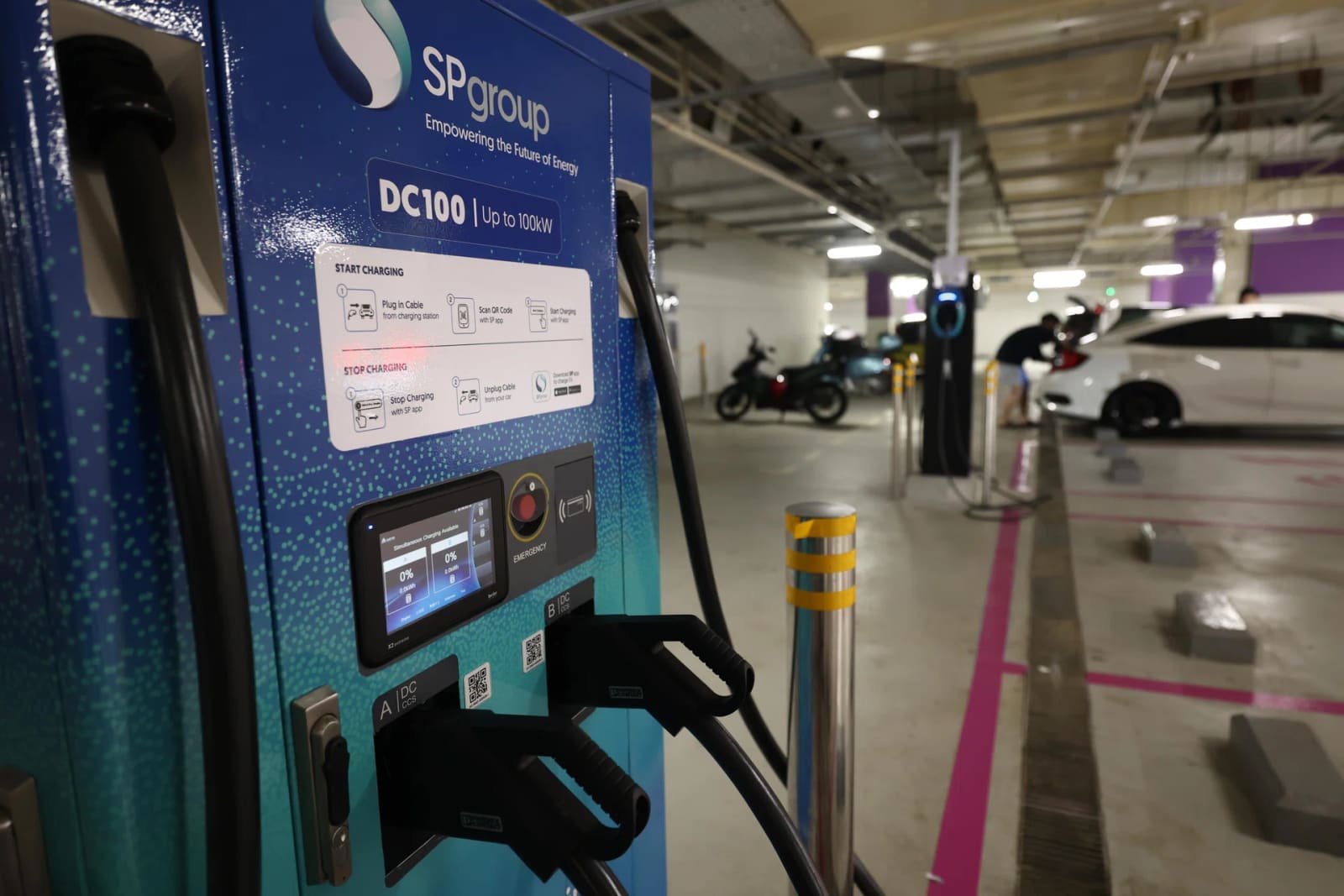
EV-Electric Charging, known as EVe and owned by the Land Transport Authority, selected SP Mobility and ComfortDelGro Engie to install chargers at 13 locations. According to EVe, the sites span newly constructed housing developments and car parks serving leisure venues across the island. The first installation is scheduled to go live in the third quarter of 2027.
The rollout will combine slower alternating-current chargers and faster direct-current units, a design intended to serve drivers who charge overnight near their homes as well as those seeking a rapid top-up during the day. Four of the 13 sites will be configured as fast-charging hubs, each equipped with multiple DC stalls.
Meeting the Town-by-Town Target
The new awards align with a government pledge to plant at least one fast-charging hub in every Housing and Development Board town by the close of 2027. With roughly two-thirds of Singaporeans living in HDB flats, the policy aims to close the convenience gap that has slowed adoption among apartment dwellers who lack private garages.
Stephanie Tan, chief executive of EVe, said the deployment addresses two distinct use cases. Drivers who park near their apartments overnight will gain access to additional AC chargers, while those in a hurry can rely on the fast hubs scattered across towns. She described the expansion as critical to keeping pace with rising vehicle registrations.
Both SP Mobility and ComfortDelGro Engie sit on EVe's pre-qualified panel of operators, a roster assembled earlier this year to accelerate the next wave of public charging infrastructure. Panel members were vetted on operational uptime, customer service quality, and their track record in delivering large-scale EV projects.
Building on Earlier Awards
The pair already hold contracts awarded in April to deploy fast-charging hubs at eight other sites, a package that covers HDB towns and car parks near recreational facilities. ComfortDelGro Engie won two of those contracts, while SP Mobility took one.
Under the April agreements, ComfortDelGro Engie is installing chargers in Tampines, Hougang, Choa Chu Kang, Kallang, Whampoa, and Bukit Batok. The Hougang site will serve as a fast-charging hub with six 50-kilowatt DC chargers and six 7.4-kilowatt AC units. A second contract covers GB Building, One Punggol, Fernvale Community Club, and Changi Naval Base.
SP Mobility's April contract focuses on sports and recreation centers, deploying DC chargers at facilities in Jurong East, Delta, Choa Chu Kang, and Woodlands.
Asia's Charging Race
Singapore's phased approach mirrors strategies in Seoul, Tokyo, and Shenzhen, where municipal authorities have leaned on competitive tenders to scale up public charging without shouldering the full capital burden. The model splits infrastructure risk between government planning and private operation, a structure that has proven effective in dense urban markets where land is scarce and grid capacity must be carefully managed.
The city-state's 2027 deadline also reflects a broader regional timeline. Across Southeast Asia, governments are under pressure to demonstrate credible charging networks before announcing stricter emissions standards or internal-combustion phase-out dates. Indonesia, Thailand, and Malaysia have all announced pilot programs in the past 18 months, though execution has lagged behind headline commitments.
For Singapore, the stakes are reputational as well as environmental. As a logistics and automotive finance hub, the city-state has positioned itself as a testbed for mobility technology, from autonomous shuttles to battery-swapping trials. A visible, reliable charging network reinforces that narrative and signals to automakers and fleet operators that the infrastructure will be ready when volume sales begin.
EVe's decision to stagger the rollout through 2027 also buys time to monitor utilization patterns and adjust the mix of AC and DC chargers at each site. Early data from the April deployments will inform later phases, allowing the authority to shift capacity toward high-traffic nodes and avoid overbuilding in quieter precincts.
The contracting structure itself offers a lesson in risk allocation. By pre-qualifying a panel of operators and awarding packages in batches, EVe maintains flexibility to bring in additional players or renegotiate terms if demand surges faster than forecast. The model contrasts with single-vendor lock-ins common in earlier charging tenders across the region, which left governments exposed when operators underperformed or went insolvent.
As the 2027 target approaches, the real test will be utilization. Installing hardware is the easier half of the equation; ensuring that chargers are maintained, priced competitively, and integrated into payment and navigation apps will determine whether the network becomes a genuine asset or a stranded investment.
RELATED STORIES
Southeast Asian Workers Embrace AI Tools Faster Than Global Peers
Priyanka V. Rao · 3 min
Singapore Banks Hit Record Highs on Wealth Management Surge
Priyanka V. Rao · 2 min
Allianz Acquires HSBC Singapore Insurance Operations in $2.3 Billion Deal
Priyanka V. Rao · 3 min

Singapore Expands Bank Network for Financial Crime Intelligence Platform
Priyanka V. Rao · 3 min
Spot something wrong? Email editor@briefasia.com. We log every correction publicly.