Technology · Dev
Samsung Locks In Memory Supply Through 2031 as Chip Crunch Extends
The Korean chipmaker has secured five-year contracts with major data center operators and is negotiating similar deals with five more customers, signaling persistent tight supply in the memory market.
KEY TAKEAWAYS
- ·Samsung Electronics has finalized five-year memory supply contracts with five data center customers and is negotiating similar deals with five more, committing DRAM and NAND output through 2031.
- ·The agreements reflect persistent supply constraints in the memory market, with the chip shortage now expected to extend into 2028 and beyond, driven by AI and cloud infrastructure demand.
- ·Long-term contracts mark a shift from historical quarterly pricing cycles and may reduce price volatility while providing revenue visibility for manufacturers and procurement certainty for hyperscale operators.
Long-Term Commitments in a Tight Market
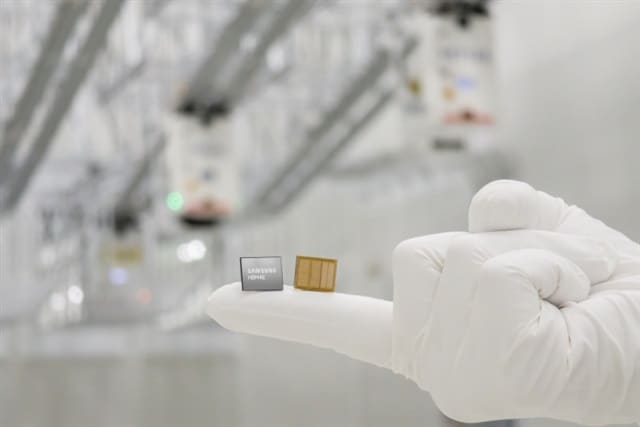
Samsung Electronics has finalized five-year memory supply contracts with five major data center operators, according to company announcements. The agreements lock in substantial portions of the company's DRAM and NAND flash production through 2031, marking a shift toward extended supply commitments in an industry historically dominated by quarterly pricing cycles.
The Korean chipmaker is simultaneously negotiating similar long-term deals with an additional five customers, suggesting that a significant share of its memory output will soon be allocated years in advance. These arrangements arrive as the memory chip shortage, initially forecast to ease by 2026, now appears positioned to extend well into the decade's final years.
Data Center Demand Drives Contract Strategy
Hyperscale cloud operators and enterprise data center customers have emerged as the primary drivers behind these extended supply agreements. The artificial intelligence boom has intensified memory requirements, with high-bandwidth memory (HBM) for AI accelerators and conventional DRAM for server infrastructure both experiencing sustained demand growth.
Samsung's willingness to commit production capacity years ahead reflects confidence in structural demand rather than cyclical upticks. The company has historically preferred shorter contracts that allow pricing flexibility, but persistent supply-demand imbalances have made long-term visibility attractive to both manufacturer and customer.
For data center operators, these agreements provide procurement certainty during a period when memory availability has become a constraint on infrastructure expansion. The contracts likely include volume commitments and pricing frameworks that offer stability against the sharp price swings that have characterized the memory market in previous cycles.
Supply Discipline and Capacity Constraints
The memory industry's shift toward extended contracts follows years of disciplined capacity additions. After the 2018-2019 oversupply crisis that triggered a prolonged price collapse, manufacturers including Samsung, SK hynix, and Micron Technology adopted more conservative expansion strategies.
New fabrication facilities require multi-year construction timelines and capital investments measured in tens of billions of dollars. Samsung's most advanced memory fab in Pyeongtaek, South Korea, represents over $20 billion in cumulative investment. The company has announced additional capacity in Taylor, Texas, though that facility remains years from volume production.
Meanwhile, the transition to more advanced process nodes has slowed. Leading-edge DRAM production has largely stabilized at the 10-nanometer class, with incremental improvements rather than aggressive node shrinks. NAND flash has moved toward vertical scaling, stacking more layers rather than pursuing smaller geometries, but each generation requires extensive qualification time with customers.
Regional Context and Competitive Dynamics
Asia's memory supply chain remains concentrated, with South Korea and Taiwan accounting for the majority of global DRAM production and substantial NAND capacity. Samsung and SK hynix together control roughly 70 percent of the DRAM market, while Samsung, SK hynix, and Kioxia (Japan) dominate NAND alongside Micron and Western Digital.
China's memory ambitions, led by CMOS Image Sensor manufacturers attempting to move into DRAM and NAND, have faced technical hurdles and export control restrictions that limit access to advanced lithography equipment. This has reinforced the supply concentration among established players and contributed to the extended timeline for capacity additions.
The long-term contracts Samsung is securing may also serve as a competitive moat, tying key customers to its supply base and complicating efforts by smaller rivals to gain share in the hyperscale data center segment. For customers, however, diversification remains a priority, and the ongoing negotiations with multiple suppliers suggest that data center operators are splitting commitments across vendors rather than consolidating with a single source.
Implications for Pricing and Investment
Extended supply agreements introduce a new dynamic into memory pricing. While spot market transactions will continue, a growing share of volume moving through multi-year contracts should dampen the extreme volatility that has historically defined the sector. This could support more stable revenue streams for manufacturers and more predictable cost structures for buyers.
For Samsung, the contracts provide revenue visibility that can underpin continued capital investment, even as the company navigates a challenging macroeconomic environment and intensifying competition in logic semiconductors and foundry services. Memory remains the company's most profitable semiconductor segment, and securing long-term customer relationships in that business is a strategic priority.
The extension of supply tightness into 2028 and potentially beyond also suggests that memory pricing will remain elevated relative to the lows seen in prior downturns. Customers willing to commit to long-term contracts are effectively signaling their expectation that securing supply is more critical than optimizing for price, a calculus that reflects the strategic importance of data center infrastructure in the AI era.
RELATED STORIES
Memory Makers Gain Leverage as AI Server Costs Climb
Cheng Wei-Lun · 3 min
Samsung's Device Division Reports First Quarterly Loss as Chip Costs Surge
Cheng Wei-Lun · 3 min
Samsung and SK Hynix Turn Down KEPCO's Multibillion-Dollar Prepayment Demand
Cheng Wei-Lun · 4 min

South Korea Records Highest September Export Start on Semiconductor Demand
Tran Quoc Bao · 3 min
Spot something wrong? Email editor@briefasia.com. We log every correction publicly.