Technology · Products
Samsung Wins HBM4 Supply Deal for AMD's Helios AI Server Rack
Production begins on the 72-accelerator system designed to challenge Nvidia's data center dominance, with shipments starting Q3 2026
KEY TAKEAWAYS
- ·AMD has started production of Helios, a rack-scale AI system with 72 Instinct MI455X accelerators and Samsung HBM4 memory, targeting late Q3 2026 shipments.
- ·Samsung's HBM4 supply deal strengthens AMD's memory diversification and highlights South Korea's dominance in advanced DRAM for AI hardware.
- ·The rack-scale approach positions Helios against Nvidia's DGX and GB200 systems, reflecting industry shift toward pre-integrated data center solutions.
Samsung Secures Strategic Memory Position
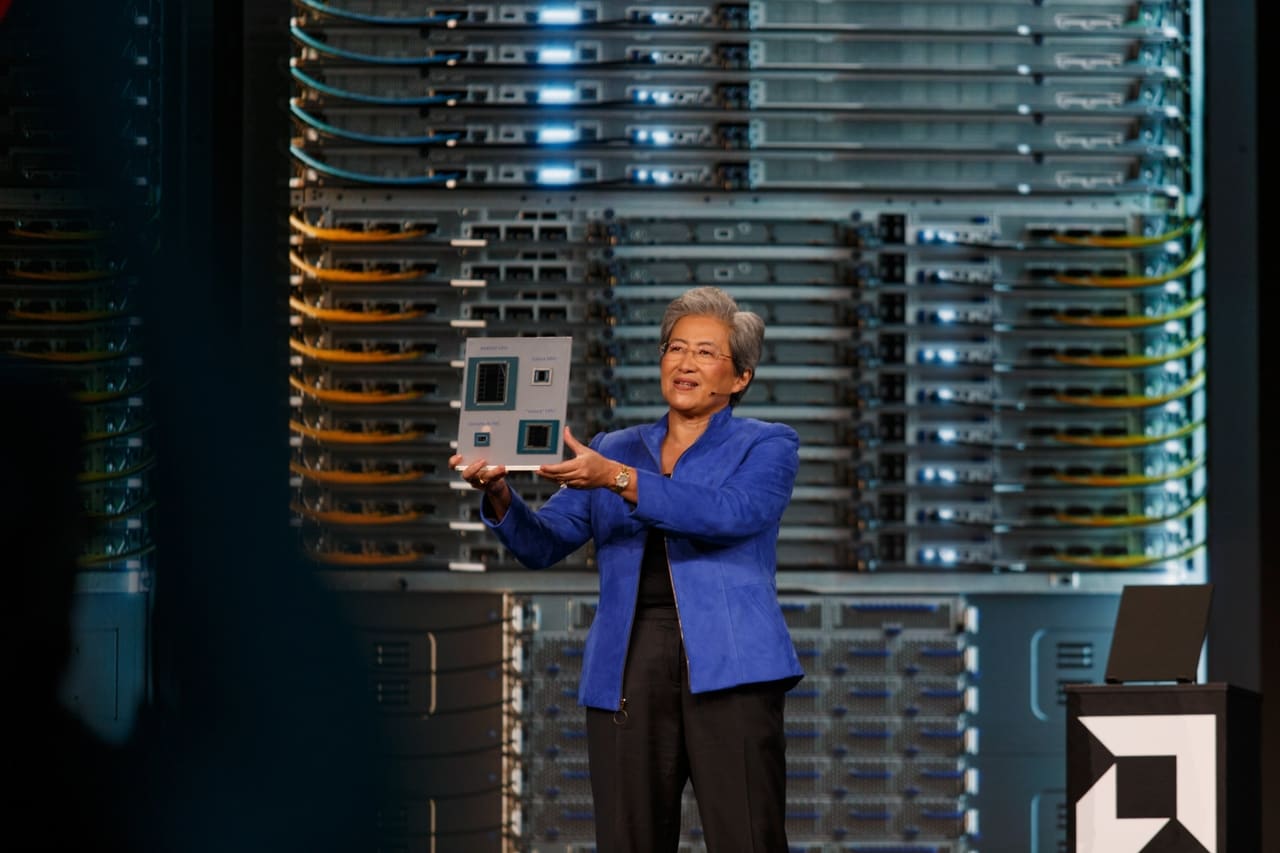
AMD has started manufacturing Helios, the company's integrated AI server rack designed to compete directly with Nvidia's data center offerings. Samsung Electronics is supplying the high-bandwidth memory for the system, marking a significant design win in the rapidly expanding AI infrastructure market.
CEO Lisa Su disclosed the production milestone during AMD's Advancing AI conference in Seoul on Thursday. The timing and venue underscore the strategic importance of Asian supply chains in the AI hardware race, particularly as memory technology becomes a key differentiator in accelerator performance.
Architecture and Market Positioning
Helios represents a shift in AMD's go-to-market strategy. Rather than selling discrete chips to system integrators, the company is offering complete cabinet units. Each Helios system houses 72 Instinct MI455X accelerators, packaged as a turnkey solution for hyperscalers and enterprise data centers.
According to Su, initial shipments will commence in the final weeks of the third quarter, with volume expanding through the fourth quarter of 2026. The production ramp aligns with broader industry moves toward rack-scale computing, where cooling, power distribution, and interconnect fabric are engineered as a single product rather than assembled post-sale.
Samsung's HBM4 supply agreement positions the Korean manufacturer alongside SK Hynix and Micron in the memory tier supporting next-generation AI accelerators. HBM4, the fourth iteration of high-bandwidth memory, delivers substantially higher data transfer rates than HBM3E, the current standard in most production AI chips. Bandwidth constraints have emerged as a primary bottleneck in large language model training and inference, making memory selection a critical competitive variable.
Seoul as Strategic Stage
AMD's decision to announce Helios production in Seoul is not incidental. South Korea hosts two of the three companies capable of mass-producing advanced HBM: Samsung and SK Hynix. The conference venue signals AMD's commitment to deepening partnerships across the Korean semiconductor ecosystem, which controls roughly 70 percent of global DRAM output and has invested heavily in HBM capacity expansion.
The announcement also comes amid intensifying competition for memory supply. Nvidia, which dominates the AI accelerator market with its H100 and H200 GPUs, has faced periodic HBM shortages that delayed shipments in 2024 and 2025. By securing Samsung as a supplier, AMD diversifies its memory sources and reduces exposure to allocation bottlenecks that have plagued rivals.
Competitive Landscape
Helios enters a market where Nvidia's DGX systems and GB200 NVL racks have set the incumbent standard. AMD's Instinct line has historically trailed in market share but gained traction among customers seeking alternatives to Nvidia's CUDA software ecosystem. The MI455X accelerator, built on AMD's next-generation CDNA architecture, is expected to offer competitive performance on open-standard frameworks like ROCm and PyTorch.
Rack-scale systems also simplify procurement for cloud providers and large enterprises, which increasingly prefer validated, pre-integrated infrastructure over component-level purchases. By selling Helios as a complete unit, AMD can control thermal design, network topology, and power efficiency, variables that directly impact total cost of ownership in data center deployments.
The production announcement arrives as AI infrastructure spending remains elevated. Hyperscalers including Microsoft, Google, and Amazon continue to expand capacity for generative AI workloads, while Asian cloud providers such as Alibaba Cloud and Tencent Cloud ramp their own GPU clusters. Samsung's involvement as the memory supplier adds a regional dimension to AMD's supply chain, potentially easing logistics for customers operating data centers across Asia-Pacific.
Looking Ahead
Shipment timelines will be closely watched. Late Q3 marks a narrow window, and any slippage into Q4 could affect AMD's revenue recognition for the fiscal year. Volume ramp in Q4 will depend on both manufacturing yield and customer readiness, as data center operators must prepare power, cooling, and network infrastructure to accommodate high-density AI racks.
Samsung's HBM4 production maturity will also be scrutinized. The memory technology is still ramping, and any yield or quality issues could constrain Helios availability. AMD's ability to scale shipments will hinge not only on its own chip output but on Samsung's capacity to deliver HBM4 in volume.
For now, Helios represents AMD's most ambitious effort yet to claim a larger share of the AI accelerator market. With Samsung's memory inside and a rack-scale approach that mirrors Nvidia's playbook, the system's commercial success will test whether AMD can convert technical competitiveness into sustained data center wins.
RELATED STORIES
Samsung Workers Plan Protest Over Pay Gap Between Chip and Device Units
Jun-ho Seo · 3 min
Memory Makers Gain Leverage as AI Server Costs Climb
Cheng Wei-Lun · 3 min
Samsung's Device Division Reports First Quarterly Loss as Chip Costs Surge
Cheng Wei-Lun · 3 min
South Korean Chip Materials Suppliers Ride AI Boom to Profit Surge
Cheng Wei-Lun · 3 min
Spot something wrong? Email editor@briefasia.com. We log every correction publicly.