Asia · Politics
Poland Joins ASEAN Treaty as Europe Deepens Indo-Pacific Security Ties
Warsaw's accession to the Treaty of Amity and Cooperation alongside three EU partners signals a strategic shift in how European states view regional stability beyond their borders.
KEY TAKEAWAYS
- ·Poland joined ASEAN's Treaty of Amity and Cooperation on July 24 alongside Sweden, Romania, and Lithuania, expanding European diplomatic engagement in Southeast Asia.
- ·Trade between Poland and ASEAN exceeded $13 billion annually by 2025, with 30,000 ASEAN nationals employed in Poland and over 1,000 students enrolled in Polish universities.
- ·The accession reflects Poland's view that security is global, shaped by lessons from Russia's war in Ukraine and the need for rules-based frameworks beyond Europe's borders.
Four European States Sign On
Poland formally acceded to the Treaty of Amity and Cooperation on July 24 at the 59th ASEAN Foreign Ministers' Meeting in Manila. The move came alongside three other European Union members: Sweden, Romania, and Lithuania. The coordinated accession represents a deliberate expansion of European diplomatic infrastructure in Southeast Asia, where ASEAN's framework has become a prerequisite for sustained regional engagement.
The TAC, first signed in 1976, establishes mutual respect for sovereignty, non-interference in internal affairs, and peaceful settlement of disputes as core principles. Over 40 states and organizations have now joined, treating it as the diplomatic gateway to structured dialogue with the ten-member bloc.
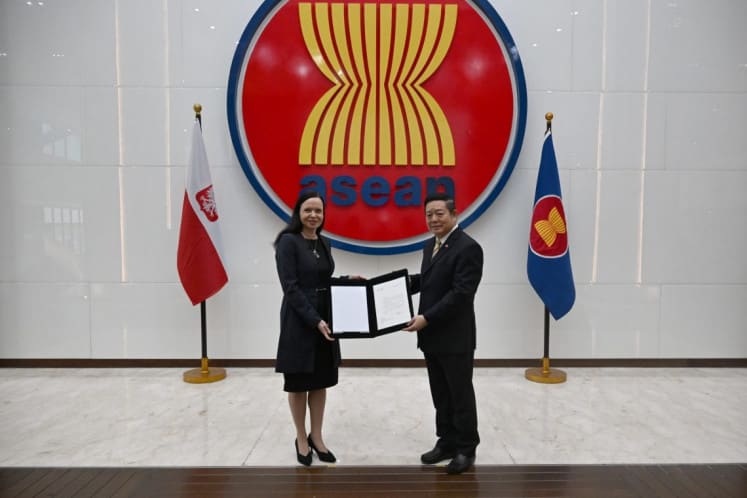
Poland's ambassador to ASEAN presented credentials at the ASEAN Secretariat in Jakarta in April, ahead of the formal treaty signing. The diplomatic sequence underscores Warsaw's intention to treat Southeast Asia as a priority theater, not an afterthought.
Poland's Growing Footprint
Poland maintains 14 embassies, six consulates general, and 12 trade and investment offices across the Indo-Pacific, one of the most extensive networks among Central European states. Trade between Poland and ASEAN surpassed $13 billion annually by 2025. Around 30,000 ASEAN nationals, primarily from Vietnam, the Philippines, and Indonesia, were legally employed in Poland. More than 1,000 ASEAN students enroll in Polish universities each year.
The economic relationship has deepened as Poland has transformed from a post-communist economy into the world's 20th largest. Warsaw sees ASEAN not only as a growth market but as a partner in digital transformation, energy transition, and connectivity projects. Polish firms have begun exploring opportunities in infrastructure, logistics, and technology services across the region.
Security Calculus Drives Engagement
Poland's accession carries a security dimension that reflects lessons from Russia's war in Ukraine. Warsaw is among NATO's highest defense spenders as a share of GDP and plays a central role in reinforcing the Alliance's eastern flank. The country has provided substantial military and humanitarian support to Ukraine since the 2022 invasion.
That experience has shaped Poland's view of security as a global, not merely regional, concern. The principle that resilience is built through international cooperation, Warsaw argues, applies equally to Europe's eastern border and the South China Sea. ASEAN's role in maintaining stability in Southeast Asia aligns with Poland's broader belief in rules-based frameworks and collective security arrangements.
The timing of the accession is significant. European states have accelerated Indo-Pacific engagement over the past three years, driven by supply-chain disruptions, Chinese assertiveness, and a recognition that economic and security interests extend far beyond the Atlantic. France, Germany, and the Netherlands have published Indo-Pacific strategies; the European Union released its own framework in 2021. Poland's TAC accession formalizes its participation in that broader European shift.
ASEAN Centrality Reinforced
For ASEAN, the quartet of new European signatories reinforces the bloc's centrality in regional diplomacy. The TAC has become a litmus test for serious engagement, a signal that external powers accept ASEAN's norms and its convening authority. The more states that join, the stronger ASEAN's claim to set the terms of regional dialogue.
The accession also comes as ASEAN faces pressure to demonstrate relevance amid great-power competition and internal divisions. Myanmar's crisis, tensions in the South China Sea, and divergent economic trajectories among member states have tested the bloc's cohesion. The addition of four European democracies, each with experience in multilateral institutions, offers ASEAN a measure of validation and a counterweight to narratives of declining influence.
Poland's emphasis on international law and dialogue echoes ASEAN's own rhetoric, even as both face criticism for gaps between principle and practice. The alignment on principles, however, provides a foundation for cooperation on issues from cybersecurity to climate adaptation.
What Comes Next
Poland's TAC membership opens the door to deeper institutional engagement. Warsaw can now participate in ASEAN-led forums, including the East Asia Summit and ASEAN Regional Forum, where security and economic issues are debated alongside major powers. The question is whether Poland will leverage that access to shape outcomes or treat it as symbolic affirmation.
The economic relationship offers the clearest near-term opportunity. Polish expertise in digital public services, renewable energy, and logistics could find application in ASEAN markets hungry for European technology and capital. Warsaw's trade and investment offices across the region are positioned to facilitate deals, but success will depend on competitive pricing and adaptation to local conditions.
Security cooperation remains more abstract. Poland's defense industry has grown in prominence, and its experience in NATO interoperability could inform ASEAN defense dialogues. Yet Southeast Asian states remain cautious about entangling themselves in European security disputes, and Poland will need to calibrate its messaging to avoid being seen as pushing a transatlantic agenda.
The broader test is whether Poland's accession marks the start of sustained engagement or a high-water mark. European attention to the Indo-Pacific has been episodic, often driven by crisis rather than strategy. If Poland treats the TAC as a platform for long-term partnership, it will stand out. If it becomes another signatory without follow-through, the treaty will add little beyond paperwork.
RELATED STORIES

Five ASEAN Members Back Regional Oil Stockpile as Study Nears Completion
Tran Quoc Bao · 3 min
Southeast Asian Firms Overlook Digital Pact Worth USD 2 Trillion
Lim Hui Ying · 4 min

Vietnam Bets $76 Billion Funding Gap Can Lure Capital Without Copying Rivals
Priyanka V. Rao · 4 min
Vietnam Draws $7.5 Billion From Singapore in Seven Months
Priyanka V. Rao · 3 min
Spot something wrong? Email editor@briefasia.com. We log every correction publicly.