Asia · Trending
Philippines Cuts Poverty Rate to Single Digits for First Time
Sustained growth and easing inflation helped 6.5 million Filipinos escape poverty between 2023 and 2025, though new headwinds threaten the pace of progress.

KEY TAKEAWAYS
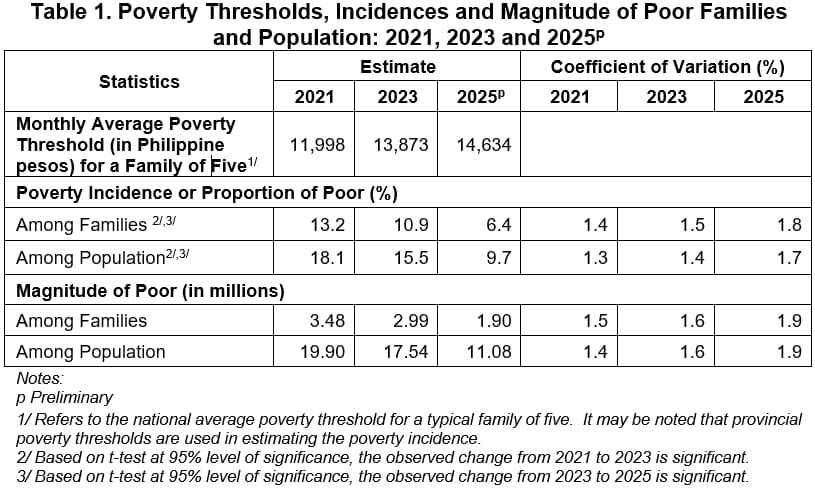
- ·The Philippines recorded 9.7 percent poverty incidence in 2025, down from 15.5 percent in 2023, moving 6.5 million people above the poverty threshold.
- ·Nominal incomes rose 22 percent across all income brackets between 2023 and 2025, outpacing five percent cumulative inflation during the same period.
- ·Rising inflation averaging five percent and GDP growth of just 2.3 percent in Q2 2026 threaten to slow further poverty reduction.
Historic Milestone Three Years Early
The Philippines crossed into single-digit poverty territory for the first time in 2025, with just 9.7 percent of the population living below the poverty threshold. The figure represents a sharp drop from 15.5 percent in 2023 and 18.1 percent in 2021, according to data released by the Philippine Statistics Authority.
In absolute terms, the number of Filipinos classified as poor fell to 11.08 million last year from 17.54 million in 2023. The decline means the country hit its single-digit poverty target under the Philippine Development Plan three years ahead of the 2028 deadline.
Arsenio Balisacan, Secretary of the Department of Economy, Planning and Development, noted the achievement marks the first time fewer than one in ten Filipinos live below the poverty line. He attributed the progress to expanding economic opportunities paired with effective social protection mechanisms.
Growth, Jobs, and Stable Prices
The poverty reduction coincided with a period of steady economic expansion and improving labor conditions. GDP growth averaged 5.1 percent across 2024 and 2025, while inflation held at an average of 2.5 percent over the same span. Unemployment averaged four percent during the period.
Nominal incomes rose approximately 22 percent across all income brackets between 2023 and 2025, far outpacing cumulative inflation of five percent. The income gains were distributed across the full income spectrum, suggesting broad-based improvement rather than concentration at the top.
The combination of wage growth, price stability, and job creation created conditions that allowed millions of households to move past the poverty threshold within a two-year window.
Clouds on the Horizon
Despite the milestone, officials cautioned that maintaining the pace of poverty reduction faces fresh challenges. Inflation climbed back above the government's two to four percent target band, reaching 6.2 percent in July and averaging five percent for the first seven months of the year.
Economic growth has also weakened sharply. Second-quarter GDP expanded just 2.3 percent year-on-year, the slowest rate in five years. The slowdown, attributed to Middle East conflict impacts and domestic policy controversies affecting consumption and investment, pulled first-half growth to 2.6 percent. That figure sits well below the government's revised 3.5 to 4.5 percent target for the full year.
Balisacan acknowledged that current developments may slow poverty reduction but said early indicators do not suggest a reversal of the gains already secured. He previously warned that elevated inflation alone could stall or even undo recent progress.
Protecting the Gains
With the administration entering its final years, policymakers are shifting focus from lifting people out of poverty to ensuring they do not fall back in. Balisacan outlined a set of priorities: restoring economic growth momentum, boosting investment and productivity, creating jobs, upskilling workers for emerging sectors, and providing timely support to businesses and workers hit by economic or climate shocks.
The strategy reflects concern that fragile households just above the poverty line remain vulnerable to external shocks. A sustained period of high inflation or weak employment growth could push recent graduates of poverty back below the threshold.
The Philippines now joins a small group of Southeast Asian economies that have achieved single-digit poverty rates. Sustaining that status will depend on whether the country can navigate the twin pressures of rising prices and slowing growth without sacrificing the income gains that drove the recent decline.
RELATED STORIES

Manila Taps Tokyo Expertise to Modernize Provincial Water Infrastructure
Priyanka V. Rao · 5 min
Philippines Cuts Poverty to 9.7% as 6.5 Million Rise Above Line
Priyanka V. Rao · 3 min

Philippines Turns to Private Sector for Major Infrastructure After Government Building Failures
Mariel D. Santos · 3 min
Philippines Regulator Tightens Oversight of Power Spot Market
Priyanka V. Rao · 3 min
Spot something wrong? Email editor@briefasia.com. We log every correction publicly.