Technology · AI
Philippine Enterprises Lag in AI Infrastructure Despite Worker Adoption
Only 22% of companies are AI-ready as hardware, security, and workflow gaps slow enterprise-scale deployment across the country
KEY TAKEAWAYS
- ·Only 22% of Philippine enterprises have the infrastructure needed for AI deployment, despite widespread individual worker adoption of AI tools.
- ·ASUS Co-CEO Samson Hu identifies three pillars for enterprise AI success: appropriate software, redesigned workflows, and hardware capable of handling AI workloads.
- ·Just 45% of Philippine enterprises have implemented essential security safeguards for AI systems, according to Cisco data.
The Individual-Enterprise Divide
Filipino professionals have moved quickly to integrate AI into their daily work. Marketing teams draft campaigns with large language models, executives transcribe meetings with automated tools, and office workers increasingly rely on generative AI for routine tasks. Yet this individual enthusiasm has not translated into organizational readiness.
According to Cisco data, only 22% of Philippine enterprises currently possess the infrastructure needed to deploy AI at scale. The gap highlights a fundamental disconnect: while employees experiment with AI on personal devices, most companies lack the governance frameworks, hardware capacity, and security protocols required to move beyond isolated trials.
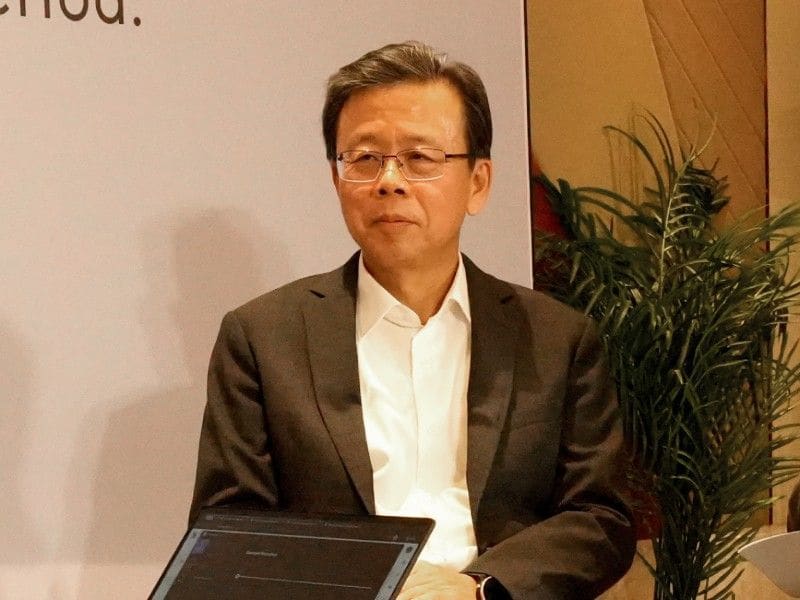
ASUS Co-CEO Samson Hu addressed this mismatch during the launch of the ASUS ExpertBook Ultra in Manila. He framed the problem as organizational rather than technological. Individual workers can adopt an AI tool in minutes, but enterprises face layered challenges around data governance, architectural integration, and systemic risk management.
"The challenge is not lack of workforce talent or interest," Hu said. "The challenge is quite about the organizational readiness, how to move AI from the experimentation stage to really enterprise-wide discussion."
Three Pillars of Enterprise AI
Hu outlined three requirements for successful enterprise AI adoption: appropriate software, redesigned workflows, and hardware built to handle AI workloads.
The first element involves the AI applications themselves, including large language models, productivity platforms, and decision-support tools that automate tasks and accelerate analysis. But software licenses alone do not guarantee results.
The second pillar centers on workflow integration. Rather than treating AI as a standalone productivity add-on, companies need to embed it into daily operations. ASUS has built features into its MyExpert Suite that illustrate this approach: AI ExpertMeet transcribes and summarizes meetings automatically, Knowledge Hub enables semantic search across enterprise files, and AI ExpertPanel provides on-device AI capabilities designed to function as part of normal work routines.
The third requirement, and the one Hu believes is most overlooked, is hardware. AI workloads demand substantially more computing power than traditional office applications, performing billions of simultaneous calculations. Many enterprise AI discussions focus exclusively on cloud platforms and software subscriptions, ignoring the physical devices that employees use to access those services.
Hardware Bottlenecks and Security Gaps
The infrastructure shortfall is particularly acute in the Philippines. Cisco found that just 22% of local organizations have the graphics processing unit capacity needed for current and future AI workloads. Meanwhile, only 45% of enterprises have implemented essential safeguards, including end-to-end encryption, security audits, continuous monitoring, and rapid threat response, to protect data used in AI systems.
This hardware gap creates a bottleneck. Companies that invest in advanced AI software while equipping employees with outdated devices cannot fully realize performance gains, responsiveness improvements, or security benefits.
ASUS positions the ExpertBook Ultra as a response to this challenge. The device features a dedicated Neural Processing Unit with up to 50 TOPS, designed to support what Hu calls Hybrid AI, an approach that distributes workloads between cloud services and local processing.
Running AI tasks on the device itself offers two advantages: faster response times and improved data security. For enterprises handling confidential financial records, customer information, or proprietary documents, local processing means sensitive data can remain on the device rather than being transmitted to public cloud AI services, reducing exposure to potential breaches.
Hu emphasized that durability remains critical for enterprise computing. Despite its slim profile, the ExpertBook Ultra is engineered to withstand daily business use, helping organizations maintain productivity through reliable, long-lasting hardware.
The Philippines in ASUS' AI Strategy
Hu's visit to Manila, his first official trip to the country in more than a decade, signals ASUS' deeper enterprise AI focus in the Philippines. The company views the market as significant due to accelerating digital transformation, a growing pool of digitally skilled professionals, and increasing AI appetite among businesses.
ASUS frames its approach around a strategy it calls "Ubiquitous AI. Incredible Possibilities," centered on anticipating future AI developments and ensuring devices can support emerging technologies. Hu acknowledged that AI will continue evolving beyond today's generative models.
"AI will keep evolving," he said. "Today we have generative AI, we have agentic AI. In the future, it will evolve into something we don't know yet."
Rather than chasing individual AI trends, ASUS is building a technology foundation designed to adapt as the landscape shifts. Whether the next phase involves autonomous AI agents, more powerful on-device computing, or unforeseen innovations, Hu believes the company's role remains consistent: adopting new technologies quickly while ensuring they address real business problems.
For Philippine businesses, the core challenge has shifted. Employee adoption is no longer the hurdle. The question now is whether organizations can build the infrastructure, workflows, and hardware capacity to support AI at enterprise scale.
RELATED STORIES

Manila's Chip Industry Still Stalled in Assembly While Taipei Built Fabs
Priyanka V. Rao · 4 min

Manila Startup Kita Closes $4.5M to Automate Loan Document Processing Across Asia
Priyanka V. Rao · 3 min

Philippine Economic Zones Pull Record ₱216 Billion in Eight Months
Priyanka V. Rao · 3 min

PhilWeb Trading Halted After P4.2 Billion JKS Tech Bet
Tran Quoc Bao · 3 min
Spot something wrong? Email editor@briefasia.com. We log every correction publicly.