Technology · Dev
Nvidia Targets Network Control in Race to Build 100,000-GPU Clusters
Spectrum-6 Ethernet switch positions chip giant at the heart of gigascale AI infrastructure as data center operators push beyond traditional compute bottlenecks
KEY TAKEAWAYS
- ·Nvidia introduced the Spectrum-6 Ethernet switch on July 21 to support gigascale AI data centers with over 100,000 accelerators, part of its Vera Rubin platform launching in late 2027.
- ·The move extends Nvidia's dominance from compute to networking, creating potential vendor lock-in for Asian operators in Japan, South Korea, and Singapore planning national AI infrastructure.
- ·A fully configured gigascale cluster is estimated to cost over USD 10 billion, with network performance now the primary bottleneck at that scale rather than GPU throughput.
The Network Becomes the Moat
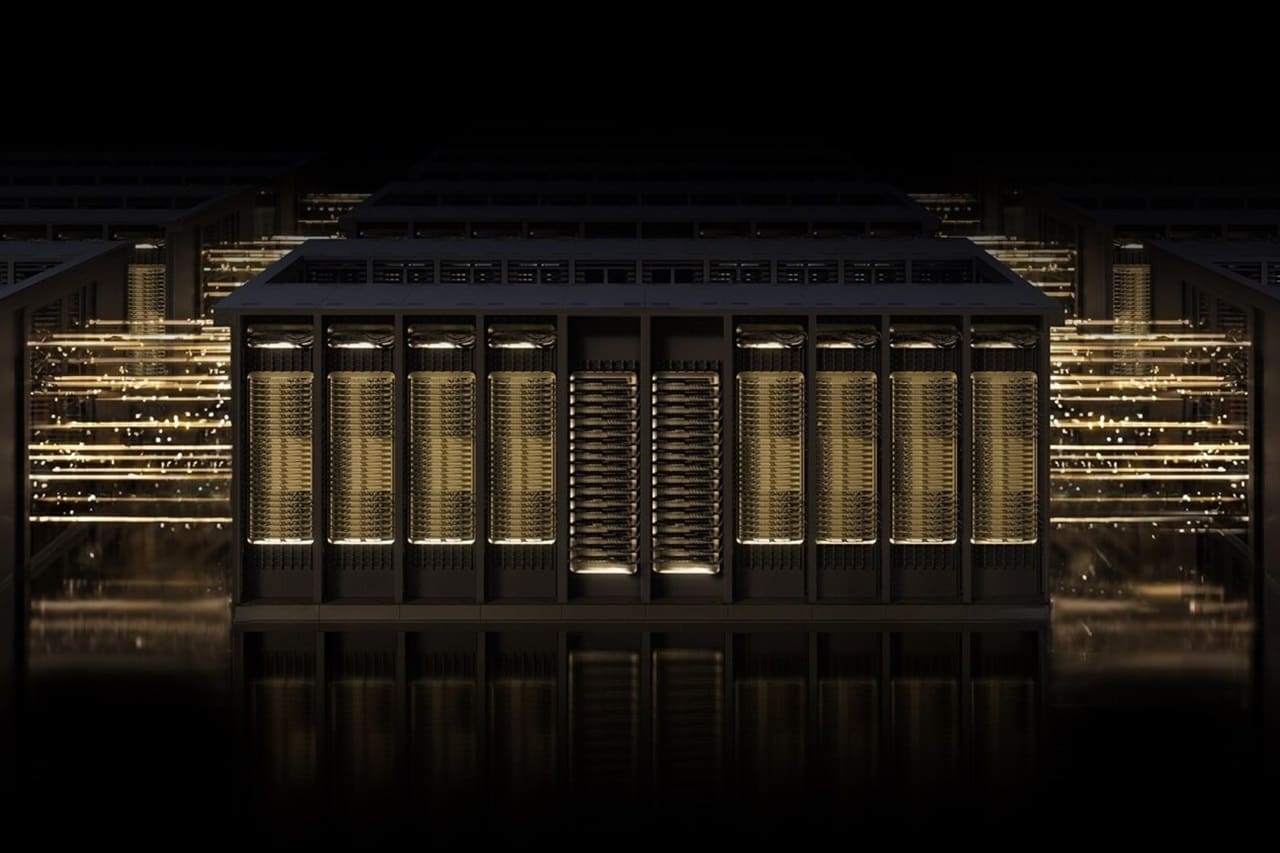
Nvidia introduced its Spectrum-6 Ethernet switch this week, positioning the hardware as the connective tissue for AI data centers that will house more than 100,000 accelerators. The announcement, shared through company channels on July 21, underscores a strategic shift: the chip maker is no longer content to dominate just the compute layer.
The Spectrum-6 will anchor what Nvidia calls "gigascale" AI factories built around its forthcoming Vera Rubin platform. The term refers to clusters large enough to train frontier models without partitioning workloads across multiple sites, a threshold that hyperscalers and sovereign AI initiatives in Asia are racing to cross.
For operators in Tokyo, Seoul, and Singapore planning national-scale AI infrastructure, the move has immediate implications. Nvidia is effectively bundling networking and compute, making it harder for rivals to offer piecemeal alternatives. The company controls roughly 80% of the AI accelerator market; extending that grip to the switch layer could lock in architectural decisions for years.
Asia's Data Center Buildout Collides with Vendor Concentration
The timing matters. Japan's National Institute of Advanced Industrial Science and Technology is procuring hardware for a 50,000-GPU cluster scheduled to come online in early 2027. South Korea's Electronics and Telecommunications Research Institute is planning a similar deployment under the National AI Computing Infrastructure initiative. Both projects were specced before Nvidia's Spectrum-6 launch, raising questions about retrofit costs if operators want to maintain compatibility with future Vera Rubin systems.
Ethernet has historically been the open alternative to Nvidia's proprietary NVLink and InfiniBand fabrics. By pushing a branded Ethernet switch optimized for its own GPUs, Nvidia blurs that distinction. The Spectrum-6 supports standard protocols, but its performance gains are tuned specifically for Nvidia silicon, according to technical documentation released alongside the announcement.
This creates a bind for Asian cloud providers and telcos investing in AI infrastructure. Choosing non-Nvidia switches may mean sacrificing throughput in multi-GPU training runs. Choosing Spectrum-6 deepens dependence on a single vendor at a moment when supply chain diversification is a policy priority from New Delhi to Canberra.
What Gigascale Means in Practice
A gigascale AI factory, in Nvidia's framing, is a facility capable of training models with more than a trillion parameters in a single continuous run. Current frontier models from OpenAI, Anthropic, and DeepSeek already approach or exceed that threshold, but they require workload orchestration across geographically distributed data centers. Gigascale infrastructure would collapse that complexity into one site, reducing latency and simplifying software.
The technical challenge is moving data fast enough to keep 100,000 GPUs fed. At that scale, network congestion becomes the primary bottleneck, not floating-point throughput. Spectrum-6 addresses this with higher port speeds and adaptive routing that Nvidia says can reduce tail latency by up to 40% compared to prior-generation switches.
The Vera Rubin platform, expected to ship in the second half of 2027, will pair these switches with next-generation Blackwell-successor GPUs. Nvidia has not disclosed pricing, but industry estimates suggest a fully configured gigascale cluster could exceed USD 10 billion in capital expenditure, a figure that puts such deployments within reach of perhaps two dozen organizations globally.
The Strategic Calculus for Asia-Pacific Operators
For investors watching Asia's AI infrastructure boom, Nvidia's network play is a reminder that the value chain is consolidating vertically. Companies that once competed on GPU performance are now competing on end-to-end system design, from power delivery to cooling to fabric topology.
This has knock-on effects for regional suppliers. Taiwan's server ODMs, which assemble white-box systems for hyperscalers, may find their design flexibility constrained if Nvidia-certified configurations become the de facto standard. Optical transceiver makers in Hsinchu and Shenzhen face pressure to prioritize Nvidia compatibility over open standards.
At the same time, the gigascale threshold creates opportunities for co-location and wholesale data center operators in markets with cheap power and streamlined permitting. Malaysia and Indonesia have both pitched themselves as destinations for AI infrastructure, offering land, energy, and tax incentives. A single gigascale facility in Johor or Batam could serve demand across Southeast Asia, provided network latency to Singapore and Jakarta remains below 10 milliseconds.
The Open Question: Will Ethernet Stay Open?
The broader industry concern is whether Nvidia's Ethernet push will fragment the standard. The company insists Spectrum-6 adheres to IEEE specifications and will interoperate with third-party hardware. But performance tuning and proprietary extensions, even if technically optional, can create soft lock-in that is difficult to unwind once a cluster is operational.
This matters most for public cloud providers and research institutions that want to avoid single-vendor dependence. If Spectrum-6 becomes the reference design for gigascale deployments, alternatives from Broadcom, Marvell, and Arista will need to match not just throughput but also the tight integration with Nvidia's CUDA software stack and GPU memory hierarchy.
The next twelve months will reveal whether Nvidia's network strategy succeeds in Asia-Pacific. Orders for Spectrum-6 are expected to begin shipping in early 2027, around the same time several national AI initiatives will finalize their hardware procurement. The decisions made in Tokyo, Seoul, Singapore, and Canberra will shape the region's AI infrastructure landscape for the next decade.
RELATED STORIES
Indian AI Firm Commits $8 Billion to Nvidia Infrastructure Buildout
Priyanka V. Rao · 3 min
Nvidia Mobilizes $500 Billion Financing Push for AI Data Centers
Cheng Wei-Lun · 4 min
China Drafts National Liquid-Cooling Standard as AI Racks Near 1MW Power Draw
Cheng Wei-Lun · 2 min

Nvidia Ships Co-Packaged Optics Switches at Scale as AI Data Centers Rethink Connectivity
Cheng Wei-Lun · 4 min
Spot something wrong? Email editor@briefasia.com. We log every correction publicly.