Technology · Products
Nvidia Shifts AI Infrastructure Pitch From Speed to Power Efficiency
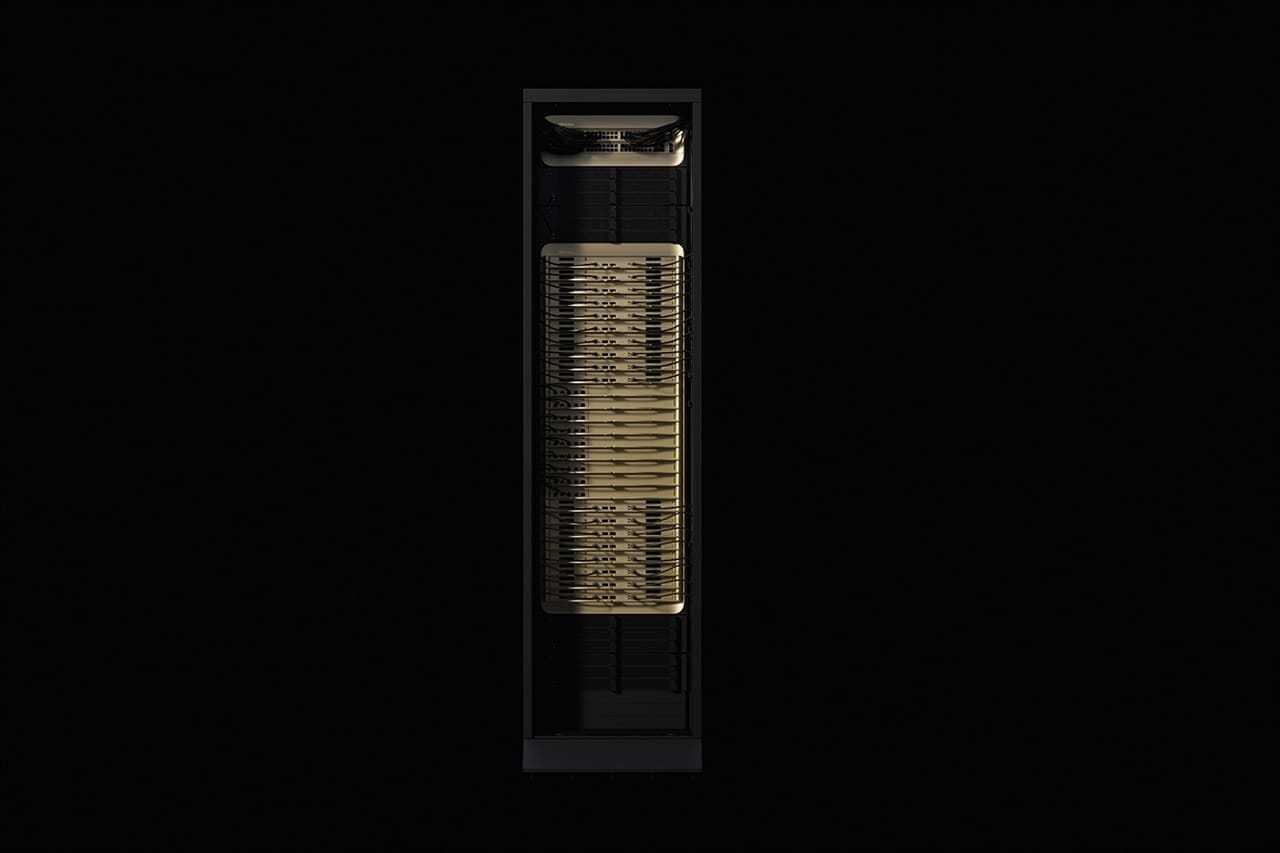
The Vera Rubin NVL72 rack system targets electricity constraints as the primary bottleneck in data center expansion, delivering 10x more tokens per megawatt than current generation hardware.
KEY TAKEAWAYS
- ·Nvidia announced the Vera Rubin NVL72 rack system, delivering ten times more tokens per megawatt than its Grace Blackwell predecessor and one-tenth the cost per million tokens.
- ·The platform includes a custom Vera CPU and positions power consumption as the primary constraint in AI data center expansion, rather than chip performance alone.
- ·Availability timelines remain undisclosed, but early deployments will likely target hyperscalers and AI-native operators facing acute electricity limits in their facilities.
Power Becomes the Primary Metric
Nvidia introduced its Vera Rubin NVL72 rack-scale system on July 21 with a notable departure from the industry's traditional focus on computational speed. The company framed the new platform primarily around energy efficiency and cost per output, signaling that electricity availability has become the binding constraint for AI infrastructure growth.
According to Nvidia, the Vera Rubin NVL72 delivers approximately ten times more tokens per megawatt compared to the Grace Blackwell NVL72, its current-generation predecessor. The system also achieves roughly one-tenth the cost per million tokens relative to the GB200 NVL72. These metrics position power consumption, rather than chip performance alone, as the critical variable in data center planning.
The announcement reflects a broader shift in how hyperscale operators and cloud providers evaluate AI hardware. As demand for training and inference capacity has grown, many facilities now face power constraints before exhausting physical space or capital budgets. Nvidia's messaging acknowledges this reality directly, emphasizing throughput per watt alongside traditional performance benchmarks.
Rack-Scale Architecture and Custom Silicon
The Vera Rubin NVL72 is designed as a complete rack system, integrating compute, networking, and cooling in a unified package. This approach allows Nvidia to optimize power delivery and thermal management across the entire stack, rather than leaving integration to data center operators.
The platform incorporates a custom Vera CPU, marking Nvidia's continued expansion beyond GPU design. While the company did not disclose detailed specifications for the processor, the inclusion of purpose-built CPU silicon suggests tighter control over system-level efficiency and workload orchestration. This follows the pattern established with the Grace CPU, which debuted in earlier Nvidia systems to handle tasks outside the GPU's domain.
By bundling components at the rack level, Nvidia can also streamline deployment for customers operating at scale. Hyperscalers building out AI clusters can treat each NVL72 rack as a modular unit, reducing integration complexity and accelerating time to production.
Implications for Data Center Buildout
The emphasis on power efficiency arrives as data center operators confront hard limits on electrical infrastructure. New AI facilities require grid connections measured in hundreds of megawatts, and securing that capacity often involves multi-year lead times for utility upgrades. In regions with constrained power supply, efficiency gains translate directly into additional deployable capacity without new construction.
Nvidia's cost-per-token metric also speaks to the economics of inference workloads, which are projected to dominate AI compute demand as models move from research into production applications. Lower operational costs per query make it feasible to run large language models and other generative AI systems at consumer scale, where margins are tighter than in enterprise or research settings.
The competitive landscape will likely follow Nvidia's lead in prioritizing energy metrics. Rival chip designers, including AMD and custom silicon teams at hyperscalers, are already positioning their offerings around similar efficiency claims. As power availability becomes the gating factor for AI infrastructure expansion, hardware differentiation will increasingly hinge on watts consumed per unit of useful output.
What Comes Next
Nvidia has not disclosed a commercial availability timeline for the Vera Rubin NVL72, but the detailed announcement suggests the platform is nearing production readiness. Early deployments will likely concentrate among large cloud providers and AI-native companies operating their own data centers, where power constraints are most acute.
The broader market will watch whether Nvidia's efficiency claims hold up under real-world workloads, particularly for inference tasks that differ significantly from the training benchmarks traditionally used to evaluate AI hardware. If the cost and power figures prove accurate at scale, the Vera Rubin platform could accelerate the shift toward inference-heavy infrastructure and reshape capital allocation across the data center industry.
For now, the announcement underscores a fundamental transition in AI hardware priorities. Performance alone no longer defines competitive advantage when the grid cannot supply enough electricity to run the chips. Nvidia's bet is that efficiency, measured in tokens per watt, will determine who leads the next phase of AI infrastructure buildout.
RELATED STORIES
China Drafts National Liquid-Cooling Standard as AI Racks Near 1MW Power Draw
Cheng Wei-Lun · 2 min
Indian AI Firm Commits $8 Billion to Nvidia Infrastructure Buildout
Priyanka V. Rao · 3 min
Nvidia Mobilizes $500 Billion Financing Push for AI Data Centers
Cheng Wei-Lun · 4 min

Nvidia Ships Co-Packaged Optics Switches at Scale as AI Data Centers Rethink Connectivity
Cheng Wei-Lun · 4 min
Spot something wrong? Email editor@briefasia.com. We log every correction publicly.