Travel & Dining · Trends
Mixue Shutters 89 Stores Across Southeast Asia Amid Profit Decline
The world's largest F&B chain closed outlets in Vietnam and Indonesia during the first half of 2026, even as it reported revenue growth and plans further regional expansion.
KEY TAKEAWAYS
- ·Mixue closed 89 international stores in the first half of 2026, concentrated in Vietnam and Indonesia, reducing its overseas footprint while maintaining 63,987 global outlets.
- ·Net profit dropped 15 percent to 2.32 billion yuan despite a 2.3 percent revenue increase to 15.2 billion yuan, driven by higher costs of sales and distribution expenses.
- ·The company is shifting from small outlets to larger format stores at prime locations and plans to expand into Central Asia and the Americas while deepening Southeast Asian operations.
Store Network Contraction
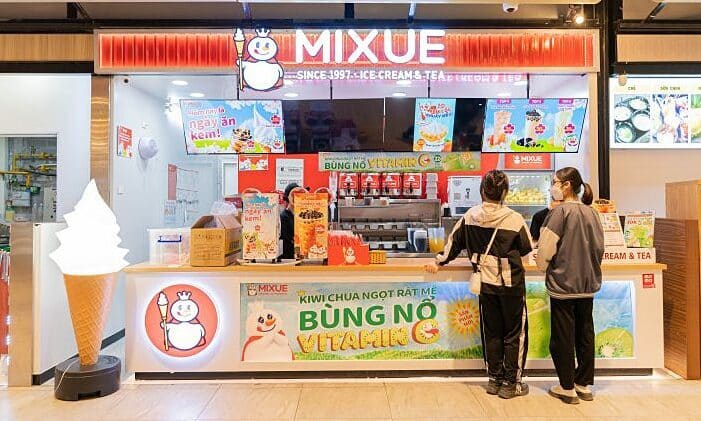
Mixue Group reported a net reduction of 89 overseas stores during the first six months of 2026, with Vietnam and Indonesia bearing the brunt of closures. The company operated 63,987 outlets globally as of June 30, including 59,609 in mainland China, according to the company's latest financial report.
The closures mark a strategic shift for the Zhengzhou-based chain, which bills itself as the world's largest food and beverage operator by store count. Mixue attributed the reductions to efforts to improve "store operational quality" in support of what it termed "more sustainable, long-term growth." The company did not break down closure figures by individual market.
Vietnam and Indonesia represent Mixue's two largest footholds outside mainland China. The chain operated 1,304 stores in Vietnam as of September 2024, according to its Hong Kong IPO prospectus filed in early 2025. Mixue entered the Vietnamese market in 2018, initially concentrating on Hanoi and northern provinces before expanding nationwide with products including lemonade, ice cream, milk tea, and fruit tea.
Financial Performance
Revenue climbed 2.3 percent year-on-year to 15.2 billion yuan ($2.26 billion) in the first half of 2026, but net profit fell 15 percent to 2.32 billion yuan. Mixue cited rising costs of sales and higher selling and distribution expenses as the primary drivers of margin compression.
The profit decline comes as the company transitions away from its traditional small-footprint model. Mixue has been closing compact outlets in favor of modern, larger-format stores positioned at prime locations, a move that typically requires higher upfront capital and carries elevated operating costs during the transition period.
Strategic Pivot
The store consolidation reflects broader challenges facing low-cost beverage chains in Southeast Asia, where saturated urban markets and rising real estate costs are forcing operators to reassess their expansion playbooks. Mixue built its regional presence on aggressive franchising and a rock-bottom pricing strategy, with signature products often priced below local competitors.
The shift to fewer, larger stores suggests the company is prioritizing profitability per location over sheer store count, a metric that has historically defined its market positioning. Larger formats allow for expanded menus, seating areas, and improved brand presentation, but require higher traffic volumes to justify the economics.
Regional Expansion Plans
Despite the first-half contraction, Mixue reaffirmed its commitment to Southeast Asian markets and outlined plans to enter Central Asia and the Americas. The company emphasized its intention to "deepen localized operations" in existing overseas markets, signaling a more measured approach than the rapid-fire franchising that characterized its initial international push.
Indonesia remains a focal point. The archipelago nation's young population and growing middle class have made it a priority market for beverage chains, though intense competition from both international and domestic players has pressured margins across the sector.
Mixue's Vietnam footprint has grown significantly since its 2018 debut, benefiting from the country's coffee and tea culture. However, local competitors and established regional chains have defended market share, particularly in Ho Chi Minh City and other southern commercial hubs.
Franchise Model Under Pressure
The closure pattern raises questions about the sustainability of Mixue's franchise-heavy model in markets where local operating conditions differ sharply from mainland China. Franchise partners in Southeast Asia face challenges including inconsistent supply chains, fluctuating currency exchange rates, and labor markets with different cost structures.
Mixue's IPO prospectus highlighted overseas expansion as a key growth driver, but the first-half results suggest the company is recalibrating expectations. The emphasis on "operational quality" over store count indicates a recognition that profitability in Southeast Asia requires more than replicating the low-cost, high-volume formula that worked in Chinese tier-two and tier-three cities.
The company has not disclosed whether additional closures are planned for the second half of 2026, but the strategic language in its financial report suggests the consolidation phase may continue as it identifies and exits underperforming locations.
RELATED STORIES
Southeast Asian Factories Adopt Proximity Planning to Retain Workers and Investors
Lim Hui Ying · 3 min

Singapore Captures Two-Thirds of Southeast Asian EV Startup Capital
Priyanka V. Rao · 3 min

Phu Quoc Prepares $5 Billion Infrastructure Push for 2027 APEC Summit
Tran Quoc Bao · 3 min

Chinese Brands Capture Vietnam's $92 Million Robot Vacuum Market
Siti Nuraini · 3 min
Spot something wrong? Email editor@briefasia.com. We log every correction publicly.