Technology · AI
MediaTek Raises AI Chip Target to 20% Market Share by 2027
Taiwan's chip designer doubles its custom AI accelerator ambitions and commits $5 billion to expand data center operations as cloud providers seek alternatives to Nvidia
KEY TAKEAWAYS
- ·MediaTek raised its 2027 custom AI accelerator market share target to 20 percent from 10 to 15 percent three months ago, with over $2 billion in data center chip revenue expected this year.
- ·The company's first AI ASIC for a US cloud provider enters volume production in Q4 2024, with a second-generation chip planned for 2028 volume production.
- ·MediaTek's board approved $5 billion to secure supply chain capacity and expand from AI ASICs to full-scale systems and platforms.
Doubling Down on Data Centers
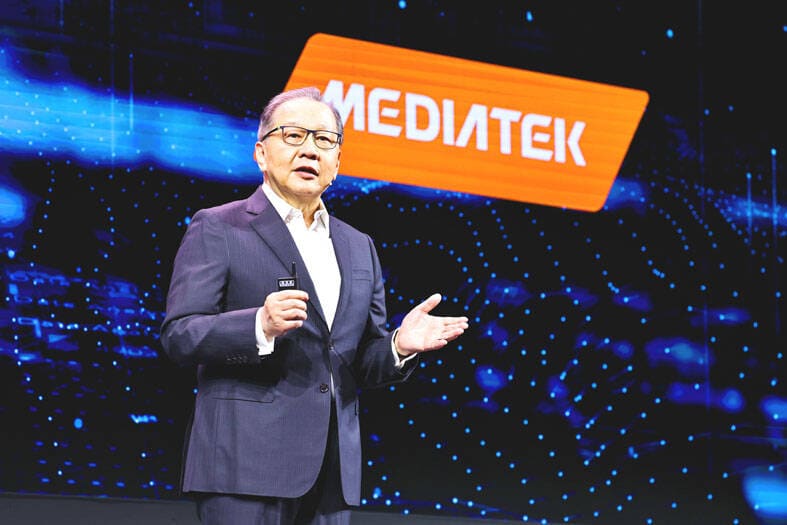
MediaTek has raised its target for the custom artificial intelligence accelerator market to 20 percent by 2027, doubling a forecast made just three months ago. The world's largest smartphone chip supplier expects to generate more than $2 billion from data center chips this year, with substantial growth anticipated in 2027.
CEO Rick Tsai told investors the revised target reflects accelerating demand from cloud operators seeking optimized performance and total cost of ownership through custom silicon. The serviceable available market for customized AI accelerators stands at $80 billion, and MediaTek previously aimed for 10 to 15 percent of that segment.
The company's first AI application-specific integrated circuit, designed for a US cloud service provider, enters volume production in the fourth quarter of this year. Industry reports indicate MediaTek is developing a tensor processing unit for Google, though the company has not confirmed the customer's identity.
Second Generation and Packaging Push
MediaTek expects both the available market and its share to expand further in 2028 when its second-generation custom AI accelerator reaches volume production. The company is deepening relationships with multiple customers to increase scale in the global AI ASIC market, according to Tsai.
On the manufacturing front, MediaTek is helping customers develop high-performance ASICs across a range of chip sizes using chip-on-wafer-on-substrate technology and EMIB-T. The former, developed by Taiwan Semiconductor Manufacturing Co, is widely deployed in AI chip production. EMIB-T, an Intel technology, is expected to reach volume production in 2028.
MediaTek's board approved a $5 billion budget to secure supply chain capacity and drive expansion from AI ASICs to full-scale systems and platforms. The investment signals the company's intention to move beyond component supply into more integrated offerings.
Smartphone Business Faces Headwinds
The chipmaker forecast third-quarter revenue between NT$152.2 billion and NT$159.8 billion ($4.71 billion to $4.95 billion), representing flat to 15 percent sequential growth. Growth in connectivity and vehicle chips is expected to offset a mid-single-digit percentage decline in smartphone chip revenue due to higher material costs.
MediaTek plans to launch a new flagship smartphone processor built on TSMC's 2-nanometer technology this quarter, targeting demand for agentic AI features in premium devices. For the full year, the company aims for high-single-digit percentage revenue growth in US dollar terms, hitting the upper end of its guidance range.
Second-quarter net profit rose 0.7 percent sequentially to NT$24.34 billion but fell 12.6 percent year-on-year from NT$27.85 billion. Earnings per share came in at NT$15.28 versus NT$15.17 in the first quarter and NT$17.5 a year earlier. Gross margin slipped to 46.2 percent from 46.3 percent in the prior quarter and 49.1 percent in the same period last year.
Asia's Custom Silicon Race
MediaTek's push into custom AI accelerators positions it within a growing cohort of Asian chipmakers seeking to capture share from dominant players. The custom ASIC market has expanded rapidly as hyperscalers look to differentiate on performance and economics, creating openings for established fabless designers with advanced node experience.
The company's leverage of 2-nanometer process expertise and its relationships with both TSMC and Intel on advanced packaging give it technical credibility in a market where performance per watt and integration density are critical. Whether MediaTek can sustain the pace of customer wins needed to reach its 20 percent target will depend on execution across multiple design generations and its ability to support customers through the full product lifecycle.
The $5 billion capital commitment suggests MediaTek views the data center opportunity as large enough to justify significant resource reallocation. Full-year gross margin guidance of approximately 46 percent indicates the company expects to maintain profitability even as it invests heavily in the new segment.
RELATED STORIES

MediaTek Executive Projects Million-GPU Clusters as Mid-Tier by 2030
Cheng Wei-Lun · 3 min
Integrated Systems Will Drive Next Wave of AI Growth, Says TSMC
Cheng Wei-Lun · 4 min

Xiaomi Unveils 3nm Mobile Processor to Challenge Qualcomm and MediaTek
Cheng Wei-Lun · 3 min
Taiwan Indicts Nvidia Manager in Chip-Smuggling Investigation
Cheng Wei-Lun · 4 min
Spot something wrong? Email editor@briefasia.com. We log every correction publicly.