Asia · Business
Manila's Electricity Crisis Lies in Generation Contracts, Not Grid Loss
World Bank data shows Filipino households pay 57% more than Malaysia for power, driven by legacy fuel agreements and stalled renewable projects rather than distribution inefficiencies
KEY TAKEAWAYS
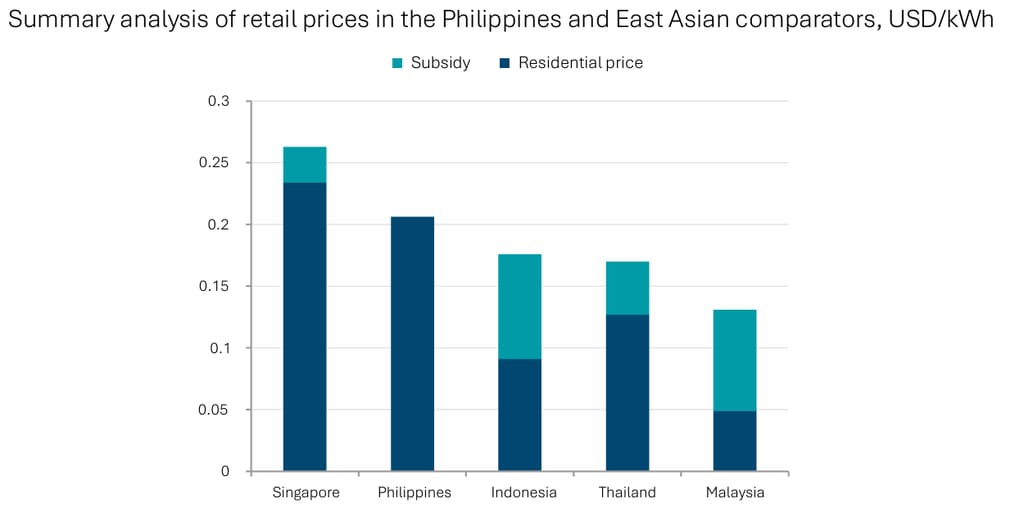
- ·Filipino households pay roughly 21 cents per kilowatt-hour, 57 percent higher than Malaysia and 17 percent above Indonesia even after adjusting for subsidies.
- ·Power supply agreements account for 70 percent of electricity purchases by large utilities, with contract prices running 1.5 to 2 times estimated cost benchmarks for solar, coal, and gas.
- ·Fewer than 20 percent of renewable capacity awarded in the first two auctions has been completed, while around 68 percent of first-auction projects remain suspended due to permitting and grid-access delays.
The Wrong Target
Lawmakers in Manila have spent months debating how to trim system losses in the electricity network. The World Bank now argues they are looking at the wrong line item. Generation costs, which make up roughly two-thirds of every electricity bill, remain locked into decades-old supply contracts that ignore today's fuel markets and block cheaper renewable capacity from reaching consumers.
Filipino families currently spend approximately 21 cents per kilowatt-hour for residential power. That figure sits well above Thailand's 13 cents, Indonesia's 9 cents, and Malaysia's 5 cents, according to the latest Philippines Economic Update released by the multilateral lender on August 3. Only Singapore, at 23 cents per kWh, posts a higher tariff in the region.
Some governments in the neighborhood subsidize electricity heavily. Yet even after the World Bank adjusted regional prices to include those subsidies, Philippine residential rates remained 57 percent costlier than Malaysia's and 17 percent above Indonesia's. Jaffar Al-Rikabi, the bank's senior country economist, dismissed subsidy differences as the main explanation. The core challenge, he said, is structural: how to cut generation expenses and unlock economic growth.
Contracts Written in a Different Era
Distribution utilities across the archipelago procure most of their electricity through medium- and long-term power supply agreements rather than the Wholesale Electricity Spot Market, where generators compete on price each day. An analysis of a large utility whose purchasing pattern mirrors that of Meralco showed that PSAs accounted for roughly 70 percent of electricity bought between January and March of this year. Another 22 percent came from older independent power producers, leaving less than 8 percent sourced from the spot market.
The bank did not name the utility in its report. Meralco, the country's dominant distribution company, does not retain generation charges as profit; it collects the fee from customers and remits the full amount to power producers. Still, its procurement decisions shape the bills paid by millions of households.
Many of those supply agreements were negotiated when fuel prices, exchange rates, and electricity demand followed entirely different trajectories. PSAs can shield utilities from sudden spot-market spikes, but they also embed capacity payments and clauses that transfer fuel and foreign-exchange risk directly to end users. Al-Rikabi noted that energy markets have shifted dramatically since those contracts were signed, yet the terms persist.
The World Bank calculated that realized PSA prices exceed estimated cost benchmarks across gas, coal, and solar. Solar and coal contract rates run about 1.5 times their respective levelized cost of electricity, while gas agreements trade at roughly double the benchmark.
Procurement rules have been tightened on paper. PSAs for captive consumers now require competitive selection, and the Energy Regulatory Commission reviews tariffs, cost structures, and risk allocation. The task ahead, Al-Rikabi said, is ensuring that stronger regulations produce genuinely competitive outcomes in practice.
Renewable Capacity Stuck in Limbo
Renewable energy offers a path off imported fuel and toward lower generation costs. The government has opened the sector to greater foreign investment and allocated substantial capacity through its Green Energy Auction Program. Awarding a project, however, does not equal commissioning a plant.
Fewer than 20 percent of the renewable megawatts awarded in the first two auctions have reached commercial operation, the World Bank found. Around 68 percent of projects from the inaugural auction have been suspended, tangled in disputes over land use, permits, local government coordination, and grid access.
The Department of Energy terminated several renewable energy service contracts tied to Solar Philippines after the company missed project milestones. Those canceled agreements represented approximately 11,428 megawatts, or about 64 percent of all renewable capacity the government terminated in 2024 and 2025. Batangas Representative Leandro Leviste, who founded the company, now faces graft and plunder complaints.
Even a completed wind or solar farm cannot reduce household bills if the electricity has no clear route to consumers. The bank identified persistent congestion within Luzon and the Visayas, with the Luzon-Visayas interconnection constrained much of the time. In the Visayas and Mindanao, prices frequently climb in the late afternoon and evening as demand rises and the system calls on more expensive thermal generators.
The Upside of Reform
If bottlenecks in contracting, permitting, and transmission can be resolved, the economic gains are substantial. Under a faster-implementation scenario modeled by the World Bank, the average residential tariff could fall to around 9.80 pesos per kWh, compared with 13.60 pesos if delays continue. Al-Rikabi estimated that residential tariffs in Luzon could drop by as much as 28 percent over the 2026 to 2030 period with effective execution.
The broader impact extends beyond monthly bills. The bank projects that accelerated reforms could generate approximately 161,000 additional jobs, lift roughly 730,000 Filipinos out of poverty, and add more than one percentage point to GDP by the end of the decade.
Those benefits hinge on moving past the current fixation on distribution losses and addressing the larger, more complex drivers of high electricity costs. Generation contracts negotiated in a bygone era, renewable projects mired in red tape, and a grid that cannot move power efficiently across islands all demand coordinated action. The policy debate is finally catching up to the data.
RELATED STORIES
Philippines Cancels Coal Tender for Key Mining Site Months Before Operator Handover
Mariel D. Santos · 4 min
Filipino Workers Abroad Send Home $3.6 Billion in July
Mariel D. Santos · 3 min
Alternergy Debuts in Philippine Debt Market with ₱2 Billion Notes Offering
Mariel D. Santos · 2 min

Five ASEAN Members Back Regional Oil Stockpile as Study Nears Completion
Tran Quoc Bao · 3 min
Spot something wrong? Email editor@briefasia.com. We log every correction publicly.