Technology · AI
Lightelligence Bets on Optical Infrastructure to Break AI's Data Movement Bottleneck
The photonics startup says AI's real challenge has moved beyond chip speed to efficient data flow across massive GPU clusters
KEY TAKEAWAYS
- ·Lightelligence is positioning co-packaged optics, near-package optics, and optical switching as solutions to AI's data movement bottleneck across large GPU clusters.
- ·The company argues the industry's primary constraint has shifted from chip performance to efficient data flow as training runs scale into tens of thousands of processors.
- ·Photonic computing remains a long-term play, while CPO and NPO address immediate bandwidth and power efficiency needs in hyperscale AI infrastructure.
The Data Movement Problem
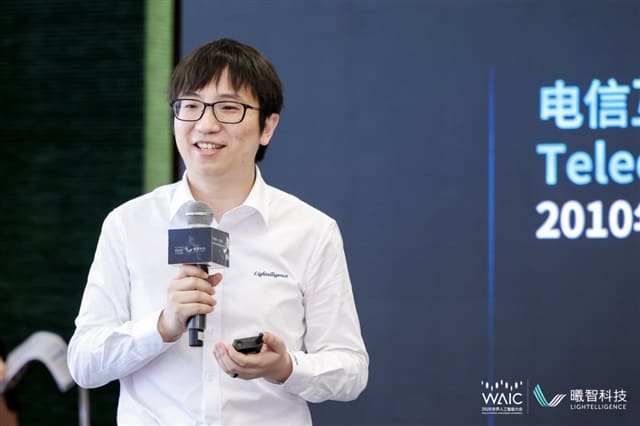
The race to build faster AI chips may be missing the point. As GPU clusters scale into the tens of thousands of units, the real constraint is no longer how quickly a processor can crunch numbers, but how efficiently data can flow between them. Lightelligence, a photonics computing firm, presented this argument at WAIC 2026 in Shanghai, making the case that optical technologies - interconnects, switches, and processors - will form the backbone of the next generation of AI infrastructure.
The company's pitch centers on three overlapping technologies: co-packaged optics (CPO), near-package optics (NPO), and photonic computing. Each addresses a different layer of the data movement problem that has emerged as training runs grow more distributed and inference workloads demand lower latency at scale.
Co-Packaged and Near-Package Optics
CPO integrates optical transceivers directly into the chip package, placing photonic components alongside electronic dies. The goal is to reduce the distance electrical signals must travel before converting to light, cutting power consumption and signal loss. Lightelligence highlighted CPO as a near-term solution for hyperscalers running large language model training across multi-rack clusters, where bandwidth density and energy efficiency per bit are now critical design parameters.
NPO sits one step removed, placing optical engines in close proximity to the processor package but not within it. This approach offers a middle ground: easier thermal management and module upgrades compared to CPO, while still delivering much of the latency and power benefit over traditional pluggable optics. The company sees NPO gaining traction in environments where modularity and serviceability matter as much as raw performance.
Optical Switching at the Rack Level
Beyond the chip package, Lightelligence is also positioning optical circuit switching as a way to reconfigure data paths dynamically within and between racks. Traditional electrical switches introduce latency and consume power at each hop; optical switches, by contrast, can redirect light without converting it back to electrical signals, lowering both. In AI training clusters where all-to-all communication patterns dominate, the ability to reconfigure connections on the fly without electronic bottlenecks could unlock higher effective bandwidth utilization.
The technology is not new - optical switching has been explored for decades in telecom - but Lightelligence argues the economics and performance requirements of AI workloads have finally created the commercial pull needed for deployment at datacenter scale.
Photonic Computing: The Long Play
The third pillar, photonic computing, remains further from volume production. The concept is to perform matrix multiplications - core to neural network inference and training - directly in the optical domain, using light to encode data and interference patterns to execute calculations. If realized at scale, photonic processors could offer orders-of-magnitude improvements in energy efficiency for certain AI operations, particularly inference tasks where latency and power per query are paramount.
Lightelligence has demonstrated prototype photonic accelerators, but commercial adoption will depend on overcoming integration challenges, building software stacks that can target optical hardware, and proving reliability in production environments. The company is positioning photonic computing as a multi-year horizon bet, while CPO and NPO address immediate infrastructure needs.
Asia's Stake in Optical AI Infrastructure
The push for optical AI infrastructure carries particular weight in Asia, where semiconductor and datacenter supply chains are concentrated. Taiwan and South Korea dominate advanced packaging and high-bandwidth memory production, both critical to CPO integration. China, meanwhile, has invested heavily in photonics research as part of broader efforts to build indigenous AI capabilities, and Japanese firms remain key suppliers of optical components and materials.
Lightelligence's messaging at WAIC 2026 reflects a broader industry recognition that the next wave of AI infrastructure investment will not focus solely on logic performance, but on the interconnect fabric that determines whether those processors can be fed data fast enough to stay busy. For Asian chip designers, equipment makers, and cloud operators, optical technologies represent both a strategic opportunity and a necessary capability as AI clusters continue to scale.
RELATED STORIES
Indian AI Firm Commits $8 Billion to Nvidia Infrastructure Buildout
Priyanka V. Rao · 3 min

MediaTek Executive Projects Million-GPU Clusters as Mid-Tier by 2030
Cheng Wei-Lun · 3 min

Integrated Systems Will Drive Next Wave of AI Growth, Says TSMC
Cheng Wei-Lun · 4 min
China Drafts National Liquid-Cooling Standard as AI Racks Near 1MW Power Draw
Cheng Wei-Lun · 2 min
Spot something wrong? Email editor@briefasia.com. We log every correction publicly.