Technology · AI
Korean Tech Leaders Seek Nvidia Partnership in Silicon Valley
Samsung, SK, and Naver chairmen plan Friday meeting with Jensen Huang as Asia's chip and AI players race to secure advanced infrastructure
KEY TAKEAWAYS
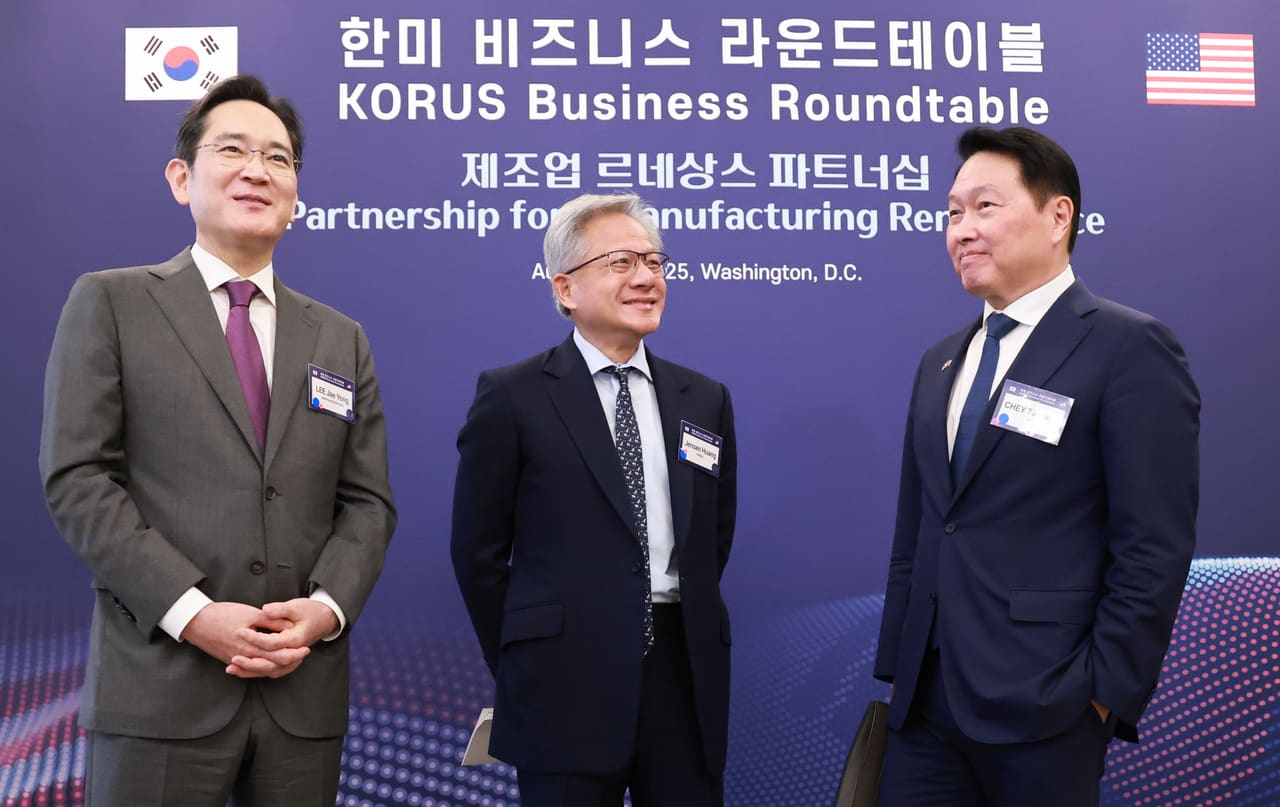
- ·Samsung Electronics Chairman Lee Jae-yong, SK Group Chairman Chey Tae-won, and Naver Chairman Lee Hae-jin are scheduled to meet Nvidia CEO Jensen Huang in Silicon Valley on Friday.
- ·The gathering may include OpenAI CEO Sam Altman and Anthropic CEO Dario Amodei, indicating discussions extend beyond chip supply to broader AI deployment strategy.
- ·This marks the second high-level meeting of its kind as Korean conglomerates compete for GPU allocations and partnerships amid surging demand for AI infrastructure across Asia.
High-Level Delegation Heads West
Three of South Korea's most powerful technology executives are traveling to Silicon Valley this week for a Friday meeting with Nvidia CEO Jensen Huang, according to industry sources familiar with the plans. Samsung Electronics Chairman Lee Jae-yong, SK Group Chairman Chey Tae-won, and Naver Chairman Lee Hae-jin are expected to attend the session near the chipmaker's headquarters.
The gathering underscores the intensity of Asia's competition for access to advanced AI infrastructure. Korean conglomerates have spent the past eighteen months scrambling to secure GPU allocations, design partnerships, and cloud capacity as generative AI applications reshape enterprise computing and consumer services across the region.
OpenAI CEO Sam Altman and Anthropic CEO Dario Amodei may also participate, though none of the companies involved has publicly confirmed the meeting or released a guest list. The potential presence of frontier AI lab leaders suggests the agenda extends beyond chip supply to broader questions of model deployment, data center design, and regional AI strategy.
Second Convening of Its Kind
This would be the second such gathering involving senior Korean executives and Nvidia's leadership. The chipmaker has hosted similar sessions as demand for its H100 and H200 accelerators has outstripped manufacturing capacity, forcing enterprise buyers and cloud providers to negotiate delivery timelines and volume commitments directly with Huang's team.
Samsung's participation carries particular weight. The company remains the world's largest memory chip manufacturer and a contract foundry rival to TSMC, which fabricates Nvidia's flagship GPUs. Any collaboration between Samsung and Nvidia could reshape supply chain dynamics in high-bandwidth memory and advanced packaging, two bottlenecks that have constrained AI hardware scaling.
SK Group operates South Korea's dominant telecom network through SK Telecom and holds stakes in semiconductor materials and battery production. The conglomerate has been investing in AI-powered services for enterprise customers and exploring partnerships with hyperscale cloud providers to expand its data center footprint in Southeast Asia.
Naver, often described as Korea's answer to Google, runs the country's leading search engine and has developed its own large language model, HyperCLOVA. The company has been working to differentiate its AI offerings for Korean-language applications and has signaled interest in deploying custom silicon for inference workloads.
Asia's GPU Scramble
The meeting reflects a broader pattern across Asia, where governments and private sector leaders view AI compute as a strategic asset. Japan's SoftBank recently announced plans to invest billions in domestic AI infrastructure. Singaporean sovereign funds have backed multiple GPU cloud startups. Indian conglomerates are negotiating with Nvidia and AMD to build inference clusters for local language models.
Korean firms face particular pressure. The country's export-driven economy depends on maintaining leadership in semiconductors, displays, and telecommunications equipment. As AI reshapes each of those industries, ensuring access to cutting-edge training and inference hardware has become a national competitiveness issue.
Nvidia's role as gatekeeper has given Huang unusual leverage in these negotiations. The company has used high-level meetings to steer customers toward preferred architectures, cloud partnerships, and software stacks that lock in long-term revenue beyond chip sales. For Asian buyers, the calculus involves balancing immediate GPU access against longer-term dependencies on Nvidia's ecosystem.
What Comes Next
If the meeting proceeds as planned, expect joint announcements in the coming weeks. Likely topics include memory supply agreements between Samsung and Nvidia, SK investments in AI data centers, and Naver collaboration on Korean-language model optimization using Nvidia's software tools.
The gathering also signals that the AI infrastructure build-out remains concentrated among a small group of companies with the capital, technical expertise, and political backing to move quickly. As model sizes plateau and attention shifts to inference efficiency and edge deployment, the partnerships formed in these closed-door sessions will shape which regions can deploy AI at scale and which remain dependent on foreign cloud providers.
For now, the Korean delegation's trip to Silicon Valley is another reminder that in the AI era, access to chips is access to economic leverage.
RELATED STORIES
Memory Makers Gain Leverage as AI Server Costs Climb
Cheng Wei-Lun · 3 min
Samsung's Device Division Reports First Quarterly Loss as Chip Costs Surge
Cheng Wei-Lun · 3 min
South Korea Taps Three Telecom Giants to Deliver Free AI Services Nationwide
Cheng Wei-Lun · 3 min
Samsung Display Restarts Asan OLED Campus as Foldable Phones Stage Recovery
Cheng Wei-Lun · 4 min
Spot something wrong? Email editor@briefasia.com. We log every correction publicly.