Finance · Fintech
Four Major Banks Deploy Ant International's AI Model for Currency Hedging
Barclays, Citi, Deutsche Bank, and Standard Chartered integrate FalconTST 2.0 to sharpen FX forecasting and manage cross-border liquidity
KEY TAKEAWAYS
- ·Ant International's FalconTST 2.0 AI model is now integrated into hedging systems at Barclays, Citi, Deutsche Bank, and Standard Chartered to improve FX forecasting accuracy.
- ·The model achieved a Mean Absolute Scaled Error score of 0.666, outperforming competing time-series transformer models from other technology providers.
- ·Ant International plans to extend FalconTST 2.0 into e-commerce demand forecasting and aviation operations management beyond financial services.
A Prediction Engine Built for Treasury Desks
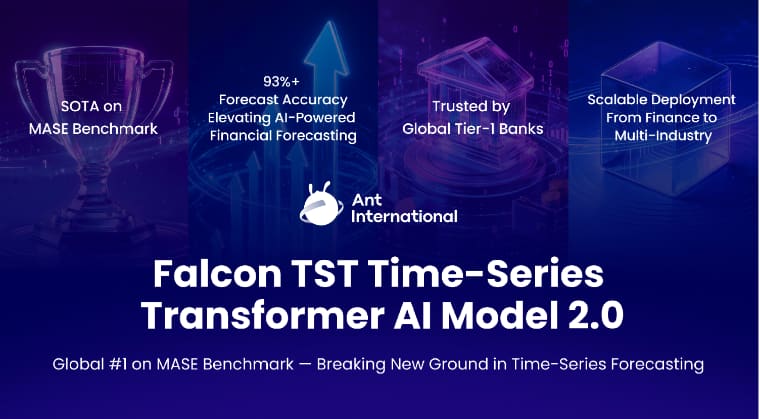
Ant International introduced FalconTST 2.0, an artificial intelligence model designed to forecast currency movements and cash flows with greater precision than legacy systems. The model has been integrated into hedging operations at Barclays, Citi, Deutsche Bank, and Standard Chartered, according to Ant International.
FalconTST 2.0 achieved a Mean Absolute Scaled Error score of 0.666, a benchmark used to measure accuracy in time-series prediction. The company said that result outperforms competing transformer models from other technology providers in the same category.
The model addresses a persistent friction in cross-border payments: banks and payment processors must continuously predict cash positions and currency exposure across multiple time horizons, from hourly intraday swings to weekly settlement cycles. Getting those forecasts wrong can force institutions to hold excess liquidity buffers or leave them exposed to unwelcome FX volatility.
From Internal Tool to Bank Infrastructure
Ant International first deployed the original FalconTST 1.0 internally to manage its own cash flow and foreign exchange exposure on hourly, daily, and weekly intervals. The firm operates cross-border payment rails across Asia, Europe, and Latin America, handling transaction flows in dozens of currencies.
After seeing operational cost reductions from improved forecasting accuracy, the company packaged the model for external use. The four banks now use FalconTST 2.0 within their treasury and hedging systems to refine cash flow projections and optimize FX liquidity management.
"FalconTST helps global businesses, including our own, manage complex cash flow and FX exposure, so they can manage cross-border transactions with greater confidence," said Kelvin Li, General Manager of Platform Tech and Senior Vice President at Ant International. "With FalconTST 1.0, clients saw real operational value and cost savings from better forecasting."
Pattern Recognition Across Industries
Unlike traditional forecasting systems that build separate models for each task, FalconTST learns common temporal patterns - cycles, trends, abrupt shifts, and seasonality - from data sets spanning finance, energy, and retail. The underlying architecture assumes that different industries often share similar structural rhythms in how their metrics evolve over time.
Jiang-Ming Yang, Chief Innovation Officer at Ant International, positioned the model as a counterpart to large language models. "Large language models have shown how AI can understand and generate information," he said. "FalconTST is about another capability that businesses increasingly need: understanding how the world changes over time, and anticipating what comes next."
Expansion Beyond Financial Services
Ant International expects FalconTST 2.0 to find applications outside treasury operations. The company cited demand forecasting for e-commerce supply chains and predictive operations management in aviation as near-term use cases.
E-commerce platforms face inventory decisions driven by volatile consumer demand, especially around seasonal peaks and promotional events. Airlines, meanwhile, must forecast passenger loads, fuel costs, and crew scheduling weeks in advance. Both scenarios require models that can detect pattern shifts quickly and adjust predictions without extensive retraining.
The four-bank deployment marks a test of whether AI-driven forecasting can deliver measurable improvements in capital efficiency and risk management at scale. For Asia's cross-border payment corridors, where currency pairs can be less liquid and more prone to sudden moves, sharper FX prediction could translate into tighter spreads and lower hedging costs for corporates moving money across the region.
RELATED STORIES

Southeast Asian Exchanges Chase Tech Listings in AI Era
Cheng Wei-Lun · 3 min

DBS Deploys AI Agents to Handle Credit Assessment Tasks Across 1,500 Staff
Priyanka V. Rao · 3 min

Singapore Exchange Retail Trading Reaches 12-Year Peak as Youth Outreach Intensifies
Lim Hui Ying · 3 min

Shein Targets $2.3 Billion in Hong Kong Debut After Years of Setbacks
Cheng Wei-Lun · 3 min
Spot something wrong? Email editor@briefasia.com. We log every correction publicly.