Asia · Business
Dixon Technologies Navigates Margin Pressure With Export Push and Localization Drive
India's largest EMS player reports component cost headwinds in Q1 FY27 while betting on policy support and higher-value manufacturing to stabilize returns

KEY TAKEAWAYS
- ·Dixon Technologies reported margin pressure in Q1 fiscal 2027 due to elevated costs for semiconductors, displays, and passive components sourced from Taiwan, South Korea, and Malaysia
- ·The company expects relief from strong order inflows, amended PLI incentives for mobile and IT hardware, and a shift toward higher-value products including 5G handsets and premium appliances
- ·Export volumes are set to grow faster than domestic sales over the next two years, supported by customer mandates and government incentives for overseas shipments to West Asia, Africa, and Southeast Asia
Component Inflation Hits First Quarter
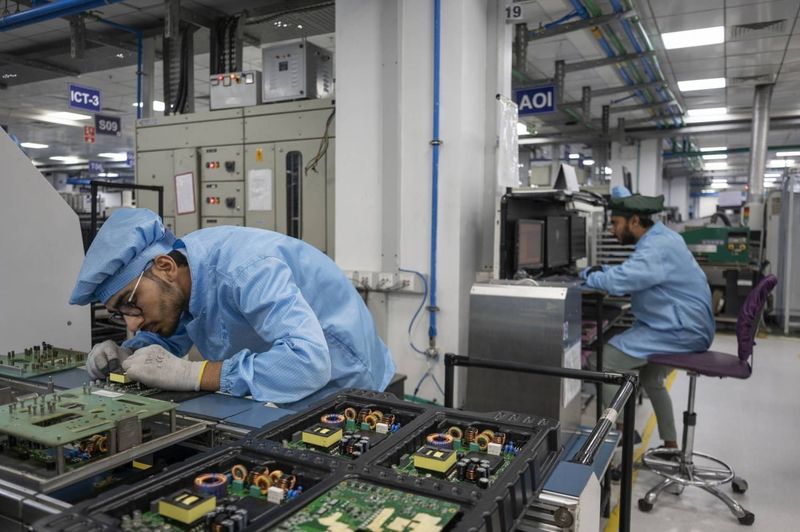
Dixon Technologies reported that climbing input costs for electronic components squeezed profitability during the opening quarter of its fiscal year 2027. The New Delhi-headquartered contract manufacturer, which assembles everything from smartphones to washing machines for global and domestic brands, said the price environment for semiconductors, displays, and passive components remained elevated through the April-June period.
The margin pressure comes as India's electronics manufacturing services sector scales rapidly. Dixon operates across consumer electronics, lighting, mobile phones, and home appliances, making it particularly exposed to swings in global component markets. Procurement teams have faced persistent cost inflation since late 2025, driven by tight supply in advanced logic chips and memory modules sourced primarily from Taiwan, South Korea, and Malaysia.
Policy Tailwinds and Order Momentum
Despite the near-term headwinds, Dixon pointed to a robust pipeline of new contracts and strengthening support from New Delhi's production-linked incentive schemes. The company manufactures under India's PLI programs for mobile phones, IT hardware, telecom equipment, and white goods, each offering tiered subsidies tied to incremental sales and domestic value addition.
Recent amendments to the mobile PLI framework have raised the threshold for qualifying investments and extended the scheme's timeline, giving manufacturers more runway to meet localization targets. Dixon expects these adjustments to improve the economics of higher-end smartphone assembly, where component costs are steeper but margins on finished goods are also wider.
Order inflows have remained strong across categories. The company has secured fresh mandates from international brands looking to diversify production out of China and from Indian labels expanding capacity ahead of the festive shopping season. Management highlighted that the mix is shifting toward more complex products, including 5G handsets, premium televisions, and connected appliances, which carry better unit economics despite higher bill-of-material costs.
Mobile Volumes Set to Recover
Dixon flagged an upturn in mobile phone production volumes after a softer start to the year. Handset output had moderated in the first quarter as brands worked through inventory built up in the preceding months. That destocking cycle appears to be ending, with production schedules ramping up for the second half of calendar 2026.
The mobile segment is critical for Dixon. It accounts for a substantial share of revenue and serves as a showcase for the company's ability to handle high-volume, high-precision assembly. Several tier-one smartphone makers have committed to lifting their India output, both for the domestic market and for export to the Middle East, Africa, and Southeast Asia.
Export momentum is a key part of Dixon's outlook. The company has been shipping finished phones and components to markets in West Asia and Africa, leveraging India's free-trade agreements and cost advantages. Management expects export revenue to grow faster than domestic sales over the next two years, supported by customer mandates and government incentives for overseas shipments.
Deepening Localization Across the Portfolio
Component localization remains a strategic priority. Dixon has been working with suppliers to establish or expand Indian operations for items including printed circuit board assemblies, camera modules, battery packs, and mechanical enclosures. The goal is to lift domestic value addition above the minimum thresholds required by PLI schemes and to insulate the supply chain from freight delays and tariff volatility.
The company has also entered joint ventures and licensing agreements to bring more sophisticated manufacturing in-house. Recent tie-ups cover areas such as display module assembly and power management ICs, both of which have historically been import-dependent. While these investments take time to yield returns, they position Dixon to capture a larger share of the value chain and improve bargaining power with global component vendors.
Localization is not only a cost play. It also reduces lead times, improves inventory turns, and makes Dixon more attractive to brands that face regulatory or reputational pressure to increase local content. As tariffs on finished electronics imports rise and China-plus-one strategies mature, the ability to source domestically becomes a competitive differentiator.
Outlook Balances Caution and Confidence
Dixon's commentary reflects the dual realities facing India's electronics sector in mid-2026. Input cost inflation is real and unlikely to vanish quickly, especially for leading-edge components where supply remains concentrated. At the same time, structural tailwinds are strong. Policy support is deepening, customer pipelines are full, and the shift toward higher-value assembly is underway.
The company's performance in the coming quarters will hinge on its ability to pass through cost increases, ramp localized sourcing, and execute on export commitments. If component prices stabilize and PLI disbursements flow smoothly, margins should recover. If not, Dixon and its peers will need to lean harder on volume growth and operational efficiency to protect returns.
For investors and brand partners watching India's electronics ambitions, Dixon's trajectory offers a real-time case study in how local champions navigate the gap between policy intent and manufacturing reality.
RELATED STORIES
India's Chinese Import Bill Climbs Despite Self-Reliance Push
Priyanka V. Rao · 3 min

Kubota Expands Indian Production to Target Western Markets
Priyanka V. Rao · 3 min

Lenskart Founder Peyush Bansal Joins Billionaire Ranks on India Eyewear Boom
Priyanka V. Rao · 4 min

Fujifilm Commits $83 Million to Semiconductor Materials Plant in India
Siti Nuraini · 3 min
Spot something wrong? Email editor@briefasia.com. We log every correction publicly.