Perspectives · Opinion
In Da Nang, the Souvenir That Travels Best Is a Pair of Hands
A fishing town became one of Asia's fastest-rising destinations. At All Seasons — the city's first unlimited-lobster buffet — the most-repeated line in thousands of guest reviews isn't about the food. Hòa Quốc Nguyễn, CEO of Viet Deli Group, thinks that says everything about what Vietnam is actually selling.
KEY TAKEAWAYS
- ·Da Nang's tourism boom was built on infrastructure, but what turns visitors into advocates is genuine human hospitality.
- ·At All Seasons, guests do not go home talking about the lobster. They go home remembering the name of the person who peeled their shrimp.
- ·Warmth may be instinctive, but delivering it consistently across hundreds of covers every night is a skill that must be trained and invested in.
The prawn arrives already opened.
It is a Tuesday night on the second floor of a seafood restaurant on Nguyen Van Thoai Street, a few hundred meters from the sand of My Khe, and a young server named Roy has set down a plate, noticed the shells, and without being asked begun peeling. He works quickly, talking the whole time, and by the time the couple across the table has finished a sentence about their day in Hoi An, the shrimp is sitting clean on the plate in front of them. Nobody's fingers got wet. Nobody had to ask how.

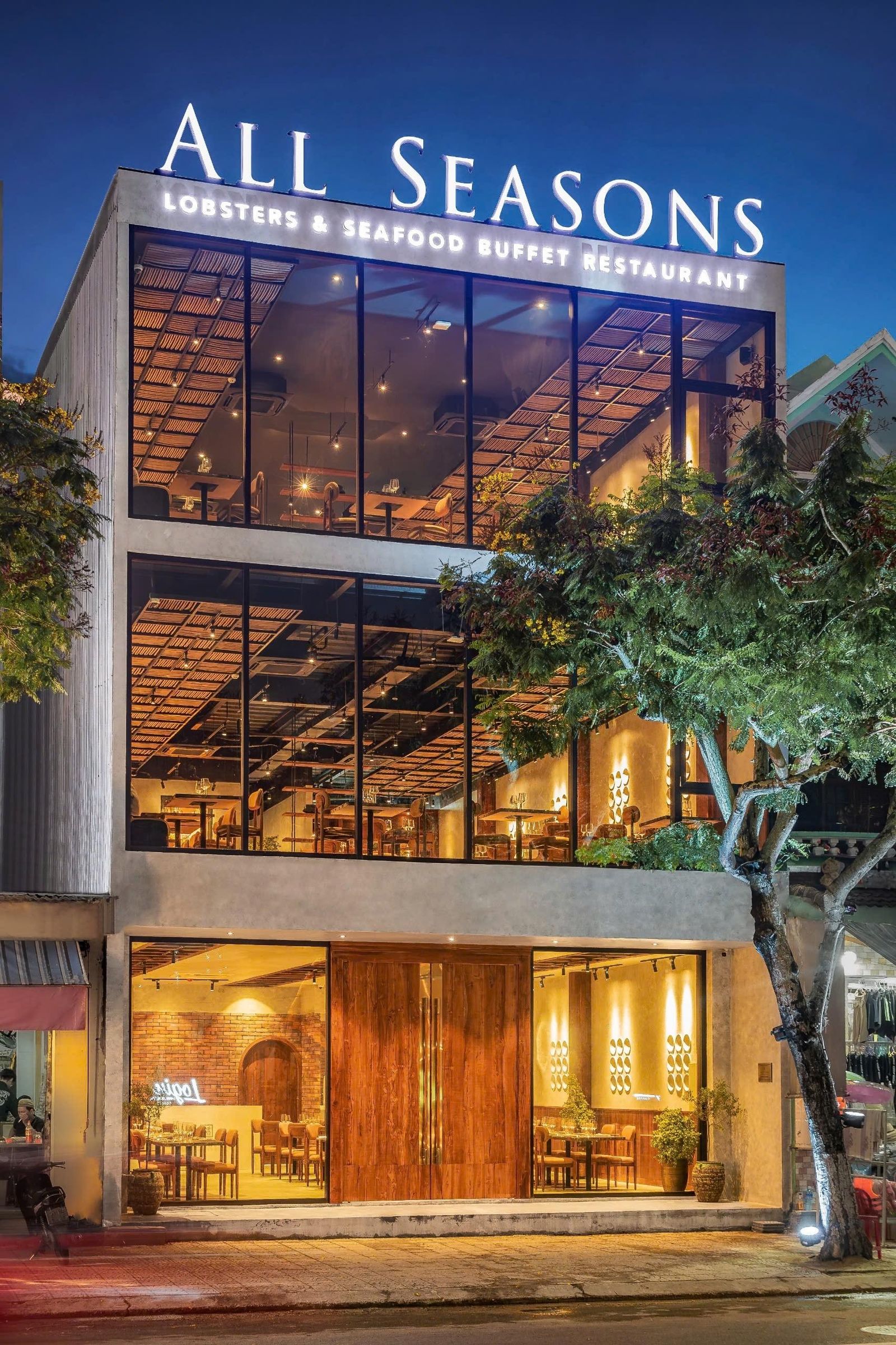
All Seasons Da Nang. Photo: Vietdeli Group
It is a small thing. It is, in fact, the whole story.
Da Nang's transformation is usually told in numbers, and the numbers are genuinely astonishing. Vietnam crossed 20 million international visitors in 2025 for the first time in its 65-year tourism history, a national record. Da Nang has been at the front of that surge: in the first five months of 2025 alone, the city welcomed more than 4.6 million visitors, with international arrivals on organized tours up roughly 37 percent year on year. A generation ago this was a working coastline of fishing boats and modest guesthouses. Today it draws Korean honeymooners, European cruise passengers, and Taiwanese families who plan their itineraries around a single dinner.
But numbers explain that people came. They do not explain why people remember. And if you want to understand what actually makes a first-time visitor decide that Vietnam is a place they love rather than merely a place they visited, the reviews of one restaurant are a more honest data set than any tourism report.
All Seasons is not subtle about its ambitions. It was the first restaurant in Da Nang to attempt an unlimited-lobster buffet, a deliberate step up into a premium bracket that the city, not long ago, would have been told it could not support. It won Best Asia F&B Interior Design in 2024. It carries a 4.9-star rating across roughly 2,700 Google reviews and more than 600 on Tripadvisor, and a 2025 Travelers' Choice award. By any commercial measure, the lobster is doing its job.
And yet.
Read those reviews closely, hundreds of them, written in English, Korean, Chinese, Russian, Portuguese, machine-translated from a dozen more, and a pattern emerges that has nothing to do with lobster. The single detail guests return to, across every language and nationality, is the sight of a staff member peeling their shrimp, cracking their crab, and unshelling their lobster for them, at the table, by hand. An Australian couple on their honeymoon noted, almost in disbelief, that the staff peeled the prawns for them. A British visitor called it one of the few places on earth where a waiter shelled his prawns. A Filipino group, a Korean family, a Brazilian couple, all independently reached for the same moment.
Then they did something even more telling. They named the person. Roy, again and again. Also Tu, whose smile one guest said lit the whole room; Hoa; Ling; Bao. Travelers who cannot pronounce the name of the street the restaurant sits on left knowing, and publicly thanking, the twenty-three-year-old who took care of them.
"People think we are in the seafood business," Hòa Quốc Nguyễn tells me. "We are not. Seafood is the reason they book. It is not the reason they come back, and it is definitely not the reason they tell their friends. What they take home is how they felt for two hours. That is the only thing that travels."
Nguyen is the CEO of Viet Deli Group, the Hanoi-based hospitality company that owns All Seasons alongside a portfolio of more than fifteen restaurants. He has a habit, common among operators who came up through the floor rather than the spreadsheet, of describing his business in terms of gestures rather than margins. When I mention the shell-peeling phenomenon in the reviews, he does not treat it as a marketing win. He treats it as a thesis being proven.
"A lobster you can buy anywhere. Singapore, Tokyo, any five-star hotel," he says. "What you cannot easily buy is someone who wants to take the trouble out of your evening, not because a manual tells them to, but because in Vietnamese culture, taking care of a guest is not a transaction. It is closer to hospitality inside a family. You do not let a guest struggle at your table."
That is the philosophical claim at the center of Da Nang's boom, and it is worth stating plainly, because the city's story is usually credited to bridges, beaches, and budget flights. Nguyen's argument is that infrastructure brought the visitors, but hospitality is what converts a visitor into an advocate, and that this conversion is Vietnam's genuine competitive advantage in a region crowded with beautiful coastlines.

Hoa Quoc Nguyen, CEO, Vietdeli Group. Photo: Vietdeli Group
“Everyone in Asia has a beach. We win on the fifteen seconds where a stranger from another country feels genuinely looked after. That feeling is our export product — and unlike lobster, we do not have to import it.” — HÒA QUỐC NGUYỄN, CEO, VIET DELI GROUP
He is careful, though, not to romanticize it as something mystical or automatic. Pushed on how a gesture becomes a standard across a full floor of staff on a busy night, he becomes noticeably more concrete, and this is where the family metaphor gives way to the operator.
"Warmth you can feel is real. But warmth you can repeat, five hundred covers a night, every night, that is trained," he says. "The instinct to help is Vietnamese. The skill to help well is ours to build. We invest in that for the long term. If you treat a young server as cheap labor, the guest feels it in one visit. If you treat them as the person who will decide whether a family in Busan or Melbourne loves this country, you train them differently, you pay attention to them differently, and they carry themselves differently."
That framing, the frontline server as the country's ambassador, is not corporate gloss. It is visible in the reviews as a competitive moat. A guest who remembers a name is a guest who has formed a relationship, and relationships do not show up in a price comparison. It also reframes a debate that Vietnam's tourism sector has largely conducted in the language of hardware: more flights, more rooms, more attractions. Nguyen's contention is that the sector has underpriced its software.
There is a version of this article that would end there, on a clean and flattering note. Honest hospitality reporting requires acknowledging that All Seasons is not universally beloved: it is not cheap, some guests find the portions modest for the price, and on a packed night the very table-side service that generates the raving reviews can leave a hurried diner waiting. Nguyen does not flinch when I raise it.
"A guest who waited too long and told us so is more valuable than a guest who left quietly," he says. "The complaint is the audit. The danger is not the bad night. The danger is not knowing you had one."
What is striking, reading the restaurant's public responses to criticism, is that they are signed by managers and mention staff by name in praise, the same names the guests remember. It is a small, consistent signal that the people doing the peeling are treated as the product, not the overhead.
Late in our conversation, I ask Nguyen the obvious question. Da Nang could keep winning on volume, cheaper packages, bigger rooms, more buses. Why bet the brand on something as fragile and unscalable as a human touch?
He answers with a story instead of a strategy.
"A few weeks ago a Korean woman came back a second time and asked for a specific server by name. Not for a dish. For a person," he says. "That is worth more than any advertisement I could buy. When I was young, Da Nang was a place people passed through on the way to somewhere famous. Now it is the destination, and the reason is not only that we built nicer things. It is that people were made to feel like someone was glad they came. That is not a small thing to sell to the world. It might be the biggest thing we have."
Outside, the beach that was once lined with fishing boats is lined with hotels. Inside, a young man leans over a table and quietly opens a shell for a guest who will fly home in three days and, statistically, tell someone about it. A city rebuilt itself in a generation. But the thing it exports best still fits in two hands.
ABOUT VIET DELI GROUP
Founded in 2015 and headquartered in Hanoi, Viet Deli Group is one of Vietnam’s pioneering premium restaurant operators, running more than 15 restaurants nationwide. Its stated mission is to bring international cuisine to Vietnam and Vietnamese cuisine to the world, anchored by a core value of long-term investment in developing its people.
Brands All Seasons Buffet · Saju Sushi & BBQ · Sajang BBQ · Home Vietnamese Restaurant · Ngon Gallery · Mammom · Gia Thien
All Seasons Da Nang Da Nang’s first unlimited-lobster buffet and winner of Best Asia F&B Interior Design 2024. 193 Nguyen Van Thoai, An Hai Ward, Da Nang — roughly 500 meters from My Khe Beach.
Web vietdeligroup.com · allseasonsbuffet.com
RELATED STORIES
The pianist who goes looking for forgotten music
Manh Khang · 8 min
Vietnam's Offshore Oil Find Tests Hanoi's Will Against Beijing
Priyanka V. Rao · 5 min
-800x471.jpg?prefix=brief-asia)
Cover the logo. They'll still know who you are.
Simon Ng · 9 min
Ho Tu Bao Taught Machines to Learn. Now He Teaches Doubt.
Manh Khang · 9 min
Spot something wrong? Email editor@briefasia.com. We log every correction publicly.