Asia · Trade
Chinese Automakers Expand Global Manufacturing Footprint Amid Margin Pressure
Slowing EV profitability and trade barriers drive China's vehicle makers to establish production outside their home market, with implications for industry standards and regional supply chains
KEY TAKEAWAYS
- ·Chinese electric vehicle manufacturers are accelerating overseas factory construction in Thailand, Indonesia, Hungary, and Mexico as domestic operating margins fall below 5 percent and tariff barriers rise.
- ·The shift enables Chinese automakers to bypass import duties, reduce logistics costs, and gain influence over regional technical standards and regulatory frameworks in emerging markets.
- ·Early production results from Thailand suggest Chinese brands can ramp operations faster than traditional automakers but face challenges replicating domestic efficiency and scale outside China.
Strategic Shift Beyond China
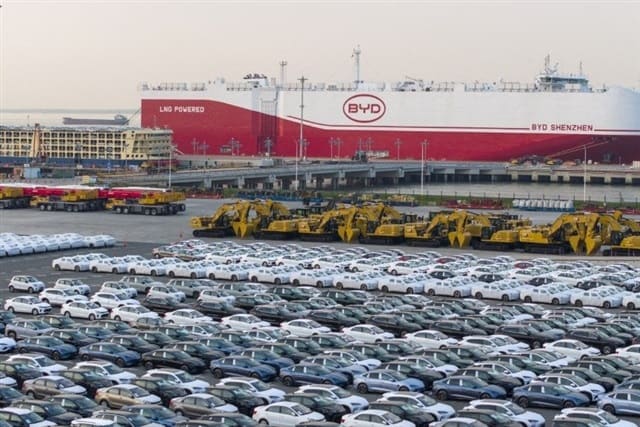
Chinese vehicle manufacturers are accelerating plans to build factories outside China, responding to a confluence of pressures that include shrinking profit margins in the electric vehicle sector, intensifying domestic rivalry, and escalating tariff barriers in key export markets. The pivot represents a fundamental change in strategy for an industry that spent the past decade scaling production at home and exporting finished vehicles.
The expansion into overseas manufacturing marks a departure from the export-led model that powered China's automotive rise. Industry executives now view local production as essential to navigating protectionist policies in Europe, Southeast Asia, and Latin America, where import duties on Chinese-built vehicles have climbed sharply over the past eighteen months. Several major Chinese EV brands have announced or begun construction on assembly plants in Thailand, Indonesia, Hungary, and Mexico since early 2025, with additional projects under evaluation in Morocco and Turkey.
Margin Compression at Home
Profitability has deteriorated across China's EV sector as manufacturers compete on price to defend market share. Average operating margins for Chinese electric vehicle makers fell below 5 percent in the first quarter of 2026, down from double-digit returns two years earlier. Price wars that began in late 2024 have eroded returns even as unit sales continue to grow, forcing companies to seek new revenue streams and cost structures.
Overseas production offers a path to higher margins by sidestepping tariffs, reducing logistics expenses, and tapping lower-cost labor markets in Southeast Asia and Eastern Europe. For Chinese automakers, the calculus now favors building closer to end customers rather than shipping from centralized Chinese mega-factories. The shift also reduces exposure to supply chain disruptions and currency volatility that have plagued cross-border vehicle trade since 2023.
Standards and Influence
Beyond immediate financial relief, Chinese manufacturers view overseas factories as platforms to shape technical standards and regulatory frameworks in emerging automotive markets. By establishing local production, Chinese brands gain direct engagement with regulators, supply chain partners, and industry associations in host countries. This presence can influence decisions on charging infrastructure, battery recycling protocols, and vehicle safety requirements, embedding Chinese technology preferences into regional ecosystems.
Thailand and Indonesia have emerged as priority markets, with multiple Chinese automakers committing to assembly plants that will serve ASEAN demand. These facilities are designed not only to assemble vehicles but also to localize component sourcing and integrate Chinese battery and software suppliers into regional supply chains. The approach mirrors strategies used by Japanese and South Korean automakers in earlier decades, when overseas production helped establish dominant positions in North America and Europe.
Trade Barriers Accelerate Timeline
Tariff increases in the European Union and potential restrictions in North America have compressed decision timelines. Several Chinese automakers that had planned to evaluate overseas production over multi-year horizons have accelerated site selection and groundbreaking schedules. Hungary has attracted three separate Chinese vehicle projects since mid-2025, leveraging its position as an EU member state with competitive labor costs and existing automotive supply base.
Mexico remains under consideration as a manufacturing hub for the North American market, though uncertainty around trade policy has slowed commitments. Chinese manufacturers are weighing the benefits of tariff-free access to the United States and Canada against the risk of future rule changes that could negate those advantages. Some companies are exploring joint venture structures with established North American players to mitigate political risk.
Competitive Landscape Reshapes
The move offshore introduces new competitive dynamics. Chinese manufacturers will face established players on their home turf, without the cost advantages and government support that defined their domestic success. Local content requirements, labor regulations, and unfamiliar permitting processes present operational challenges that many Chinese automakers have limited experience navigating.
At the same time, the ability to produce locally may prove decisive in markets where buyers prioritize jobs and economic development over price. Governments in Thailand, Indonesia, and Hungary have conditioned incentives and market access on investment commitments, job creation targets, and technology transfer agreements. Chinese manufacturers that meet these terms gain preferential treatment; those that rely solely on imports risk exclusion.
The shift to overseas production will test whether China's automotive industry can replicate its domestic scale and efficiency in diverse regulatory and cultural environments. Early results from Thailand, where Chinese brands began local assembly in late 2025, suggest that operational ramp-up is slower than in China but faster than traditional automakers achieved in comparable market entries. The coming two years will determine whether Chinese manufacturers can sustain quality, cost discipline, and innovation outside the integrated industrial clusters that enabled their initial rise.
RELATED STORIES
Beijing Warns Domestic EV Makers Against Overseas Price Wars
Cheng Wei-Lun · 3 min
Volkswagen Probes Chinese Supplier After Hundreds of New Graduates Dismissed
Cheng Wei-Lun · 3 min
Malaysia's Rare Earth Deposits Draw Foreign Interest Ahead of China Export Controls
Priyanka V. Rao · 3 min
China's Manufacturing Index Holds Below Expansion Threshold for Second Month
Cheng Wei-Lun · 5 min
Spot something wrong? Email editor@briefasia.com. We log every correction publicly.