Technology · AI
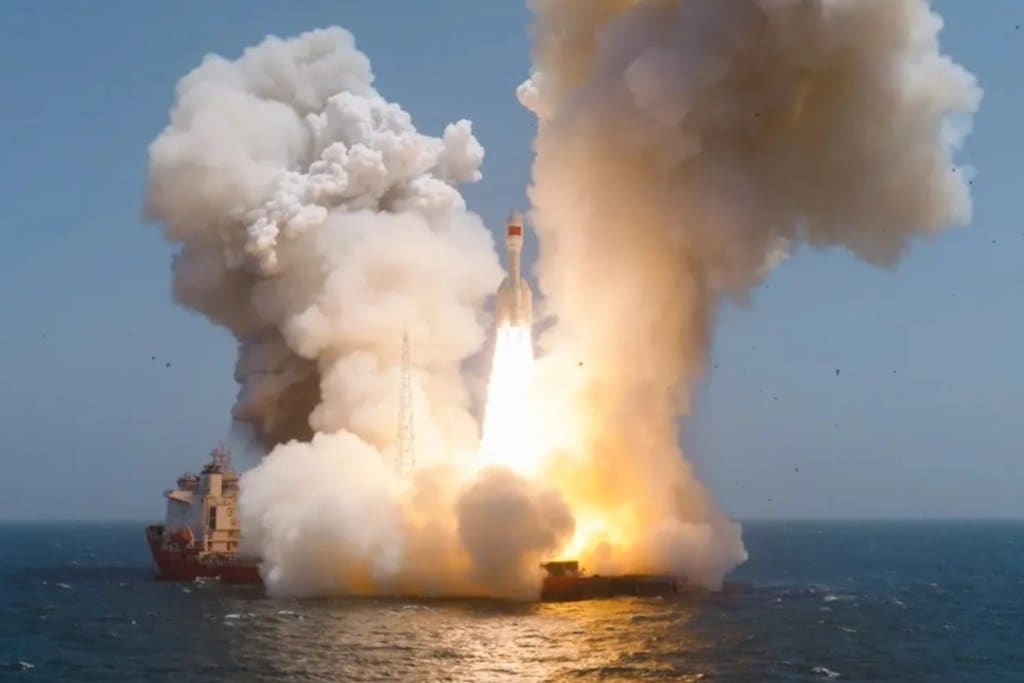
China Launches Satellites from Sea as Space Race Intensifies
Orienspace's mobile ocean platform marks a strategic shift in satellite deployment, blending commercial ambition with military resilience in orbit
KEY TAKEAWAYS
- ·Chinese commercial provider Orienspace launched rockets from a mobile ocean platform this month, expanding launch flexibility and infrastructure resilience beyond fixed terrestrial sites.
- ·Sea-based launches allow trajectory optimization and geographic dispersal, complicating adversarial targeting while supporting China's goal to deploy competitive satellite constellations against SpaceX.
- ·Onboard AI systems manage real-time trajectory adjustments and autonomous operations, reducing reliance on ground control and enhancing military survivability during communications disruptions.
Mobile Platforms Enter the Orbital Arena
China has demonstrated a new dimension in satellite deployment by launching rockets from mobile ocean platforms, signaling a convergence of commercial ambition and strategic military planning. Orienspace, a Chinese commercial launch provider, executed the operation this month, marking a technical milestone that extends the country's launch flexibility beyond fixed terrestrial sites.
Sea-based launches offer distinct advantages: they allow operators to select optimal launch trajectories by repositioning vessels closer to the equator, where Earth's rotational speed provides additional velocity. This reduces fuel requirements and increases payload capacity. For China, the capability also disperses launch infrastructure geographically, complicating potential adversarial targeting and enhancing resilience in contested scenarios.
The move comes as orbital competition intensifies. SpaceX has deployed more than 5,000 Starlink satellites since 2019, dominating low Earth orbit broadband services and reshaping the economics of space access. China's response blends state-backed ventures with commercial entities like Orienspace, aiming to field competitive constellations while maintaining strategic control over launch cadence and satellite architecture.
AI Integration and Autonomous Systems
Onboard artificial intelligence systems are playing an expanding role in Chinese launch operations. AI manages real-time trajectory adjustments, monitors propulsion health, and optimizes fuel consumption during ascent. For sea-based platforms, where environmental variables such as wave motion and wind shear introduce additional complexity, autonomous decision-making reduces reliance on ground-based command links and shortens response times.
This integration extends beyond launch vehicles. Chinese satellite constellations increasingly incorporate AI for orbital maneuvering, collision avoidance, and payload management. The technology enables satellites to adjust orbits autonomously in response to debris threats or operational requirements, reducing the burden on ground control networks and improving constellation agility.
Military applications are implicit. Autonomous systems can maintain operations during communications disruptions, a critical capability in contested environments where ground stations may be targeted or jammed. The ability to launch from mobile platforms further decentralizes China's space infrastructure, aligning with broader doctrines of distributed operations and survivability.
Commercial Constellations with Strategic Underpinning
China's commercial satellite sector is expanding rapidly, with multiple firms pursuing constellations for broadband, Earth observation, and Internet of Things connectivity. Orienspace joins companies like Galactic Energy and LandSpace in offering launch services, a market previously dominated by state-owned entities such as the China Aerospace Science and Technology Corporation.
These commercial ventures operate within a framework that blurs civilian and military boundaries. Chinese regulations require private space companies to coordinate closely with government agencies, ensuring that commercial capabilities can be mobilized for national security purposes. Satellite constellations ostensibly designed for broadband or remote sensing can support military communications, surveillance, and navigation during contingencies.
The economic dimension is equally significant. By lowering launch costs and increasing deployment frequency, China aims to capture market share in the global satellite services industry, challenging established players in North America and Europe. Competitive pricing and integrated offerings - combining launch, satellite manufacturing, and ground services - position Chinese firms to attract customers in Asia, Africa, and Latin America, regions where infrastructure gaps create demand for satellite connectivity.
Orbital Domain and Regional Implications
The expansion of Chinese satellite capabilities has implications for regional security dynamics. Enhanced reconnaissance and communications infrastructure supports power projection in the Indo-Pacific, where territorial disputes and strategic competition remain acute. Space-based assets enable persistent surveillance of maritime chokepoints, tracking of naval movements, and coordination of distributed forces across vast distances.
Allies and competitors are taking note. The United States, Japan, and India are accelerating their own space programs, investing in satellite defense, counter-space technologies, and launch resilience. The European Union is advancing sovereign satellite constellations to reduce dependence on non-European providers. The result is a more crowded and contested orbital environment, where the risk of collisions, interference, and debris generation rises alongside the number of active satellites.
International governance frameworks have struggled to keep pace. Existing treaties focus primarily on preventing weaponization and ensuring liability for damage, but lack mechanisms to manage congestion, coordinate traffic, or adjudicate disputes over orbital slots and frequency bands. As commercial and military constellations proliferate, the absence of robust governance increases the likelihood of incidents that could escalate into broader conflicts.
What Comes Next
China's demonstration of sea-based launch capability is unlikely to remain isolated. Further investments in mobile platforms, AI-driven autonomy, and commercial constellation deployment are expected, driven by both economic incentives and strategic imperatives. The country's space program is positioned to sustain high launch rates, fielding hundreds of satellites annually to compete with SpaceX's Starlink and other Western systems.
The trajectory suggests a long-term contest for orbital dominance, where launch flexibility, cost efficiency, and operational resilience determine competitive advantage. Sea-based platforms, once a niche capability, may become standard infrastructure as nations seek to diversify launch sites and reduce vulnerability. For Asia's space-faring powers, the race is no longer confined to reaching orbit - it extends to controlling the pace, scale, and strategic utility of satellite deployment in an increasingly contested domain.
RELATED STORIES
China's Chip Makers Split Three Ways Beneath the Revenue Growth
Tran Quoc Bao · 3 min

LG Pivots to AI-Defined Vehicle Platform as Korea Chases China's Self-Driving Lead
Jun-ho Seo · 3 min

China's Auto Chip Race Shifts to Volume as Horizon Robotics Crosses 15 Million Units
Jun-ho Seo · 3 min

Hong Kong Debuts Robot-Run Convenience Store in Commercial Automation Push
Cheng Wei-Lun · 3 min
Spot something wrong? Email editor@briefasia.com. We log every correction publicly.