Sustainability · Mobility
China's Electric Vehicles Average Just 1.8 Years on the Road
Rapid technology upgrades and steep depreciation drive Chinese EV owners to replace vehicles faster than smartphones, revealing a churn cycle fundamentally different from traditional auto markets.
KEY TAKEAWAYS
- ·Electric vehicles in China average just 1.8 years in service versus 8.2 years for gasoline cars, with owners replacing them faster than smartphones as technology advances rapidly.
- ·Chinese EVs retain only 43.35 percent of original value after three years, while 43 percent of owners upgrade primarily for intelligent features and digital experience improvements.
- ·China's new-energy vehicle sector produced 7.438 million units in the first half of 2026, up 6.7 percent year-on-year, with NEVs capturing nearly 60 percent of June sales.
A Throwaway Car Culture
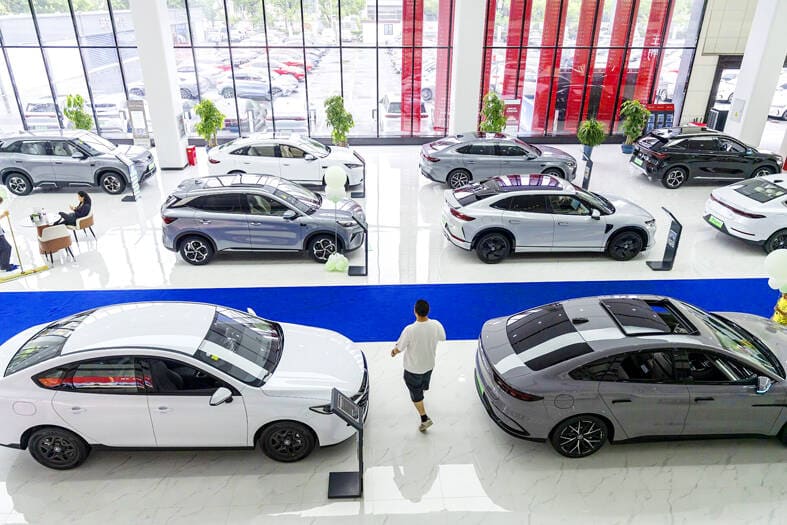
Electric vehicles in China are being replaced at a pace that defies conventional automotive economics. The average EV on Chinese roads is just 1.8 years old, according to data from the China Association of Automobile Manufacturers and Hejun Consulting. That compares to 8.2 years for gasoline-powered vehicles in the same market.
The replacement cycle is shorter than the typical lifespan of a smartphone, signaling a fundamental shift in how Chinese consumers view vehicle ownership. Rather than decade-long commitments, EVs are increasingly treated as upgradable hardware, replaced as soon as newer technology arrives.
Technology Obsolescence Drives Churn
The rapid turnover reflects the breakneck pace of innovation in batteries, autonomous driving software, and in-car computing. Chinese automakers release updated models with meaningful capability improvements every 12 to 18 months, making two-year-old vehicles feel outdated.
Data from Dongchedi, a Chinese automotive platform, shows that 43 percent of EV owners cite the desire to upgrade intelligent features and user experience as their primary reason for replacing vehicles. For a generation that grew up trading in smartphones annually, the logic extends naturally to cars.
Buyers under 35 form the core customer base for new-energy vehicles in China, according to the research. This demographic prioritizes advanced driver-assistance systems, over-the-air software updates, and digital cockpit experiences over traditional automotive virtues like longevity or mechanical refinement.
Depreciation Accelerates the Cycle
Economics reinforce the behavior. The average Chinese EV retains just 43.35 percent of its original value after three years, according to the CAAM report. That depreciation curve is steeper than conventional vehicles, making the financial cost of upgrading relatively modest for buyers who were planning to replace vehicles anyway.
The depreciation reflects both rapid technological obsolescence and uncertainty about long-term battery performance. First-generation lithium iron phosphate batteries from 2022 and 2023 models now face questions about capacity fade, while newer vehicles ship with chemistries promising better energy density and faster charging.
For manufacturers, the churn creates both opportunity and challenge. High replacement rates mean repeat customers and steady sales volumes, but they also compress the window for recovering development costs and put pressure on residual value guarantees.
Market Momentum Continues
The short service life has not dampened overall market growth. China's new-energy vehicle sector produced and sold more than 7 million units in the first half of this year, according to CAAM. Output from January through June reached 7.438 million units, up 6.7 percent year-on-year.
In June alone, NEVs accounted for nearly 60 percent of all new car sales in China, underscoring the speed of the country's transition away from internal combustion engines. That penetration rate, the highest in any major market, reflects aggressive pricing, expanding charging infrastructure, and policy support at both national and municipal levels.
Implications for the Global Auto Industry
The Chinese replacement cycle has implications beyond the country's borders. As Chinese EV makers expand into Southeast Asia, Europe, and Latin America, they bring with them a product development cadence and feature velocity that traditional automakers struggle to match.
Western manufacturers typically plan vehicle lifecycles of five to seven years, with mid-cycle refreshes rather than annual overhauls. That rhythm may not survive contact with a market where consumers expect meaningful upgrades every 18 months.
The environmental calculus is also complex. Shorter vehicle lifespans mean more embedded carbon from manufacturing and more end-of-life disposal challenges, even as EVs eliminate tailpipe emissions. Whether the net environmental impact is positive depends on how quickly the grid decarbonizes and how effectively batteries are recycled.
For now, the 1.8-year average service life stands as a data point that captures the unique dynamics of the world's largest EV market: a young, tech-forward customer base, relentless innovation, and a willingness to treat cars as consumer electronics rather than durable goods.
RELATED STORIES
Indonesia Seeks 100GW Solar Build From China, But Not Chinese Ownership
Priyanka V. Rao · 3 min

Solar Overtakes Coal in China's Power Grid for the First Time
Cheng Wei-Lun · 4 min

China's Social Security Fund Doubles Offshore Holdings to $86 Billion
Jun-ho Seo · 3 min

China Tightens Pre-Sale Mortgage Release to Protect Homebuyers Amid Stalled Market
Cheng Wei-Lun · 3 min
Spot something wrong? Email editor@briefasia.com. We log every correction publicly.