Technology · Products
Chenbro Flags Seven Indicators for Second Half 2026 AI Demand Outlook
Taiwan server chassis maker reports July revenue fluctuations tied to shipment timing while maintaining confidence in artificial intelligence infrastructure build-out
KEY TAKEAWAYS
- ·Chenbro CEO Corona Chen attributed July 2026 revenue fluctuations to shipment scheduling and recognition timing rather than demand weakness.
- ·The Taiwan chassis maker identified seven indicators to monitor AI server demand through the second half of 2026 as the industry shifts toward inference workloads.
- ·Asia-Pacific data center expansion and enterprise adoption will determine whether AI infrastructure spending sustains momentum beyond hyperscale customers.
Shipment Timing Drives Monthly Volatility
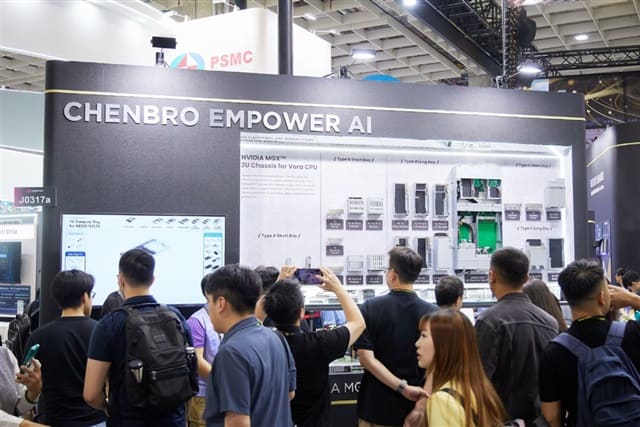
Chenbro Micom, a Taiwan-based manufacturer of server and storage chassis, saw its July 2026 revenue swing on shipment scheduling and revenue recognition cycles rather than underlying demand weakness, according to CEO Corona Chen. The company specializes in rack-mount and blade server enclosures used in data center deployments, a segment that has expanded rapidly as hyperscalers and enterprise customers build out infrastructure for generative AI workloads.
Chen noted that logistics variables and the timing of when revenue is formally recognized on the books contributed to month-to-month fluctuations. These operational factors are common in the server supply chain, where large orders can shift between quarters based on customer acceptance, shipping lead times, and contract terms.
Despite the near-term variability, Chenbro remains optimistic about sustained demand for AI-optimized server platforms. The company's chassis are deployed in configurations that house high-density GPU accelerators, advanced cooling systems, and power delivery architectures required for training and inference workloads.
Seven Metrics to Watch
Chenbro has identified seven indicators it plans to monitor closely through the second half of 2026 to gauge the trajectory of AI infrastructure investment. While the company has not publicly detailed all seven metrics, industry participants typically track GPU shipment volumes, data center construction starts, power infrastructure upgrades, cooling system deployments, networking equipment orders, memory and storage attach rates, and customer capex guidance.
These indicators offer a multi-dimensional view of whether AI demand is broadening beyond the handful of hyperscale customers that drove the initial wave of spending in 2024 and 2025. A sustained build-out requires not only continued investment by the largest cloud providers but also enterprise adoption and regional data center expansion across Asia-Pacific markets.
Server chassis suppliers like Chenbro sit upstream of final system integrators, giving them visibility into order pipelines and design wins several quarters ahead of revenue realization. Any shift in customer forecasts or design refresh cycles tends to surface first in component and subsystem demand.
Asia Data Center Landscape
The Asia-Pacific region has emerged as a critical theater for AI infrastructure deployment. Governments in Singapore, Japan, South Korea, and India have announced incentives and regulatory frameworks to attract data center investment, while local cloud providers and telecommunications operators are expanding capacity to serve domestic AI application developers.
Taiwan's server supply chain, which includes chassis makers, motherboard manufacturers, and thermal solution providers, plays a central role in this build-out. Companies in the ecosystem benefit from proximity to semiconductor fabs, established relationships with global ODMs, and expertise in high-performance computing hardware.
Chenbro's product portfolio spans general-purpose server chassis, GPU-optimized enclosures, and edge computing platforms. The company has been investing in thermal management technologies and modular designs that allow customers to scale configurations as workload requirements evolve.
Demand Outlook and Supply Chain Dynamics
The second half of 2026 will test whether AI infrastructure spending can sustain the pace set in the first half. Early-stage deployments focused on foundational model training, but the industry is now shifting toward inference at scale, which requires different hardware configurations and cost structures.
Inference workloads are more distributed, latency-sensitive, and price-conscious than training, prompting server vendors to optimize for power efficiency and total cost of ownership rather than raw compute density. This transition could reshape demand patterns for chassis and subsystems, favoring designs that support liquid cooling, edge deployment, and modularity.
Chenbro's monitoring framework reflects the need to track both top-down spending commitments from hyperscalers and bottom-up adoption signals from enterprises and regional providers. The seven indicators the company has flagged will serve as a barometer for whether the AI infrastructure cycle is entering a consolidation phase or continuing to broaden.
Forward View
The server supply chain has experienced multiple cycles of exuberance and correction over the past decade, driven by cloud migration, cryptocurrency mining, and now artificial intelligence. Chenbro's cautious optimism, paired with a structured approach to demand monitoring, suggests the company is preparing for a range of scenarios in the second half.
Revenue recognition and shipment timing will continue to introduce quarter-to-quarter noise, but the underlying question for investors and supply chain participants is whether AI infrastructure spending can maintain momentum as the technology moves from research labs to production environments. The seven indicators Chenbro plans to track will offer insight into that transition as 2026 unfolds.
RELATED STORIES
Wiwynn Profit Surges as Cloud Giants Accelerate AI Data Center Buildout
Cheng Wei-Lun · 4 min
Taiwan's Chip Exports Hit Record on Memory Price Surge and AI Build-Out
Cheng Wei-Lun · 2 min
Taiwanese Display Maker Qisda Bets on AI Servers to Reverse Monitor Slump
Cheng Wei-Lun · 3 min
GlobalFoundries Positions Itself as US Chip Sovereignty Cornerstone Amid Subsidy Push
Cheng Wei-Lun · 4 min
Spot something wrong? Email editor@briefasia.com. We log every correction publicly.