Asia · Politics
Beijing Institute Unveils Truck-Mounted Drone System That Blends Into Civilian Traffic
A new mobile launcher design points to China's strategy of dispersing airpower through commercial vehicles, lowering entry costs for allied states seeking strike capability
KEY TAKEAWAYS
- ·Beijing Institute of Technology demonstrated a truck-mounted drone launcher designed to blend into civilian traffic and disperse airpower away from fixed airbases.
- ·The system lowers the cost barrier for countries seeking offensive drone capability without investing in traditional manned aviation or dedicated military infrastructure.
- ·Footage was released and then quickly removed, suggesting the technology has reached demonstration stage for potential clients or internal stakeholders.
A Weapons Platform Hidden in Plain Sight
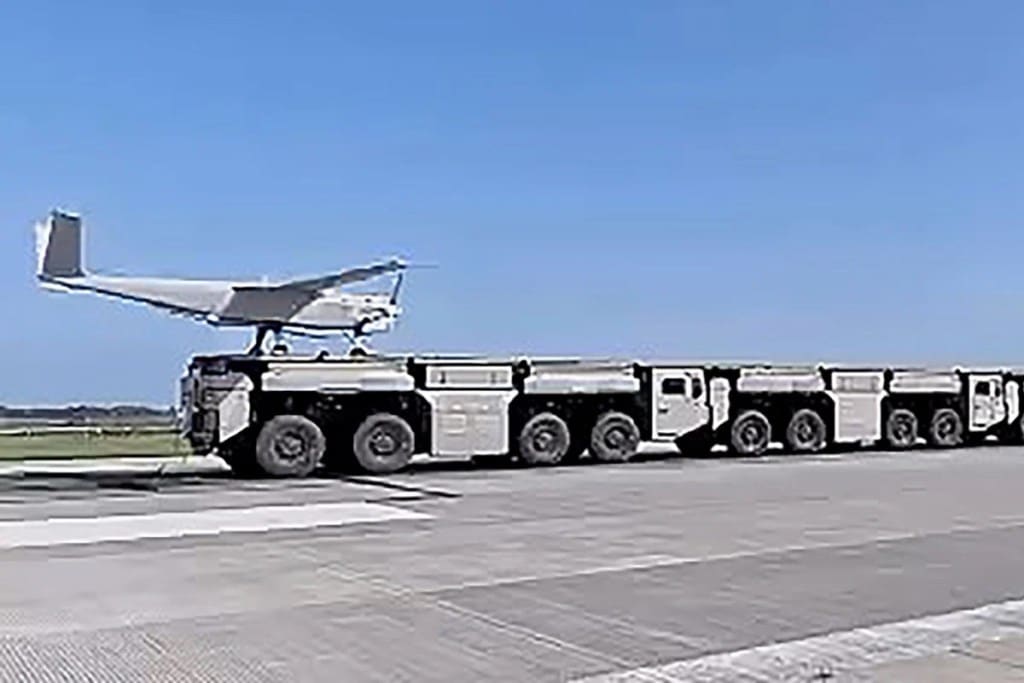
The Beijing Institute of Technology released social media footage this month showing a truck-mounted drone launcher capable of operating from civilian vehicles before swiftly removing the content from public view. The system represents a tactical shift in how military airpower can be deployed and concealed within everyday commercial traffic.
Rather than a standalone weapons platform, the design functions as a template for distributing strike capability across mobile units that resemble ordinary freight trucks. The approach allows military assets to blend into urban and rural logistics networks, complicating detection and targeting by adversaries.
Dispersed Airpower at Lower Cost
The launcher addresses two strategic priorities. First, it decentralizes air operations away from fixed airbases vulnerable to precision strikes. Second, it reduces the financial threshold for countries seeking offensive drone capability without investing in traditional fighter jets or dedicated military airfields.
For states across Southeast Asia, South Asia, and the Middle East, the system offers an alternative to expensive manned aviation programs. A truck-based launcher requires minimal infrastructure and can be operated by smaller military units with basic logistics support.
China has positioned itself as a supplier of affordable military technology to countries excluded from Western defense markets or unable to afford high-end systems. The truck drone launcher fits that export strategy, providing clients with asymmetric strike tools that challenge conventional air defenses.
Civilian Cover and Operational Flexibility
The use of commercial vehicle platforms creates operational ambiguity. Standard cargo trucks can move freely on public roads, park in industrial zones, and operate near civilian infrastructure without triggering immediate military alerts. This dual-use design complicates intelligence gathering and response planning for potential adversaries.
In a conflict scenario, the system could be deployed rapidly from dispersed locations, launch unmanned aircraft, and relocate before counterstrikes arrive. The mobility and low signature make the launchers difficult to track using satellite surveillance or signals intelligence.
The Beijing Institute of Technology, a state-affiliated research body with close ties to the People's Liberation Army, has previously developed technologies spanning autonomous systems, precision guidance, and electronic warfare. The institute's involvement signals that the truck launcher is part of a broader modernization effort within China's defense research ecosystem.
Regional Implications
The technology arrives as regional militaries reassess their own drone procurement and counter-drone strategies. Countries in the Indo-Pacific are expanding unmanned systems portfolios, with several already operating Chinese-made reconnaissance and strike drones.
A truck-based launcher lowers the barrier for smaller militaries to field offensive air capability. It also raises questions about verification and arms control, as the systems can be disguised within civilian logistics fleets and moved across borders without obvious military markings.
For China, the system supports a broader doctrine of distributed operations and layered air defenses. Mobile launchers complement fixed installations and traditional aircraft, creating a more resilient and adaptable force structure.
What Comes Next
The rapid removal of the footage suggests sensitivity around public disclosure, possibly due to export negotiations or operational security concerns. However, the brief release indicates the system has reached a stage of development where demonstration to potential clients or domestic stakeholders is underway.
Defense analysts will watch for further details on payload capacity, range, and integration with command networks. The truck launcher's true impact will depend on how widely it is adopted by China's military and which international buyers express interest.
As unmanned systems continue to reshape military aviation, platforms that merge with civilian infrastructure represent a new category of capability. The Beijing Institute's truck launcher is an early indicator of how air power may be hidden, moved, and deployed in future conflicts across Asia and beyond.
RELATED STORIES
Malaysia's Rare Earth Deposits Draw Foreign Interest Ahead of China Export Controls
Priyanka V. Rao · 3 min

Honda Demands 30% Price Cuts From Suppliers in $9.4 Billion Cost Plan
Cheng Wei-Lun · 3 min
Beijing Warns Domestic EV Makers Against Overseas Price Wars
Cheng Wei-Lun · 3 min
Volkswagen Probes Chinese Supplier After Hundreds of New Graduates Dismissed
Cheng Wei-Lun · 3 min
Spot something wrong? Email editor@briefasia.com. We log every correction publicly.