Finance · Fintech
Behind the Tap: How Travel Cards Route Payments Across 26 Currency Wallets
LuLu Exchange rebuilt its prepaid card architecture to eliminate vendor handoffs and unify issuing, processing, and foreign exchange on a single ledger
KEY TAKEAWAYS
- ·LuLu Exchange launched a prepaid travel card supporting 26 currency wallets after consolidating issuing, processing, and FX on a single platform provided by Stitch.
- ·Cross-border spending on Asia-Pacific Visa cards grew more than twice as fast as domestic transactions in 2025, while travel merchant spending rose 2.5 times faster than overall card use.
- ·The unified architecture enables priority-based wallet dipping, automatically drawing from a secondary wallet and converting only the shortfall when the primary balance is insufficient.
The Hidden Routing Problem
When a shopper taps a payment card abroad, the terminal sees a standard transaction. The card platform, however, must solve a routing puzzle in milliseconds: identify the purchase currency, locate the corresponding wallet, check if another balance should cover any gap, execute foreign exchange if needed, then authorize and settle the payment.
That complexity intensifies as Asian travelers return to pre-pandemic patterns. Cross-border spending on Visa cards issued in Asia-Pacific outpaced domestic volume growth by more than two-to-one in 2025, according to the network's data. Travel merchant spending climbed roughly 2.5 times faster than overall card use. UN Tourism recorded over 300 million international arrivals in the first quarter of 2025, up five percent year-on-year.
Financial institutions responding to that demand face an architectural question: how to coordinate issuing, processing, currency conversion, settlement, and reconciliation when customers hold a dozen or more currency wallets on one card.
A Stack Built from Separate Vendors
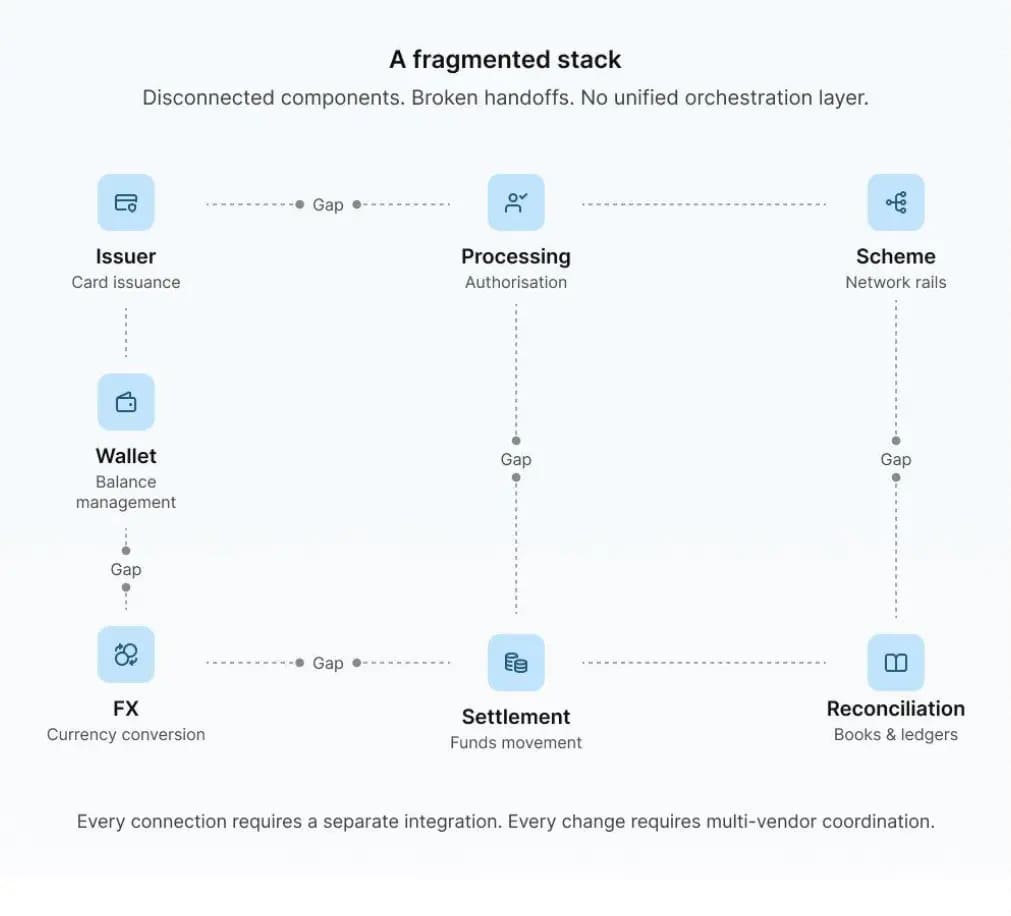
LuLu Exchange, a UAE-based remittance and foreign exchange firm, encountered the problem when it designed a prepaid travel card. The company had worked with separate providers for processing, issuing infrastructure, FX conversion, and settlement. Each vendor performed its role, but no single layer managed the logic connecting them.
Joseph Cleetus, Vice President of Business Transformation at LuLu Exchange, said the fragmented arrangement imposed a ceiling on product development. Adding a currency required fresh integrations. Adjusting a transaction limit or fee structure became a multi-vendor coordination task. Scaling transaction volume meant accepting parallel increases in operational complexity.
The challenge was not scarcity of components. Issuers, processors, FX platforms, and reconciliation tools are widely available in the market. The gap lay in the orchestration layer between them.
Consolidating the Operating Environment
LuLu Exchange turned to Stitch, a fintech infrastructure provider, to collapse the vendor stack into a unified operating environment. Stitch integrated issuing, transaction processing, FX execution, ledger management, and reconciliation within a single platform.
A shared data model gave LuLu Exchange real-time visibility into balances and transaction flows. A consistent API set allowed the product team to configure programme rules without maintaining separate connections for each function. External partners, including the sponsoring bank and payment networks, remained in place; Stitch coordinates card behavior and transaction logic across those relationships.
The unified ledger underneath the platform maintains the authoritative record of balances and movements. Operations staff no longer trace mismatches across disconnected systems after a customer completes a purchase.
Priority-Based Wallet Dipping
The architecture enables a funding mechanism Stitch calls priority-based wallet dipping. Customers rank their currency wallets in preferred order. When the wallet matching the purchase currency holds insufficient funds, the platform automatically checks the next wallet in the sequence and converts only the shortfall amount needed to approve the transaction.
Consider a customer making a 100 Singapore dollar purchase with only 70 dollars remaining in the SGD wallet. A single-balance card would decline the payment. The LuLu card instead draws the 30-dollar shortfall from the next available wallet, converts the amount at the prevailing rate, and completes the authorization. The customer sees one approved transaction; the institution records debits across two wallets, currency conversion, and ledger updates that must later reconcile with network settlement data.
Configuration Versus Engineering Work
The consolidated architecture shifts product control from vendors back to the financial institution. Currencies, fees, transaction limits, and wallet priorities can be adjusted through configuration rather than engineering releases coordinated across multiple providers.
That distinction matters when travel corridors shift or customer behavior changes. A product team able to add a currency or reprice FX margins through configuration can respond in days. A team dependent on vendor roadmaps and integration cycles may wait months.
Stitch says its platform can reduce implementation timelines by 80 percent, with some programmes launching in 90 days compared to nine-to-twelve-month cycles typical of traditional card stacks.
Live in 26 Currencies
LuLu Exchange now offers a reloadable prepaid travel card supporting AED and 25 additional currencies, available in both digital and physical formats through the LuLu Money app. Customers manage PINs, adjust spending limits, freeze or unfreeze the card, and review transaction history through PCI-certified widgets embedded in the existing app.
Supporting 26 wallets creates ongoing operational demands. Travel patterns evolve, new corridors emerge, and pricing requires periodic review. The unified platform allows LuLu Exchange to adjust those parameters without reopening the underlying technology stack.
The Invisible Test
Customers evaluate a travel card at the point of sale: does the transaction go through, and does it draw from the right balance? Product teams face a different benchmark: can the programme adapt without triggering another round of integrations and operational fixes?
The architecture remains invisible to the cardholder tapping in Tokyo or Singapore. It determines, however, how much control the issuing institution retains after launch and how quickly it can respond when the next travel wave reshapes cross-border payment flows across Asia.
RELATED STORIES

Franklin Templeton Restructures Leadership With Two Senior Appointments
Priyanka V. Rao · 4 min

Allianz Acquires HSBC Singapore Insurance Operations in $2.3 Billion Deal
Priyanka V. Rao · 3 min

Singapore Approves 37 Crypto Firms From Nearly 300 License Applications
Priyanka V. Rao · 2 min
Singapore's Big Three Banks Post Solid First-Half Gains as Wealth Offsets Margin Pressure
Priyanka V. Rao · 3 min
Spot something wrong? Email editor@briefasia.com. We log every correction publicly.