Technology · Dev
AMD Unveils ROCm.ai Platform to Challenge NVIDIA in AI Software
New AI-native development suite promises 3.3x inference performance gains and automated optimization for enterprise AI deployment
KEY TAKEAWAYS
- ·AMD launched ROCm.ai, an AI-native development platform integrating coding assistants and deployment tools, claiming inference performance gains of up to 3.3x on supported models.
- ·The platform aims to reduce developer friction in moving from NVIDIA CUDA by automating kernel optimization, model quantization, and distributed inference across AMD Instinct accelerators.
- ·Asia's sovereign AI infrastructure projects in Japan, Singapore, and South Korea favor vendor diversity, giving AMD an opening as regional cloud operators evaluate alternatives to NVIDIA hardware.
AMD's Software Play
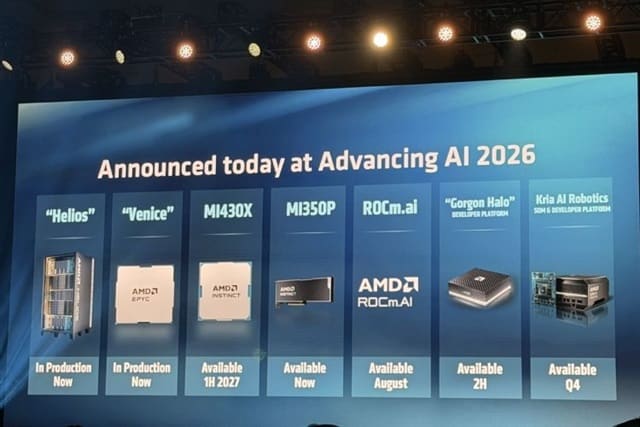
AMD announced ROCm.ai at its Advancing AI 2026 event, positioning the platform as a comprehensive answer to NVIDIA's entrenched CUDA toolkit. The AI-native development environment bundles coding assistants, deployment infrastructure, and automated optimization engines into a single package designed to lower barriers for developers building agentic AI systems on AMD hardware.
The company claims inference performance improvements of up to 3.3x on supported models, though it has not yet disclosed the baseline configurations or specific workloads used for those benchmarks. The figure suggests AMD is targeting real-world deployment scenarios where inference speed directly affects user experience and operational cost.
What ROCm.ai Includes
ROCm.ai extends AMD's existing Radeon Open Compute (ROCm) stack with three new layers. The first is an AI-powered coding assistant that generates hardware-optimized kernels and suggests parallelization strategies for AMD Instinct accelerators. The second is a deployment toolchain that automates model quantization, memory management, and distributed inference across multi-GPU clusters. The third is a profiling suite that identifies bottlenecks and applies optimizations without manual tuning.
Together, these components aim to compress the development cycle for enterprises moving from prototype to production. AMD is pitching the platform at organizations building retrieval-augmented generation pipelines, autonomous agent frameworks, and multi-modal applications where model orchestration and latency matter as much as raw compute.
The CUDA Moat
NVIDIA's CUDA has enjoyed a decade-long head start, and thousands of libraries, frameworks, and training programs have coalesced around it. Developers familiar with CUDA's APIs, debugging tools, and performance characteristics rarely have an incentive to retrain on alternative stacks, even when competing hardware offers better price-performance on paper.
AMD has spent years trying to bridge that gap with ROCm, but adoption has been slower than the company hoped. ROCm.ai represents a shift in strategy by embedding AI into the development experience itself rather than asking developers to port code manually. If the coding assistant can automatically translate CUDA idioms into ROCm equivalents and the profiler can match or exceed hand-tuned performance, the friction cost of switching drops.
Asia's AI Infrastructure Race
The announcement comes as governments and cloud providers across Asia accelerate investments in sovereign AI infrastructure. Japan's ABCI-3.0 supercomputer, Singapore's National Supercomputing Centre expansion, and South Korea's K-Cloud AI initiative all include procurement processes that favor vendor diversity and interoperability over single-vendor lock-in.
AMD has already secured design wins with several regional cloud operators, and ROCm.ai gives those customers a more complete software story when pitching AI services to enterprise clients. For hyperscalers in Jakarta, Taipei, and Mumbai evaluating alternatives to NVIDIA's H100 and forthcoming Blackwell systems, a mature software stack reduces deployment risk.
Deployment Timing
AMD did not provide a general availability date for ROCm.ai but indicated that select partners are already testing early builds. The company plans to release documentation, API references, and a developer preview program in the coming quarter, with broader rollout tied to the production ramp of its next-generation Instinct MI300-series accelerators.
Whether ROCm.ai can erode NVIDIA's software moat will depend less on feature parity and more on whether AMD can sustain the engineering investment required to keep pace with CUDA's rapid evolution. NVIDIA ships multiple toolkit updates each year, and any gap in framework support or performance can send developers back to the incumbent. AMD's gamble is that AI-assisted development tools can close that gap faster than human engineers alone.
RELATED STORIES

SK Hynix Opens Silicon Valley HBM Design Hub to Lock Down Next-Gen Chip Orders
Cheng Wei-Lun · 3 min
AMD Points to Server CPU Playbook as Template for AI Chip Growth
Cheng Wei-Lun · 3 min
AMD Acquires Taalas to Embed AI Model Weights Directly in Silicon
Cheng Wei-Lun · 3 min
Advantech Unveils AMD EPYC 9006-Powered AI Server Platform
Cheng Wei-Lun · 4 min
Spot something wrong? Email editor@briefasia.com. We log every correction publicly.