Technology · Products
Wistron Launches $700 Million Texas Plant to Mass-Produce Nvidia's GB300 Chips
Taiwan-based manufacturer opens its first US facility in Fort Worth, with plans for a second plant double the size as AI hardware demand accelerates
KEY TAKEAWAYS
- ·Wistron opened a $700 million, 30,100-square-meter facility in Fort Worth, Texas, becoming the first to mass-produce Nvidia GB300 Grace Blackwell Ultra chips in the United States.
- ·The plant operates at 60 percent automation and began production this month, with Wistron already planning a second facility twice the size to meet AI infrastructure demand.
- ·The investment reflects Taiwan manufacturers' strategy to establish US production capacity for geopolitical resilience while developing local supply chains from chips to complete systems.
Taiwan's Server Giant Establishes US Manufacturing Beachhead
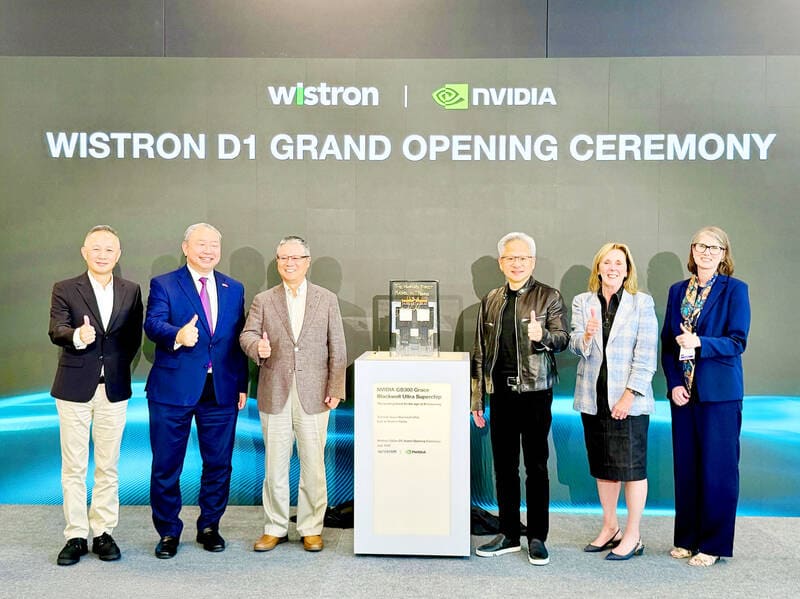
Wistron inaugurated its first American manufacturing base on Tuesday, a 30,100-square-meter smart facility in Fort Worth that represents a $700 million bet on reshoring advanced AI hardware production. The plant, designated D1, has begun mass-producing Nvidia's GB300 Grace Blackwell Ultra chips, marking the first time these advanced processors are being manufactured at scale on US soil.
The facility's 60 percent automation rate reflects the complexity of modern AI server assembly, where precision and speed determine competitive advantage. Wistron acquired the Fort Worth site in April 2025 and accelerated production timelines to meet customer demand, bringing the plant online this month.
Expanding Footprint in the AI Supply Chain
Wistron chairman Simon Lin announced at the opening ceremony that the company is already planning D2, a second facility expected to span twice the area of the current plant. The expansion signals confidence in sustained demand for AI infrastructure as hyperscalers and enterprise customers race to deploy generative AI capabilities.
The Fort Worth plant will also manufacture Nvidia's next-generation Vera Rubin chips, positioning Wistron as a critical partner in the GPU maker's roadmap. Lin emphasized that future AI industry growth requires global manufacturing presence rather than concentration in a single region, a strategic shift driven by supply chain resilience concerns and geopolitical considerations.
The company plans to develop a local supply chain ecosystem in Texas covering components from chips through complete systems, reducing dependence on cross-Pacific logistics and tariff exposure. This vertical integration approach mirrors strategies employed by competitors establishing US operations.
Regional Manufacturing Stakes
The Fort Worth facility opening drew Nvidia CEO Jensen Huang and Taiwan's representative to the US, Alexander Yui, underscoring the diplomatic and commercial significance of the investment. For Texas, the plant represents an anchor in the state's push to attract semiconductor and advanced manufacturing capacity, competing with Arizona, Ohio, and other states offering incentives under federal CHIPS Act funding.
Wistron president Jeff Lin noted that mass production began this month, an unusually rapid ramp-up that suggests pre-existing customer commitments and pressure to deliver capacity quickly. The timeline from acquisition to production in roughly fourteen months is aggressive by industry standards, where facility build-outs typically span two to three years.
The D1 plant positions Wistron alongside Hon Hai (Foxconn), which is also establishing AI server production in Texas. Both Taiwan-based manufacturers are responding to customer requirements for geographic diversification and compliance with "Made in USA" mandates increasingly common in government and enterprise procurement.
Asia's Role in the US AI Hardware Build-Out
Taiwan's dominance in electronics manufacturing is extending into the AI era through investments like Wistron's Fort Worth facility. The island's expertise in precision assembly, supply chain orchestration, and rapid production scaling remains difficult to replicate, even as manufacturing shifts westward.
The facility's 60 percent automation rate, while high by traditional standards, leaves 40 percent of processes dependent on skilled labor, a potential bottleneck in the tight Texas manufacturing labor market. Wistron will need to recruit and train technicians capable of handling advanced server assembly, competing with semiconductor fabs and other high-tech employers in the region.
The D2 expansion plans suggest Wistron sees Fort Worth as a long-term hub rather than a hedge against geopolitical risk. Doubling capacity before the first plant reaches full utilization indicates either firm customer commitments or an expectation that AI infrastructure spending will continue accelerating through the end of the decade.
As Asian manufacturers establish US operations, they bring capital, technology transfer, and supply chain relationships that reshape regional industrial ecosystems. The success of Wistron's Texas gambit will depend on execution speed, yield rates, and whether customers are willing to pay premiums for domestically assembled AI servers over alternatives produced in Taiwan or Southeast Asia.
RELATED STORIES
Delta Electronics Unveils AI-Powered Dual-Arm Cobot for Server Assembly
Cheng Wei-Lun · 3 min
Taiwan Indicts Nvidia Manager in Chip-Smuggling Investigation
Cheng Wei-Lun · 4 min

Itochu and Taiwan IT Leader Back Taiwanese Chip Firms' Kyushu Push
Cheng Wei-Lun · 3 min

Taiwan's Neousys Bets on Edge AI Expansion Across Defense and Manufacturing
Cheng Wei-Lun · 3 min
Spot something wrong? Email editor@briefasia.com. We log every correction publicly.