Finance · Markets
Vietnam's Gold Trades Above Global Rates as Mideast Tensions Push Bullion Higher
Local prices rose above international benchmarks while spot gold reached a two-week peak on technical buying and geopolitical risk
KEY TAKEAWAYS
- ·Vietnam's gold bars rose 0.41 percent to VND147 million per tael, maintaining a VND14.8 million premium over global rates due to import constraints.
- ·Spot gold climbed 1.6 percent to $4,139.64 per ounce, reaching a two-week high as Middle East tensions and technical buying revived demand.
- ·Traders await the Federal Reserve's July meeting for interest rate guidance, with higher rates increasing the opportunity cost of holding non-yielding bullion.
Domestic Rates Climb on Global Rally
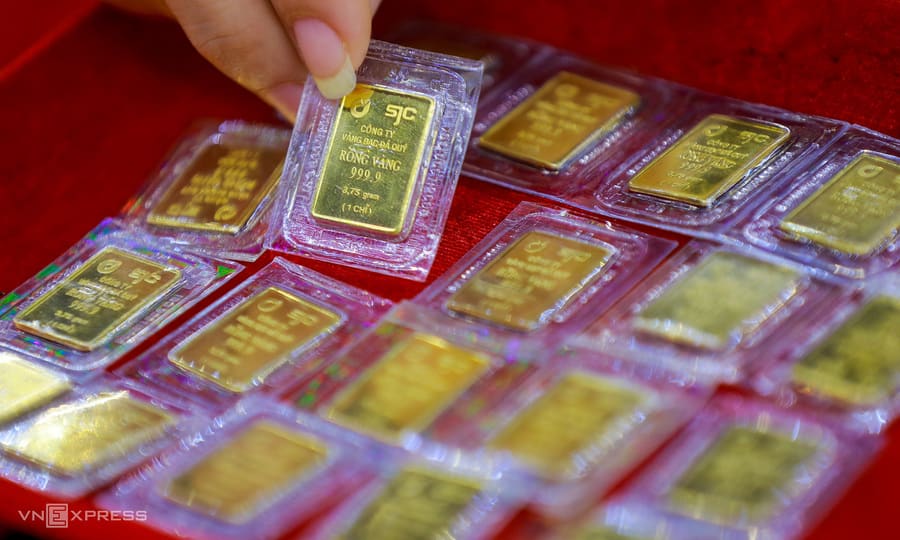
Vietnam's gold bars rose on Wednesday morning, with Saigon Jewelry Company lifting its benchmark price by 0.41 percent to VND147 million per tael, equivalent to $5,581.71. The increase tracked a global rally that pushed spot bullion to its highest level in fourteen days, though local rates maintained a substantial premium over international benchmarks.
The domestic market traded roughly VND14.8 million per tael above equivalent global prices, a spread reflecting Vietnam's structural supply constraints and persistent retail demand. Gold rings, typically sold at a slight discount to bars due to fabrication costs and lower purity, reached VND146 million per tael. One tael equals 37.5 grams.
The premium gap between Vietnamese and international gold has persisted for months, driven by import licensing bottlenecks and limited central bank allocations to commercial banks. State Bank of Vietnam auctions have provided intermittent supply, yet volumes remain insufficient to close the arbitrage window that has made Vietnam one of Asia's most expensive gold markets on a per-gram basis.
Geopolitical Risk Revives Safe-Haven Demand
Spot gold advanced 1.6 percent to $4,139.64 per ounce on Wednesday, while August futures contracts in the United States jumped 1.7 percent to $4,144.20. The move represented a technical rebound after prices retreated from multi-year highs earlier this year, with traders reassessing risk exposures ahead of next week's Federal Reserve policy meeting.
Tim Waterer, chief market analyst at KCM Trade, noted that buyers returned following the recent pullback, viewing current levels as attractive entry points. Diplomatic signals between Washington and Tehran also contributed to cautious optimism, though the Middle East conflict has already reshaped gold's trajectory in recent months.
The escalation of tensions between the United States and Iran earlier this year helped deflate a multi-year rally that had carried gold to nearly $5,600 per ounce in January. Prices have since declined approximately 25 percent from that peak, according to data compiled by Bloomberg. The correction reflected a combination of profit-taking, reduced safe-haven flows as diplomatic channels reopened, and expectations that central banks would maintain restrictive monetary policy longer than markets initially anticipated.
Interest Rate Outlook Weighs on Sentiment
Market participants are balancing competing forces as they position for the Federal Reserve's upcoming decision. Rising energy costs, partly linked to Middle East instability, have complicated the inflation picture, while softer economic data from the United States suggests demand pressures may be easing. The interplay between these dynamics will shape the Fed's assessment of whether to hold rates steady or signal a shift in policy stance.
Higher interest rates typically weigh on gold because the metal generates no income, making it less attractive relative to interest-bearing assets such as Treasury securities or money-market funds. The opportunity cost of holding bullion rises when yields climb, drawing capital away from precious metals and into fixed-income instruments. Conversely, rate cuts or dovish guidance can reignite demand for gold as a hedge against currency depreciation and inflation.
The Fed's July meeting will be closely watched for clues about the path forward. Any indication that policymakers are considering rate reductions later this year could provide fresh support for bullion, particularly if inflation data continues to moderate. Conversely, hawkish rhetoric emphasizing the need to keep policy tight would likely cap near-term gains.
Asia's Persistent Appetite for Physical Gold
Vietnam's elevated domestic prices underscore a broader pattern across Asia, where physical gold demand remains robust despite price volatility. Retail buyers in the region view bullion as a store of value and a hedge against currency fluctuations, with cultural preferences reinforcing demand during festivals, weddings, and other significant life events.
In neighboring markets such as India and China, gold imports have fluctuated with government policy and tariff adjustments, yet underlying demand has proven resilient. India's wedding season typically drives seasonal spikes in jewelry purchases, while Chinese investors have turned to gold as property markets weaken and equity returns disappoint. Vietnam's market shares these characteristics, with households accumulating gold bars as a form of savings in an environment where deposit rates often lag inflation.
The premium structure in Vietnam also reflects the country's position as a net importer of gold, with limited domestic mining output and regulatory constraints on cross-border flows. Efforts by the State Bank of Vietnam to stabilize the market through periodic auctions have provided temporary relief, yet they have not eliminated the price gap. Importers face licensing requirements and quota restrictions, creating supply tightness that supports elevated domestic valuations.
Regional Context and Forward Outlook
Southeast Asia's gold markets are navigating a complex environment shaped by global monetary policy, geopolitical risk, and local regulatory frameworks. Thailand, another major gold consumer in the region, has seen similar dynamics, with domestic prices occasionally diverging from international benchmarks due to import restrictions and demand surges.
The trajectory of gold prices in the coming months will hinge on several factors. The Federal Reserve's policy stance remains paramount, with any shift toward rate cuts likely to provide tailwind for bullion. Geopolitical developments, particularly in the Middle East, will continue to influence safe-haven flows. In Vietnam specifically, the government's willingness to expand gold supply through auctions or import liberalization could narrow the premium gap, though policy changes have historically been gradual.
For now, Vietnamese buyers are paying one of the highest premiums in the region, a reflection of both structural market features and the enduring appeal of gold as a wealth preservation tool. As global prices stabilize and central banks signal their next moves, the interplay between international benchmarks and local demand will determine whether Vietnam's premium persists or begins to compress.
RELATED STORIES

Vietnam's VN-Index Climbs Toward 1,800 as Market Sentiment Strengthens
Priyanka V. Rao · 3 min

Malaysia Hospital Group A1Health Prepares US$1.7 Billion IPO for Early 2027
Tran Quoc Bao · 2 min

Vietnam's Trade Turnover Hits $770 Billion as Imports Surge Past Exports
Jun-ho Seo · 2 min

Samsung's Vietnam Operations Post 23% Profit Jump to $2.3 Billion
Tran Quoc Bao · 3 min
Spot something wrong? Email editor@briefasia.com. We log every correction publicly.