Perspectives · Analysis
Vietnam's Double-Digit Growth Gamble
Hanoi's push for 10 percent expansion collides with inflation risk and an ageing population, testing whether the country can leap to high-income status without repeating past credit booms.
KEY TAKEAWAYS
- ·Vietnam aims for 10 percent annual GDP growth through 2030, requiring 16-20 percent credit expansion, 11-12 percent consumption growth, and a 4-5 percent fiscal deficit.
- ·The country faces a narrowing demographic window as healthy life expectancy lags regional peers, raising the risk of an ageing population with insufficient social security coverage.
- ·Export growth is threatened by potential US tariff escalation above 40 percent on transshipment goods, while diversification into new markets remains difficult.
- ·Credit-fueled growth in 2007-2010 triggered inflation above 18 percent and non-performing loans exceeding 8 percent, prompting current caution at the State Bank of Vietnam.
- ·The policy dilemma centers on whether credit can expand fast enough to hit growth targets without repeating past cycles of overheating and asset bubbles.
A Political Mandate Meets Economic Reality
Since General Secretary To Lam took office in August 2024, Vietnam's economic strategy has centered on a single, high-stakes target: sustained double-digit GDP growth. Former Prime Minister Pham Minh Chinh framed the goal as a "must-do" to propel the country into developed, high-income status by 2045. His successor, Le Minh Hung, has doubled down on this commitment, even as the Iran War disrupts global supply chains and energy markets.
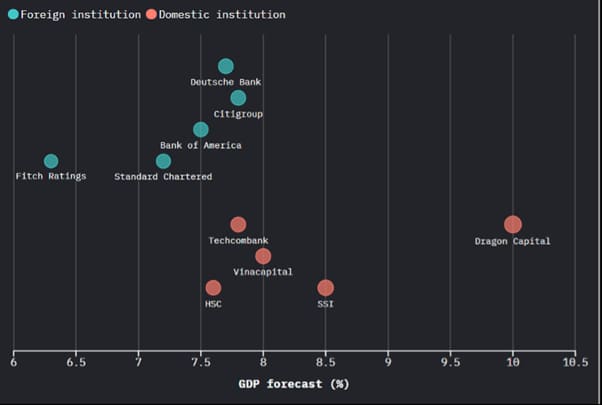
The conviction stands in sharp contrast to forecasts from multilateral institutions. The IMF, World Bank, and Asian Development Bank project Vietnam's 2026 growth at 6 to 7 percent, citing tariff uncertainty and cooling consumer demand. Domestic brokerages, meanwhile, echo Hanoi's optimism: SSI Securities sees 8.8 percent expansion, and Dragon Capital pencils in 10 percent. The gap is not merely a difference in spreadsheet assumptions. It reflects a deeper question about whether Vietnam can sustain an accelerated growth model without repeating the credit booms and inflation spikes that destabilized the economy in 2007-2010.
The Clock Is Ticking
Vietnam's urgency is rooted in demography. The country currently enjoys a "golden population" structure, with a large working-age cohort and relatively few dependents. But that window is closing fast. Giang Thanh Long of the National Economics University points to a troubling divergence: Vietnam's overall life expectancy now matches Thailand and Malaysia, yet its healthy life expectancy lags behind. The country faces the prospect of an ageing population that is "living longer, but not necessarily better," unable to work or start businesses in later years.
Social security coverage compounds the challenge. In the informal sector, which accounts for a significant share of employment, contribution rates to social insurance often sit below 10 percent. Without rapid income growth and a funded safety net, the demographic shift will become a fiscal burden just as the labor force shrinks. The window to accumulate capital, build infrastructure, and expand the tax base is narrowing. Hanoi's calculus is straightforward: grow fast now, or face the middle-income trap with an elderly population and insufficient resources.
The Recipe: Credit, Spending, and Exports
Dragon Capital, Vietnam's largest independent fund manager, has modeled the requirements for 10 percent annual growth through 2030. The ingredients are clear. Credit expansion must run between 16 and 20 percent per year, well above the State Bank of Vietnam's current 15 percent target. Domestic consumption needs to accelerate from an average of 8 percent over 2021-2024 to 11-12 percent. The fiscal deficit should widen to 4-5 percent of GDP, channeling funds into infrastructure. Export growth must exceed 12 percent annually, generating a trade surplus of 50 billion dollars by 2030. And inflation must stay contained between 4.5 and 5 percent.
The government's own projections align with this blueprint. Industry and construction are expected to expand by 12 percent or more, with services growing at 11 percent. Public investment is the primary lever, rising more than 10 percent compared to 2025. Public-private partnerships are encouraged, though state resources are positioned to play a "guiding role."
The model is internally coherent, but it rests on assumptions that are increasingly fragile. Export growth, long a pillar of Vietnam's rise, now faces headwinds. The country has benefited from production shifting out of China, positioning itself as a "connector economy" for multinationals. But that same strategy exposes Vietnam to tariff escalation. The United States currently applies a 20 percent tariff; goods identified as transshipments could face rates exceeding 40 percent. The recent de-escalation in trade tensions is widely seen as a pause, not a resolution. Vietnam remains one of the most trade-dependent economies in emerging Asia, and diversification into the Middle East, Latin America, and Africa is proving difficult. Those markets are smaller, and every other exporter is chasing the same opportunities.
Consumption Cools, Credit Looms
Domestic demand is also softening. Nominal retail sales grew 9.5 percent recently, but after adjusting for inflation, real spending rose just 7.2 percent. Consumer confidence has fallen to its lowest level since the pandemic, with households pulling back on discretionary purchases and increasing savings. The shift toward defensive behavior suggests that households are bracing for uncertainty, not preparing to drive an 11-12 percent consumption boom.
That leaves credit and public spending as the primary engines. But here the policy dilemma sharpens. Achieving 16-20 percent credit growth while holding inflation to 4.5-5 percent is a narrow path, especially with energy prices volatile due to the Iran War. Vietnam has walked this tightrope before and stumbled. Between 2007 and 2010, bank lending surged above 30 percent annually, peaking above 50 percent in 2007. The short-term stimulus delivered growth, but it also triggered inflation that exceeded 18 percent in 2008 and 2011. Non-performing loans climbed above 8 percent by 2012, forcing the establishment of the Vietnam Asset Management Company in 2013 to clean up bank balance sheets.
The memory of that cycle informs current caution at the State Bank of Vietnam, which set a 15 percent credit growth target for 2026, down from 19 percent in 2025. Nguyen Duc Hien, Deputy Head of the CPV Central Commission of Policy and Strategy, has warned that growth cannot come at any cost. "If inflation gets out of control, the price to pay will be much greater than the benefits of growth," he stated. The central bank also faces tension in its exchange rate policy: it must keep monetary conditions loose enough to support growth targets while defending currency stability, a priority that Le Minh Hung has reaffirmed.
The Quality of Growth Matters
The core challenge is not whether Vietnam can generate 10 percent growth in the short term. With enough credit and fiscal stimulus, it probably can. The question is whether that growth will be productive or inflationary, whether it will build the foundation for high-income status or leave behind a legacy of bad loans and asset bubbles. The answer depends on how credit is allocated.
If lending flows into high-multiplier projects such as transportation networks, energy security, and digital infrastructure, the growth will be durable. If it chases real estate speculation or low-productivity sectors, the result will be a repeat of 2007-2010. The government's emphasis on public investment and state-guided partnerships suggests an awareness of this risk, but execution will determine the outcome. Vietnam's banking system has improved since the reforms of the 2010s, yet the pressure to meet political growth targets can distort credit allocation, especially when local officials face performance metrics tied to GDP expansion.
Navigating the Dilemma
Vietnam's double-digit growth strategy is not irrational. The country has structural advantages: a young workforce, deep integration into global supply chains, rising urbanization, and a track record of policy pragmatism. The demographic clock and the middle-income trap are real constraints, and the argument for front-loading growth has merit. But the strategy is high-risk. It requires threading a needle between credit expansion and price stability, between fiscal stimulus and debt sustainability, between export dependence and tariff exposure.
The disparity between Hanoi's targets and international forecasts reflects more than a difference in optimism. It signals a fundamental tension in Vietnam's development model. The mechanisms needed to hit 10 percent growth are the same ones that threaten macroeconomic stability. Credit must expand rapidly, but not so fast that it fuels inflation or asset bubbles. Public spending must rise, but without creating a debt overhang. Exports must grow, but not in ways that invite protectionist retaliation.
The next few years will test whether Vietnam can manage this balance. The country has navigated difficult transitions before, from post-war reconstruction to the Doi Moi reforms of the 1980s to the integration into global markets in the 2000s. But each of those shifts occurred in a more favorable external environment. Today, global trade is fragmenting, monetary conditions are tightening in advanced economies, and geopolitical rivalries are intensifying. Vietnam's ambition is clear. Whether the execution matches the rhetoric will determine whether the country reaches high-income status or stumbles into another cycle of boom and bust.
What Comes Next
The government's commitment to double-digit growth is unlikely to waver in the near term. It is a political imperative, tied to the legitimacy of the CPV and the promise of prosperity. But the risks are mounting. If inflation accelerates, the State Bank of Vietnam will face pressure to tighten policy, undermining growth. If credit quality deteriorates, the banking sector will weaken, limiting future lending capacity. If exports falter due to tariffs, the model will rely even more heavily on domestic stimulus, amplifying fiscal and monetary strain.
The path forward requires discipline. Credit must be directed toward productive investment, not speculation. Fiscal policy must prioritize infrastructure with long-term returns, not short-term spending to inflate GDP numbers. Exchange rate stability must be defended without sacrificing growth entirely. And policymakers must be willing to adjust the target if conditions deteriorate, rather than pursuing growth at any cost.
Vietnam's double-digit ambition is bold, but ambition alone does not guarantee success. The country stands at a crossroads, and the choices made in the next few years will shape its trajectory for decades. The question is not whether Vietnam wants to grow fast. It is whether the country can grow fast and grow well at the same time.
RELATED STORIES

Vietnam's Offshore Oil Find Tests Hanoi's Will Against Beijing
Priyanka V. Rao · 5 min
Vietnam's National Assembly Closes Extraordinary Session With Nuclear and Renewable Energy Approvals
Tran Quoc Bao · 3 min

The pianist who goes looking for forgotten music
Manh Khang · 8 min
-800x471.jpg?prefix=brief-asia)
Cover the logo. They'll still know who you are.
Simon Ng · 9 min
Spot something wrong? Email editor@briefasia.com. We log every correction publicly.