Finance · Markets
Taiwan Reclaims Foreign Investor Flows as AI Stock Volatility Persists
Steadier earnings and supply-chain breadth draw $1.7 billion net inflows this month while South Korean markets shed $6.2 billion
KEY TAKEAWAYS
- ·Foreign investors bought $1.7 billion of Taiwanese equities this month after a six-week selling streak, while withdrawing $6.2 billion from South Korean markets.
- ·Analysts raised 12-month earnings estimates for Taiwan-listed firms by 9.5 percent in the past month, outpacing South Korea's 7.4 percent upward revision for the first time in nearly a year.
- ·South Korea's heavier leverage and single-stock ETF positioning amplify volatility, while Taiwan's diversified supply-chain exposure offers more stable returns despite lower valuation discounts.
Capital Reverses Course
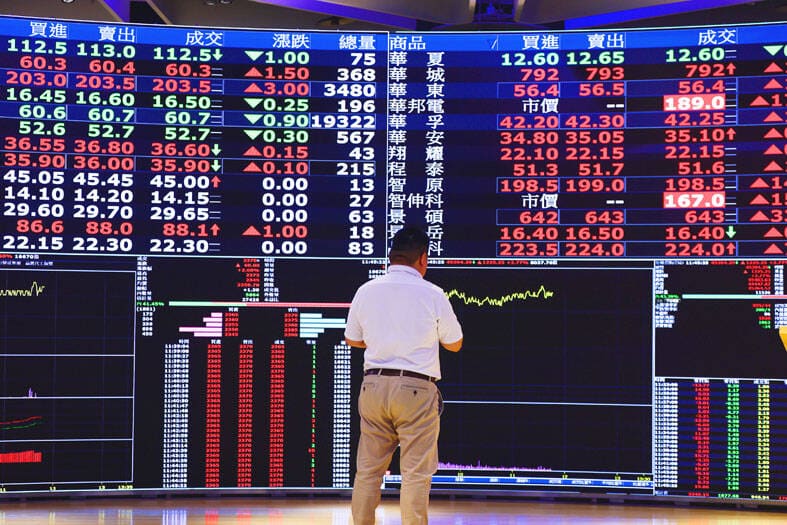
Foreign investors poured $1.7 billion into Taiwanese equities so far this month, ending a six-week selling streak, while pulling $6.2 billion from South Korean markets over the same period. The shift signals a recalibration among international funds weighing exposure to Asia's two dominant artificial intelligence equity plays following last month's global tech rout.
The divergence underscores how investors are prioritizing stability and earnings visibility as they reassess positions in markets that have each gained more than 50 percent this year. Taiwan recently overtook South Korea as Asia's best-performing benchmark, a title the KOSPI had held for much of 2026.
Earnings Revisions Tilt Northward
Analysts lifted 12-month forward earnings estimates for TAIEX-listed companies by 9.5 percent last month, outpacing the 7.4 percent upward revision applied to KOSPI constituents. It marks the first time in nearly a year that Taiwan's earnings momentum has exceeded South Korea's, reflecting confidence in the island's broader industrial base.
Taiwan's semiconductor and electronics supply chain spans design, foundry services, packaging, and component manufacturing. The breadth contrasts with South Korea's concentration in memory chips, a segment historically prone to sharp cyclical swings. Samsung Electronics and SK Hynix dominate flash memory and DRAM, products that have delivered dramatic rallies but also steep corrections when demand falters.
Grantham Mayo Van Otterloo portfolio manager Warren Chiang noted that Taiwanese companies are high quality and less exposed to excessive fundamental risk, moving with the global economy without the leverage-driven volatility seen elsewhere.
Leverage Amplifies South Korean Swings
South Korea's equity market carries heavier speculative positioning, particularly through single-stock leveraged exchange-traded funds that magnify price moves. Even modest shifts in sentiment can trigger disproportionate sell-offs without meaningful deterioration in underlying business performance.
Vantage Global Prime senior analyst Hebe Chen highlighted that Korea trades with much heavier leverage, so a small wobble in expectations can trigger outsized moves. The dynamic has contributed to sharper intraday swings and broader volatility bands compared to Taiwan's more measured price action.
Despite recent turbulence, the KOSPI now trades at a record discount to the TAIEX following the sell-off. Aberdeen Asian Income Fund senior investment director Isaac Thong observed that Korea looks relatively attractive given current valuations, since Taiwan did not correct as much during last month's downturn.
Supply Chain Depth as Differentiator
Taiwan's role as the backbone of global tech hardware production extends from advanced logic chips to passive components, connectors, and printed circuit boards. The island's companies supply nearly every component category required for smartphones, data center servers, and AI accelerators.
Chiang emphasized that every part in an iPhone comes from Taiwan, illustrating the supply-chain density that insulates the market from single-product exposure. That diversification offers a cushion when specific segments such as memory chips face inventory corrections or pricing pressure.
South Korea's strength in high-bandwidth memory has positioned Samsung and SK Hynix as critical suppliers to Nvidia and other AI infrastructure leaders. However, the segment's cyclicality introduces earnings volatility that can weigh on broader market sentiment when demand signals weaken.
Monetization Remains the Long-Term Variable
The sustainability of gains in both markets hinges on whether heavy research and development spending by hyperscale cloud providers and chipmakers translates into revenue growth and margin expansion. Doubts about the payoff timeline for generative AI investments triggered last month's sell-off, and those concerns have not fully dissipated.
Industry observers note that the longer-term picture revolves around the monetization of AI, representing the key risk for continued equity performance. If enterprises and consumers adopt AI-enabled products at scale, demand for semiconductors and hardware components should sustain elevated growth rates. A slower adoption curve would force downward earnings revisions across the sector.
For now, foreign investors appear to be placing incremental bets on the market they view as offering more predictable returns. Whether that preference persists will depend on how earnings seasons unfold in the coming quarters and whether volatility subsides as the AI investment cycle matures.
RELATED STORIES
Renminbi Faces Upward Pressure After US-Japan Yen Intervention
Cheng Wei-Lun · 3 min

Asian Tech Stocks Surge as Weak US Jobs Data Dims Rate Hike Outlook
Cheng Wei-Lun · 4 min

Asia Vital Components Posts Record Margins on AI Server Cooling Demand
Cheng Wei-Lun · 2 min
Foxconn Q2 Profit Jumps 35% as AI Server Sales Cross Half of Revenue
Cheng Wei-Lun · 3 min
Spot something wrong? Email editor@briefasia.com. We log every correction publicly.