Asia · Business
Taiwan GDP Forecast Hits 10.35% on AI Export Surge
Chung-Hua Institution for Economic Research raises growth projection to highest among domestic institutes as semiconductor shipments approach record $900 billion
KEY TAKEAWAYS
- ·Chung-Hua Institution for Economic Research raised Taiwan's 2026 GDP growth forecast to 10.35 percent, driven by AI chip exports potentially reaching $900 billion, up 50 percent year-over-year.
- ·External demand contributes 5.62 percentage points to growth as Taiwan's semiconductor industry supplies advanced chips essential to global AI infrastructure built by major US technology companies.
- ·Consumer inflation is forecast at 2.02 percent, slightly above the central bank's 2 percent target, with policy response dependent on energy prices and geopolitical developments.
Double-Digit Growth Driven by Chip Demand
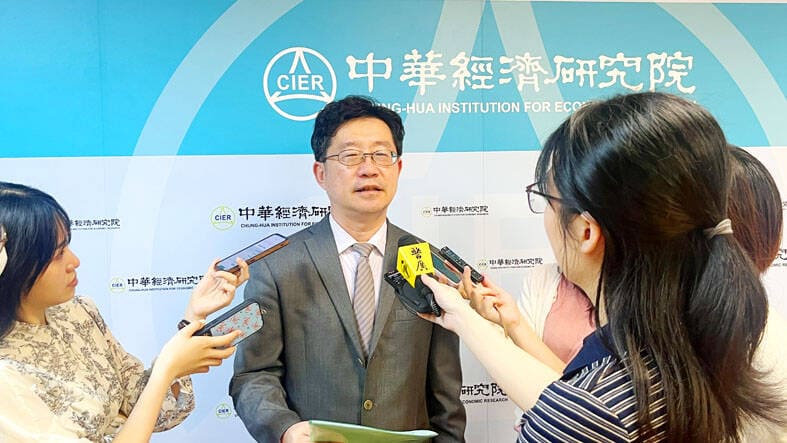
Taiwan's economy is on track for its strongest expansion in years. The Chung-Hua Institution for Economic Research raised its GDP growth forecast to 10.35 percent for 2026, the most optimistic projection among domestic research institutes. The upgrade reflects unexpectedly robust export performance in the first half, according to CIER president Lien Hsien-ming.
Domestic demand is projected to contribute 4.73 percentage points to growth, while external demand adds 5.62 percentage points. The revision underscores how deeply Taiwan has embedded itself in the global artificial intelligence supply chain, with semiconductor manufacturers supplying advanced chips, servers, and hardware critical to data centers worldwide.
If current momentum holds, Taiwan's exports could exceed $900 billion in 2026, Lien said at a briefing in Taipei. That figure would mark a 50 percent increase from the previous year and set a new record for the island economy.
AI Infrastructure Orders Fuel Semiconductor Shipments
The surge stems largely from orders placed by major US technology companies building out AI infrastructure. Taiwan's semiconductor industry has become indispensable to this buildout, producing the cutting-edge chips that power machine learning workloads and data center operations.
CIER's forecast anticipates that economic growth will remain elevated but moderate as the year progresses. The institute projects first-quarter GDP growth of 14.55 percent, second-quarter growth of 10.96 percent, third-quarter growth of 10.63 percent, and fourth-quarter growth of 6.04 percent.
The expected deceleration reflects a high comparison base rather than weakening underlying demand, Lien noted. Taiwan's economy is coming off a period of exceptional expansion, making year-over-year comparisons increasingly difficult in the latter half of 2026.
Inflation Edges Above Central Bank Target
CIER also adjusted its consumer inflation forecast upward to 2.02 percent for the year, slightly exceeding the central bank's 2 percent target. Whether this will prompt monetary policy tightening remains uncertain, Lien said, with the outlook hinging on energy prices and geopolitical developments.
Tsai Yu-tai, head of statistics at the Directorate-General of Budget, Accounting and Statistics, said some producer-price increases have filtered through to consumers, particularly in memory chips, computers, and other electronics. However, these items represent only 1.6 percent of the consumer price index basket, limiting their broader inflationary impact.
If global risks subside, inflationary pressures could ease, Lien said. The institute is monitoring energy markets and supply chain conditions for signs of price stabilization.
Regional Context and Forward View
Taiwan's position as a primary beneficiary of AI investment reflects broader dynamics reshaping Asia's technology landscape. As hyperscalers and cloud providers expand capacity, semiconductor hubs across the region are seeing surging demand. Taiwan's advanced packaging capabilities and leading-edge foundry capacity place it at the center of this shift.
The island's export-driven model remains vulnerable to shifts in global technology spending. Recent volatility in AI-related equity markets and concerns about overcapacity have introduced uncertainty. A powerful Chinese AI model released earlier this year demonstrated that lower-cost alternatives to Western systems are emerging, potentially affecting demand for high-end chips over time.
For now, orders remain strong. Taiwan's semiconductor sector continues to operate at high utilization rates, with capacity expansions underway to meet anticipated demand through the next several years. The question is whether the current pace of AI infrastructure investment can be sustained, or whether a period of consolidation lies ahead as the industry digests recent buildouts.
RELATED STORIES

Taiwan Consumer Confidence Falls Amid Record Growth Forecasts
Cheng Wei-Lun · 2 min

Eurasian Security Bloc Convenes as Shein Prices Hong Kong IPO
Cheng Wei-Lun · 3 min
Manila's Chip Industry Still Stalled in Assembly While Taipei Built Fabs
Priyanka V. Rao · 4 min

Xiaomi Unveils 3nm Mobile Processor to Challenge Qualcomm and MediaTek
Cheng Wei-Lun · 3 min
Spot something wrong? Email editor@briefasia.com. We log every correction publicly.