Travel & Dining · Trends
Starlux Airlines Debuts Artist-Designed A350 on Tokyo Route
Taiwan carrier's Airsorayama Silver aircraft, featuring Japanese artist Hajime Sorayama's metallic aesthetic, launched with chairman at controls and plans for October expansion
KEY TAKEAWAYS
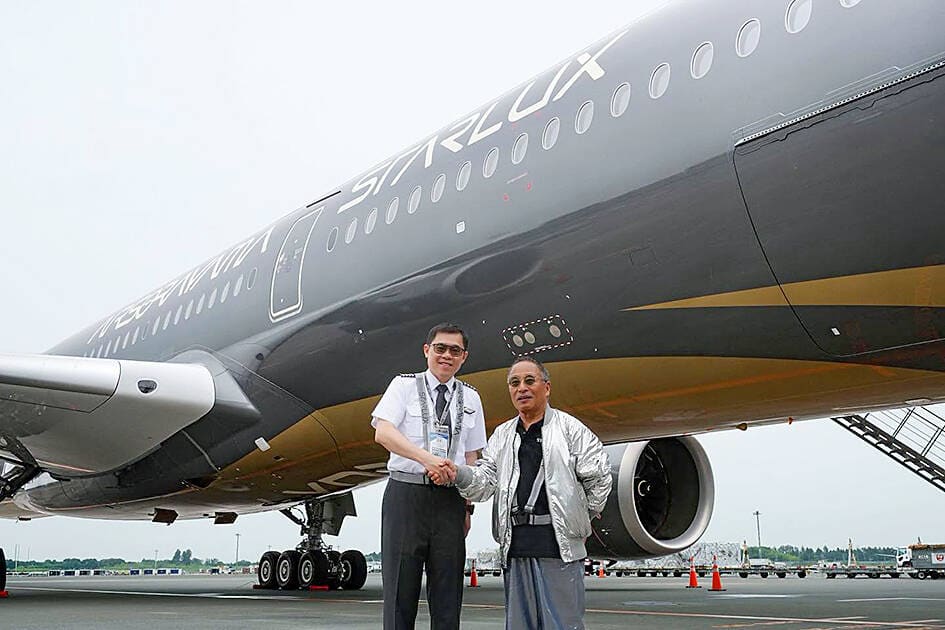
- ·Starlux Airlines flew its Airsorayama Silver A350-1000 to Tokyo for the first time on Sunday, piloted by chairman Chang Kuo-wei, with artist Hajime Sorayama signing the cabin interior after landing.
- ·The airline will deploy both Airsorayama Silver and Gold aircraft on scheduled Tokyo, Phoenix, and Prague routes starting October 1, each configured with 350 seats across four cabin classes.
- ·The collaboration embeds Sorayama's metallic futuristic aesthetic across livery and passenger amenities, part of Starlux's strategy to differentiate in Asia's competitive premium travel market.
Chairman Takes Controls for Inaugural Flight
Taiwan's Starlux Airlines flew one of its two artist-collaboration aircraft to Tokyo on Sunday, with chairman Chang Kuo-wei in the cockpit for the Airsorayama Silver's first trip to Japan. The Airbus A350-1000, designed in partnership with Japanese artist Hajime Sorayama, represents the carrier's latest effort to differentiate itself in Asia's competitive premium travel market.
After landing, Chang brought Sorayama aboard to autograph the cabin, marking what the airline calls a "flying artwork." The artist's signature now appears inside an aircraft that carries his aesthetic across its exterior livery and throughout its passenger amenities.
Metallic Aesthetic from Tokyo to Prague
The collaboration brings Sorayama's futuristic mechanical style to the skies. His signature approach, known for metallic finishes, streamlined forms, and liquid-metal textures, appears on the aircraft's exterior paint scheme and extends into the cabin experience. The design treatment covers branded items from baggage tags and napkin rings to the aluminum foil used in meal service, plus coasters, paper cups, napkins, and menus.
Starlux operates two aircraft in the Airsorayama series: the Silver variant that flew to Tokyo and a Gold sister ship. Both are configured identically with 350 seats split across four cabins: four first-class seats, 40 in business, 36 in premium economy, and 270 in economy.
October Start for Regular Service
The airline plans to deploy both Airsorayama aircraft on scheduled routes beginning October 1. The planes will serve Tokyo, Phoenix, and Prague, connecting Taiwan to key business and leisure destinations across three continents. The route selection positions Starlux to compete on high-demand Asia-Americas corridors while tapping Central European travel from its Taipei hub.
At Narita Airport, Starlux held a launch event showcasing the design elements and distributed limited-edition items, including streamers, collectible cards, and tote bags. The merchandise strategy mirrors approaches by Asian carriers that have turned aircraft liveries into brand experiences, from ANA's Star Wars jets to EVA Air's Hello Kitty planes.
Asia's Premium Carrier Competition
Starlux, founded by Chang in 2018, entered a crowded field of established full-service and low-cost carriers across Asia. The airline has pursued a premium positioning, ordering wide-body Airbus aircraft and emphasizing service quality to differentiate from both legacy flag carriers and budget competitors.
Artist collaborations offer one avenue for younger carriers to build brand recognition. Japan's domestic market and the Tokyo route in particular matter for Taiwan-based airlines: the corridor ranks among the busiest in Asia, with multiple carriers offering dozens of daily flights between Taipei and Tokyo's two airports.
The October service launch will test whether design-focused branding translates to load factors on competitive routes. Starlux's A350-1000 fleet provides range for the Phoenix route, which serves the U.S. Southwest, and for Prague, a less-served European destination from Taiwan that could attract both business and tourism traffic.
What the Collaboration Signals
Sorayama, whose work blends retro-futurism with hyper-realistic metallic renderings, brings name recognition in Japan and among design enthusiasts globally. For Starlux, the partnership extends beyond a paint job: the airline is embedding the aesthetic into passenger touchpoints throughout the journey, from check-in to meal service.
Whether travelers prioritize aircraft design when booking remains an open question, but the strategy offers Starlux a talking point in a market where product and service have converged across premium carriers. The Airsorayama fleet gives the airline content for social media, merchandise opportunities, and a visual identity distinct from competitors flying standard liveries.
As Asia's aviation market continues its post-pandemic recovery, carriers are exploring non-price differentiation. Starlux's bet on design-led branding, backed by modern wide-body aircraft and a focus on premium cabins, positions it as a niche player targeting travelers who value experience alongside schedule and price. The October route expansion will show whether that formula resonates beyond the launch event at Narita.
RELATED STORIES
Taiwan Indicts Nvidia Manager in Chip-Smuggling Investigation
Cheng Wei-Lun · 4 min

Itochu and Taiwan IT Leader Back Taiwanese Chip Firms' Kyushu Push
Cheng Wei-Lun · 3 min
Tokyo Summit Pushes Trilateral Tech Alliance Among Taiwan, Japan, and US
Cheng Wei-Lun · 3 min
Hon Hai Posts Record August Revenue on AI Server Demand
Jun-ho Seo · 3 min
Spot something wrong? Email editor@briefasia.com. We log every correction publicly.