Asia · Politics
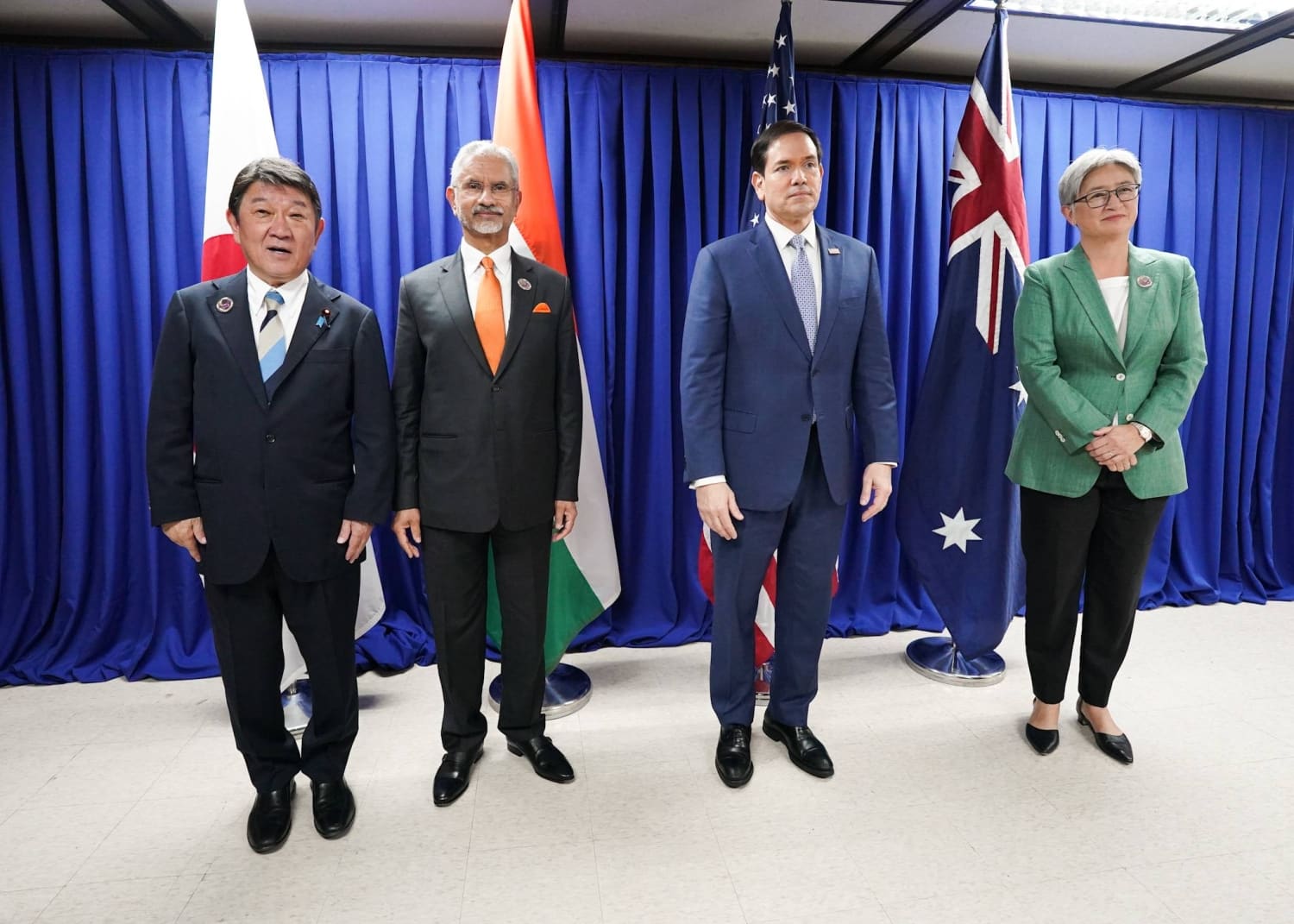
Quad Foreign Ministers Meet in Manila, Prioritize ASEAN Maritime Security
The four-nation grouping held talks on regional stability without explicitly naming Beijing in their joint statement
KEY TAKEAWAYS
- ·Foreign ministers from Japan, India, the United States, and Australia met in Manila to discuss maritime security cooperation with ASEAN member states.
- ·The joint statement deliberately avoided mentioning China by name despite ongoing South China Sea tensions and territorial disputes in the region.
- ·The meeting emphasized practical information sharing and capacity building while respecting ASEAN's preference to remain the primary driver of regional security architecture.
A Diplomatic Gathering in Manila
Foreign ministers from the Quadrilateral Security Dialogue convened in the Philippine capital on Wednesday, placing Southeast Asian maritime security at the center of their agenda. The meeting brought together Japan's Toshimitsu Motegi, India's S. Jaishankar, U.S. Secretary of State Marco Rubio, and Australia's Penny Wong.
The choice of Manila as venue carries weight. The Philippines has been among the most vocal ASEAN members on territorial disputes in the South China Sea, where overlapping claims have strained regional relations for years. By gathering in a Southeast Asian capital rather than one of their own, the Quad ministers signaled their intent to frame maritime issues as shared concerns rather than external impositions.
What Was Discussed
The ministers focused on ways to strengthen cooperation between the Quad and ASEAN member states on maritime domain awareness, freedom of navigation, and regional security architecture. According to the Japanese Foreign Ministry, the talks emphasized practical mechanisms for information sharing and capacity building rather than broad strategic declarations.
The meeting comes at a moment when several ASEAN states are recalibrating their security relationships. Vietnam has expanded defense ties with multiple partners, Indonesia is modernizing its maritime surveillance capabilities, and the Philippines has opened additional military sites for allied access under existing frameworks.
The China Question
What drew attention was not what the ministers said, but what they omitted. No joint statement from the meeting explicitly mentioned China, despite ongoing tensions in waters where Beijing has expanded its presence through island construction, coast guard patrols, and overlapping jurisdictional claims.
This careful language reflects a balancing act. All four Quad members maintain substantial economic ties with China. Japan and Australia count it as their largest trading partner; India's bilateral trade exceeded $135 billion last year; the U.S. remains deeply integrated despite friction over technology and investment controls.
For ASEAN, the calculus is even more complex. The bloc's members depend on Chinese infrastructure investment, supply chain integration, and market access. Public alignment with explicitly anti-China messaging risks economic retaliation, as several Southeast Asian governments have learned in previous disputes.
Reading Between the Lines
Diplomatic observers note that avoiding direct references does not mean ignoring the issue. Terms like "rules-based order," "freedom of navigation," and "respect for international law" function as code in regional security discourse, understood by all parties to reference specific behaviors without triggering immediate confrontation.
The Quad itself was revived in 2017 after a decade of dormancy, driven by shared concerns about regional power dynamics. Its members have conducted joint naval exercises, coordinated on vaccine distribution during the pandemic, and established working groups on technology standards and supply chain resilience.
ASEAN's Position
Southeast Asian nations have consistently resisted being forced to choose sides between major powers. The bloc's centrality doctrine holds that ASEAN should remain the primary driver of regional security architecture, with external partners supporting rather than supplanting its initiatives.
This meeting's framing, emphasizing partnership with ASEAN rather than parallel structures, acknowledges that reality. Whether it translates into substantive cooperation will depend on how the Quad's offers of capacity building and information sharing align with what individual ASEAN members actually want, as opposed to what external partners think they need.
What Comes Next
The ministers did not announce concrete deliverables beyond commitments to continue dialogue. Future working-level discussions will determine whether Wednesday's meeting produces tangible programs or remains at the level of diplomatic signaling.
For now, the gathering serves as another data point in the ongoing reconfiguration of Asian security relationships. The Quad's ability to work effectively with ASEAN will hinge on whether it can offer value without demanding exclusivity, a challenge that has tripped up previous regional initiatives.
RELATED STORIES

Philippine Water Operator Earmarks $400 Million for Southeast Asia Expansion
Mariel D. Santos · 2 min

Philippines Energy Budget Climbs 26% as Electric Vehicle Funding Surges
Priyanka V. Rao · 3 min

Philippine Nickel Miners Push for Unified Policy Framework as Critical Minerals Race Intensifies
Priyanka V. Rao · 3 min

Philippine Economic Zones Pull Record ₱216 Billion in Eight Months
Priyanka V. Rao · 3 min
Spot something wrong? Email editor@briefasia.com. We log every correction publicly.